John Atkinson

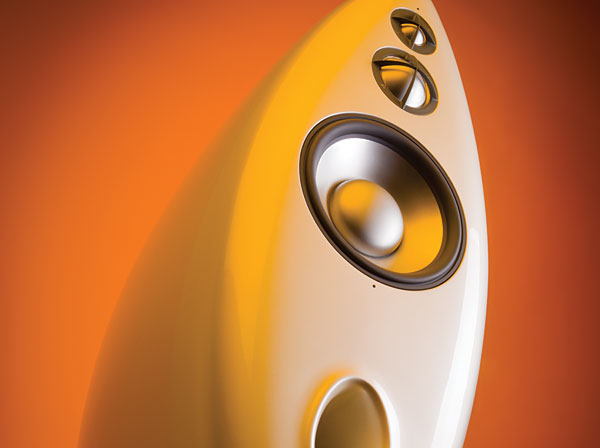
Wilson WATT Series 3-Puppy 2 loudspeaker

666wil32.jpg"No pain; no gain." Thus goes the June 1991 offering from the Cliché-of-the-Month Club—(800) MOT-JUST—a saying that seems particularly appropriate for audiophiles with aspirations. High-performance loudspeakers fall into two categories. First are those exasperating thoroughbreds requiring endless Tender Loving Care and fussy attention to system detail to work at all. Take the Avalon Eclipse or the Infinity IRS Beta, for example: when everything is just fine, you put on record after record, trying to get through as much music as possible before the system goes off song again. On the other hand, speakers like the Vandersteens, Magnepans, B&W 801 Matrix, and KEF R107/2 appear to sound excellent even as you unpack them, before you've even put them in what you think might be the optimum positions in your listening room.

The question is: Are such unfussy designs really high-end? I mean, if they were truly high-performance speakers, shouldn't the owner have to suffer even just a little to reach musical nirvana? "A little pain; some sonic gain!" goes that other familiar saying.

You all know where you stand on this vitally important question. Me, I prefer to sit and construct the following graphical analogy. Draw a vertical axis and mark it "Absolute Performance." (The units are "gb," footnote 1) Now draw a horizontal axis and label it "Setup." (The units are "dU" for "deci-Ungers," footnote 2) Okay, sketch out an inverted V-shape. This curve, something like an engine's torque vs RPM curve, represents the manner in which a system's or component's performance changes according to how it is set up.

Continue Reading »

Sennheiser US Celebrates 20th Anniversary

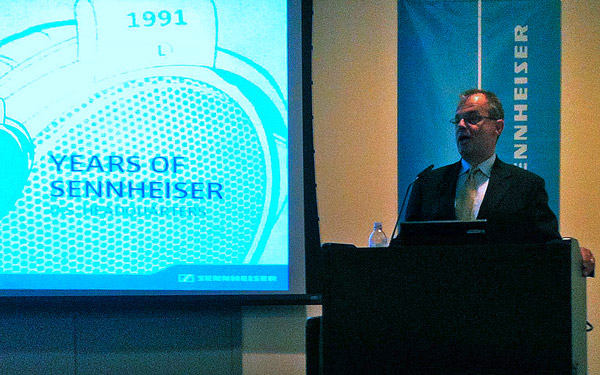
While August 29 was officially the day the State of Connecticut honored Sennheiser Electronic Corporation, the celebrations the US subsidiary of the German headphone and microphone manufacturer had planned were postponed, thanks to Hurricane Irene. But Tuesday, September 20 saw journalists converging on the company's headquarters in shoreline town of Old Lyme—"conveniently located midway between New York and Boston," according to company president John Falcone, pictured above—to take part in the delayed event. "This recognition celebrates Sennheiser's vital role in the business community, as well as the talented and passionate employees who are essential to its success," stated Governor Dannel P. Malloy in an official document that proclaimed August 29, 2011 as Sennheiser Electronic Corporation Day.
Continue Reading »

EarsNova Opens Its New Manhattan Store

Photo: Laurie Srebnick

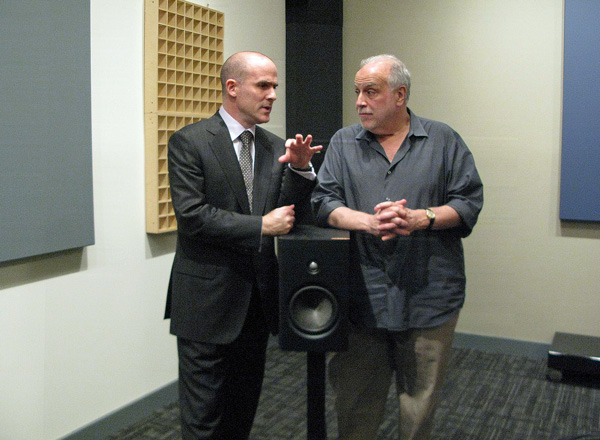
As we announced last month, this past weekend saw the grand opening of EarsNova's new store at 3 East 28th Street, in Manhattan. Founded in 1979 by Joshua Cohn (right in photo), the store's new location is on the second floor of a solidly constructed 1920s building, with high ceilings and the space to present high-end audio products and systems under ideal circumstances. The listening rooms, for example, have floors and walls that are isolated from the building's structure. Not only does this prevent sound from the audio systems being demmed leaking into the other floors, it makes the rooms extremely quiet. When I was auditioning the new Magico Q1s during last Friday's evening rush hour, there was no clue that just half a block away there was the usual torrent of 5th Avenue traffic.

Continue Reading »

Musical Fidelity AMS100 power amplifier

"That's just silly on so many counts, Antony."

I was talking last winter to Musical Fidelity's Antony Michaelson, who had been enthusing about his forthcoming stereo amplifier, the AMS100. It would be physically enormous—almost a yard deep—and commensurately heavy at 220 lbs. Despite its bulk, its maximum rated output would be just 100Wpc into 8 ohms. It would also be expensive, at $19,999. And to cock a snoot at environmentalists and their concerns, the AMS100's output stage would be biased into class-A up to its rated 8 ohm power, meaning that, even when not playing music, it will draw around 10 amps from a typical US wall supply of 120V. This also means that it will run very hot, making the amplifier impracticable for summer use in homes without central air-conditioning. Like mine.

Continue Reading »

High-End Audio & the Invisible Hand

A recent e-mail from a reader asked why we list the recordings and systems used by Stereophile writers in their reviews. I responded that we do so in order that readers can place our value judgments in context, and predict how those products might sound with different ancillaries and recordings when they audition the products reviewed at their local high-end audio retailer.
Continue Reading »

Meridian 602 CD transport

"I don't like Mondays!" sang Bob Geldof some years back, and I'm beginning to hate Mondays too. No, not for the obvious reason. You see, Monday is "hate-mail" day. Every day I get letters from Stereophile's readers. But for some reason known only to the mavens (or should that be Clavens?) of the US Postal Service, the ones pointing out my stupidity, dishonesty, and sheer incompetence as a human being arrive on Mondays.

For example: "Bits are bits, and it is therefore dishonest for Stereophile's writers to continue to insist that they can hear any differences between CD players or digital processors!" recently wrote an angry reader, canceling his subscription. (They always tell me they're going to cancel their subscription.) "Yeah, right!" thought I, having just sat through a comparative audition of, would you believe, digital data interconnects in Robert Harley's listening room. Some of the differences I heard were not trivial. They might even be audible in a blind listening test.

Continue Reading »

The Second Capital AudioFest...

... may have been fairly small as these things go, with just 28 exhibitor rooms, which is way fewer than THE Show Newport Beach a month ago. However, that is still 6 more rooms than the Axpona NYC just two weeks ago, with about the same number of marquee brands, in a hotel with generally better-sounding rooms than New York's Affinia. Show organizer Gary Gill, shown here giving away the prizes at the first of the nightly raffles, took a big gamble moving last year's intimate show into a hotel venue, but it seemed to have worked: both exhibitors and attendees seemed very upbeat about the event. Attendance on Saturday evening was a hair short of 700, meaning that possibly 900 or even 1000 people had packed the rooms of the Rockville Crowne Plaza by the time the Show closed Sunday evening.

Are regional shows like Gary's the future of the audio market, as Classic Speakers' John Wolff believes, or will we return to the days when there were just one or at most two large shows each year? That is going to depend on the resources of audio manufacturers and retailers and their willingness to spend more time on the road. But the 2011 Capital AudioFest certainly proved that if you hold it, audiophiles will come.

Continue Reading »

JS Audio—Wilson—Dan D'Agostino—HRS—Nordost

The larger of the two JS Audio rooms featured Wilson Sasha W/P speakers driven by Dan D'Agostino's new Momentum monoblock amplifiers. Source was either a Sooloos system or the Sound Devices digital recorder belonging to Wilson's Peter McGrath (pictured standing on that hotel carpet), both feeding data to Meridian's 808 Mk.3 CD player/digital processor, which also controlled playback volume. My hurriedly scrawled notes say that the Sooloos feed was via Ethernet, but don't hold me to that; the Sound Devices was definitely S/PDIF. The cabling was all Nordost Odin, which may well have cost more than everything else in the system, and the source components sat on a Harmonic Recovery Systems rack, which all involved said was a major contributor to the quality of the sound in this room.

And OMG, the sound! Whether it was Peter McGrath's hi-rez recordings or commercial material like Yello's "Stay," you were mainlining the music. Peter asked if he could play some of my hi-rez recordings, and played first the Cantus performance of Eric Whitacre's Lux Aurumque in 24/88.2k fidelity. I was transported to the Sauder Auditorium at Goshen College in Indiana, with the acoustic wrapped around me. The system did subtlety. Peter then played the 24/88.2k master of Attention Screen's "Blizzard Limbs," from Live at Merkin Hall. Again, the acoustic wrapped round me but the drum transients were more startling than I have ever heard before. And I mastered the recording!

I have heard Wilson Sashas in a number of systems, and yes, they are "fast," in that the bass doesn't boom or blur. Yes, the Nordost Odin is extraordinarily transparent cable (at a price) and that Meridian player's D/A is top-rank. And that HRS rack is a black hole for vibrations. But driven by the Dan D'Agostino amps—wow, did the Sashas kick some awesome booty! Without ever sounding crass or lacking in subtlety.

Continue Reading »
Advertisement
Advertisement
Advertisement