Audacious Audio

Sort By:  Post Date TitlePublish Date

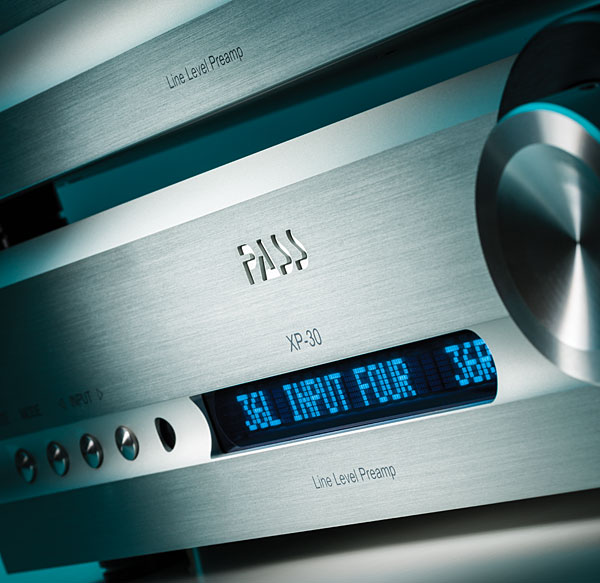
Pass Laboratories XP-30 line preamplifier

It was the strangest thing. In the fall of 2008 I was comparing Ayre Acoustics' then-new KX-R line preamplifier with no preamplifier at all—I was feeding the power amplifier directly with the output of the Logitech Transporter D/A processor. (Levels were matched for the comparisons, of course, made possible by the fact that the Transporter has a digital-domain volume control.) Being a rational being, I knew that the active circuitry of a preamplifier, as well as the extra socketry and cables, would be less transparent to the audio signal than a single piece of wire. I wanted to determine by how much the Ayre preamp fell short of that standard.

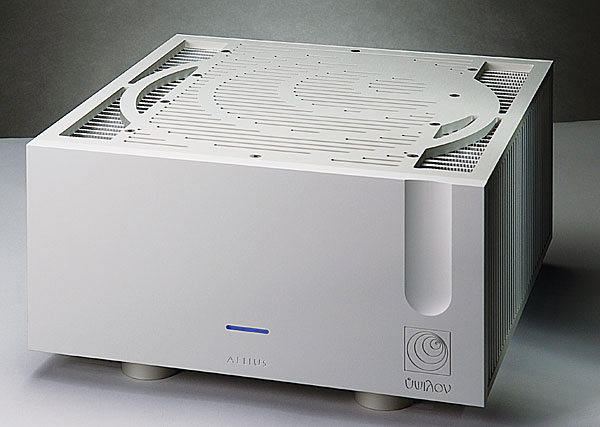
Ypsilon Aelius monoblock power amplifier

I knew nothing of Ypsilon when I first saw its products in a room at an overseas audio show. Even though the speakers in this system were complete unknowns, I was convinced that it was the electronics that were responsible for the magical balance of what I was hearing. That was confirmed when I reviewed the VPS-100 phono preamplifier in August 2009 and PST-100 Mk.II preamplifier in July 2011.

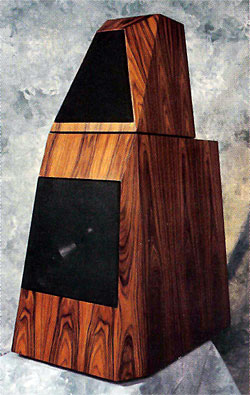
Artemis Systems Eos Signature loudspeaker & Base Module

666Artemis_Eos.jpgThough the original Artemis Systems Eos has been around for a few years, it doesn't seem to have made a big impression on audiophiles. Judging by a brief but exciting audition of the new Eos Signature and its accompanying Base Module at HI-FI '96, I found it hard to understand how it could remain such a well-kept secret. A few weeks later, to my surprise, Wes Phillips asked me if I wanted to review a pair and, throwing caution to the winds, I jumped at the opportunity. Rash move.

The movers delivered three large boxes and two absolutely huge crates. Inside the boxes were the two Eos Signatures and their external crossovers. Each crate contained a Base Module, and their appearance struck fear into my heart. I had gone too far—each one weighed 300 lbs, and together they were more commodious than some apartments in my Manhattan neighborhood. I signed for the delivery, then panicked when I realized there was no way to get these unpacked before my wife came home. Indeed, I didn't know how I was going to do it at all.
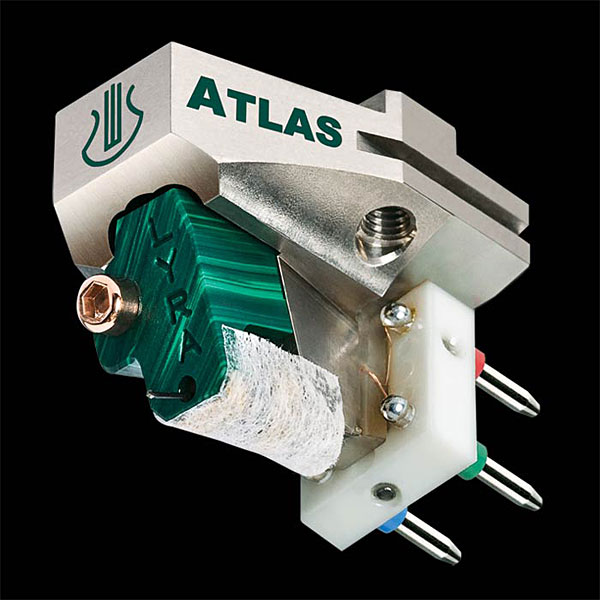
Lyra Atlas MC phono cartridge

At the 2012 Consumer Electronics Show, I spoke with Lyra's Jonathan Carr about the Atlas. He told me that, rather than having started as a blank sheet of paper, the Atlas is an outgrowth of the Kleos ($2995), which I reviewed in January 2011, when I thought it Carr's best balanced design yet, even if it didn't have quite the resolution of the Titan i. Like the lower-priced Delos ($1650, reviewed in August 2010), the Kleos included Carr's New Angle technology, which mechanically aligns the coils to be perfectly positioned relative to the front and rear magnets when the stylus is in the groove.

YBA CD 1 Blue Laser CD player

ybacd101.jpgI'm about to out YYves-Bernard André as one of the great unknown tweakers of high-end audio. (My own predilection for stepping into uncharted tweakwaters is well known.) Yves-Bernard, his wife and partner Ariane Moran, and importer/distributor Daniel Jacques of Audio Plus Services seemed perfectly sanguine about letting the cat out of the bag. And why not? In a singular way, the YBA audio solution encompasses both the supertweak and the more-casual-about-equipment music lover.

The YBA CD 1 Blue Laser (or Lecteur CD 1, as it's known at home in France) breaks new ground. It is very French in that it's individualistic in the extreme, and perfectly embodies current thinking chez YBA regarding music playback in the home. Its design dates back to 1991, a point Yves-Bernard takes pains to point out in the manual.

Wilson Audio Specialties Alexandria XLF loudspeaker

The Wilson Audio Specialties Alexandra XLF costs $200,000/pair. So does a Ferrari. Perhaps if Wilson Audio Specialties sold as many pairs of XLFs as Ferrari sells cars, the price might drop. For now, $200,000 is what you pay.

Can a loudspeaker possibly be worth that much? Add $10,000 for speaker cables, and that's what I paid for my first home in 1992. Today, the average American home costs around $272,000, which is likely less than the cost of an audio system built around a pair of Alexandra XLFs.

Devialet D-Premier D/A integrated amplifier

Most reviews are straightforward. One preamplifier or power amplifier replaces another. DACs are swapped out. A new pair of speakers takes up residence in the listening room.

But some products demand a complete revision of a system's architecture. Such was the case with Devialet's D-Premier ($15,995). Not only is this French product an integrated amplifier, with phono and line analog inputs; it has digital inputs and an internal D/A section.

Mark Levinson No.53 Reference monoblock power amplifier

Mark Levinson founded Mark Levinson Audio Systems in 1972, but sold it, and the right to market audio gear under his own name, to Madrigal Audio Laboratories, then owned by the late Sandy Berlin, in 1984. Harman International bought Madrigal in 1995. As well as Mark Levinson, Harman's Luxury Audio Group now also includes digital processing pioneer Lexicon, speaker manufacturer Revel, and JBL Synthesis. The Mark Levinson brand is now headquartered in Elkhart, Indiana, at the Crown Audio facility, another Harman-owned brand. The No.53 ($25,000 each; $50,000/pair) is Mark Levinson's first new Reference series monoblock since the No.33, way back in 1993, when Madrigal owned the company. Like other Mark Levinson products, it is manufactured at an independent facility in Massachusetts.
Advertisement
Advertisement
Advertisement