Audacious Audio

Sort By:  Post Date TitlePublish Date

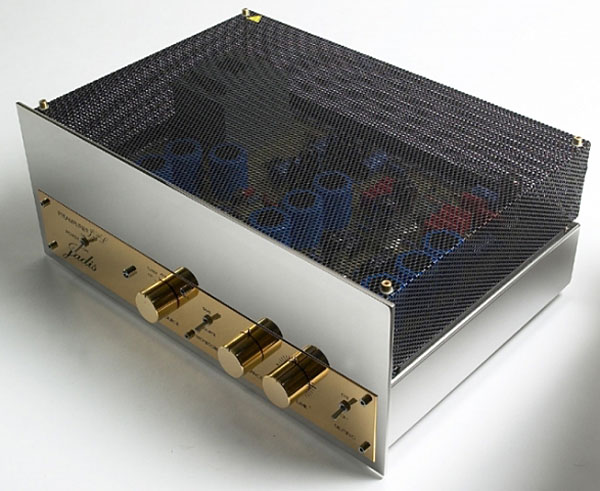
Jadis JPL line preamplifier

In its comparatively few years in the marketplace, the line-level preamplifier appears to have established commercial parity with its full-function big brother. That this was inevitable was clear as far back as the mid-'80s. The advent of the CD and the proliferation of digital sources argued for a modular approach to preamp design. In such an environment, line-level sources (eg, DAT, CD, even analog tape) deserve special attention.

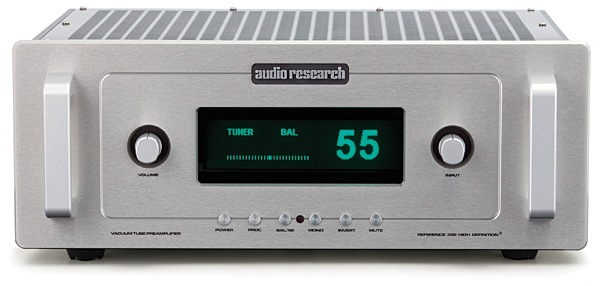
Audio Research Reference 5 SE line preamplifier

I've heard a lot of great audio components over the years, but even in that steady stream of excellence, a few have stood out as something special. These are the products that, in their day, set a new standard for performance, and many of them are ones I wish I'd hung on to. Among these products are three preamps from Audio Research: the SP3A, the SP6B, and the SP10 (footnote 1). I know I'm not alone in viewing these models as classics.

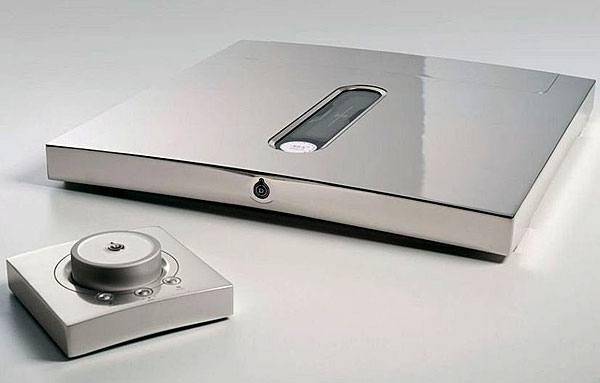
MSB Technology Platinum Data CD IV transport & Diamond DAC IV & D/A converter

The audiophile does not pursue music reproduction because it is useful; he pursues it because he delights in it, and he delights in it because it is beautiful. If music were not beautiful it would not be worth knowing, and if music were not worth knowing life would not be worth living.

My apologies for corrupting the well-known statement by French mathematician Jules Henri Poincaré (1854–1912), in which he described his relationship with science and nature. But substituting audiophile for scientist and music for nature, I feel the sentiment expresses what drives many audiophiles to the extremes for which mere mortals often chide us.

Jadis Eurythmie II loudspeaker

The Jadis Eurythmie speakers ($37,000/pair) arrived in a multitude of oversized boxes. Importer Northstar Leading the Way's Frank Garbie dragged them into our downstairs lobby and broke them open, elevatoring the individual modules up to our door. This happened on one of my office days, but Kathleen pushed me out the door in the morning with a "Don't worry cherie, I can handle it..." She phoned in periodic updates on Garbie's progress. Remember that old Stan Freberg routine? "I got it, I got it...I don't got it!" I arrived home just in time to hook up the amps.

darTZeel NHB-458 monoblock amplifier

A recent (unpublished) letter to the editor argued that the reference for audio perfection is the sound of real instruments in a real space. The writer claimed that, since the art and/or science of audio is advancing, and because it is a "scientific truth" that the closer you get to perfection, the less divergence there is components, that therefore there should be less difference in sound among the components listed in Class A of Stereophile's "Recommended Components" than among those in Class B, much less Class C. This should be true of loudspeakers, he said, but even more true of top-rated amplifiers, since "they inherently have less divergence."

Jadis Defy-7 Mk.II power amplifier

Owning a powerful tube amplifier is like owning a classic automobile. Great pleasure may be had, but ownership involves a little more care and maintenance than usual.

Jadis, an audiophile company specializing in all-tube amplifiers and operating out of a small French town, has enjoyed a good reputation for some years, even if some of its models have suffered from the reliability problems that occasionally afflict the largest tube amps. Another problem area is that of power consumption and heat output. In common with class-A amplifiers and high-bias A/B types, including solid-state models, larger tube amps give off substantial heat. The Defy-7's 240W idling consumption may or may not be welcome, according to your location and the season.

Lansche Audio 5.1 loudspeaker

The phenomenon of the "singing flame" has been known since the 19th century. Place electrodes either side of a flame and, if you apply a high enough audio-modulated voltage to those electrodes, the ionized particles in the flame will cause it to emit sound. (Search YouTube for "singing flame" and you'll find many examples.) This principle was developed into a practical loudspeaker in 1946 by a French inventor, Siegfried Klein, who confined an RF-modulated arc to a small quartz tube, coupled it to a horn, and called the resulting speaker the Ionophone. An intense radio-frequency electrical field ionizes the air between inner and outer electrodes to produce a distinctive, violet-tinged yellow flame in the quartz combustion chamber. When the RF field is modulated by the audio signal, this causes the almost massless ionized flame to expand and contract in what should be a perfectly pistonic manner.

Brinkmann Balance turntable

Everyone's got their prejudices, and mine are against turntables with box-like plinths and big slabs of undamped acrylic. I have no problem with either in models that cost a few grand or less, but once you get into high-priced terrain, less plinth and less acrylic usually yields better performance. Generally, though, all a plinth gets you is a vibrating surface to transmit or store and release energy. Who needs that? If your high-performance 'table has a plinth, you need to heroically damp it the way SME does in its Model 30, and the way Rockport did in its System III Sirius.
Advertisement
Advertisement
Advertisement