Digital Processor Reviews

Sort By:  Post Date TitlePublish Date

Sumo Axiom CD transport & Theorem II D/A processor

Making digital audio sound good appears to be a much more difficult job than its developers first realized. When digital audio was in its infancy, there was a tendency to think that digital either worked perfectly, or didn't work at all. This belief led the engineering community to devise ill-considered and flawed standards that affect the musical quality of digitally reproduced music today.
AudioQuest DragonFly Cobalt USB D/A-headphone amplifier

Unlike the world of recorded music, where streaming has decimated sales of physical products, book publishing is seeing the reverse trend: sales of eBooks are declining while those of both hardback and paperback books are recovering. I have been a book junkie all my life—the two long walls of my listening room are lined with floor-to-ceiling bookshelves and I have many boxes of books in storage—but these days almost all my book reading is with the Kindle app on my iPad mini.

Timbre Technology TT-1 D/A processor

As the sides of the slim-line Timbre Technology TT-1 DAC are radiused rather than flat, it's elegant compared to its typical boxy competition. While the TT-1's handsome shape stands out more than your average audiophile device, its curved sides help create a stronger, less resonant shape than the usual box, and serve as just one of the many elements contributing to a high degree of mechanical integrity and damping.

PS Audio Digital Link II D/A processor

Looking at the Digital Link II's build quality and circuitry, it's hard to believe that it can sell for $499 at retail. The Digital Link II shares the same appearance as PS Audio's SuperLink and UltraLink processors, but has a 4"-shorter chassis. The ¼"-thick front panel uses PS Audio's familiar touch-sensitive switches that turn the unit on and select between coaxial and optical inputs. LEDs above these switches indicate when the unit is locked to the digital source. A third LED illuminates when power is applied.

Music in the Round #100: Multichannel & Merging Anubis

This is the 100th and—surprise!—final edition of Music in the Round. MitR began in mid-2003, shortly after SACD and DVD-A discs made high-quality multichannel music convenient and widely available. At the time, I was convinced that multichannel reproduction was superior to stereo because it was able to reproduce the full sound of the performance—not just the performers. Stereophile's founder, J. Gordon Holt, had promoted this idea many times, but the appearance of the new media finally brought it to a wider audience.

dCS Bartok D/A processor/headphone amplifier

The Vivaldi—the four-box flagship product from digital audio specialists dCS—is, in my opinion, misnamed. Vivaldi the composer was an asthmatic priest who worked in an orphanage for 30 years and died in poverty. The Vivaldi stack dedicates four separate products to converting into music digital code stored on silver discs (although you can play music—very well I am sure—on just one box, the Vivaldi DAC, footnote 1). Together, those boxes weigh about 148lb and cost some $115,000. The most expensive is the CD/SACD transport; leave that off and you can save 51lb and $42,000.

Sumo Theorem D/A processor

The $799 Theorem was originally shown at the 1992 WCES in a very small chassis that prohibited adding features or upgrades. Sumo has since become more ambitious, putting the Theorem in a full-sized chassis and offering several upgrade options that would have been impossible in the truncated version.

Theta Digital Cobalt 307 digital processor

One measure of a high-end product designer's talent is the musical success of his top-of-the-line product. This is his statement to the world of what he can accomplish—a kind of "personal best" that defines the upper limits of his talent. Because he knows of no way to make the product better, the component stands as the ultimate testimonial to his skill.

Music in the Round #99: Revel & exaSound

There is necessity as well as comfort in having a long-term reference recordings and, system. The necessity derives from the familiarity with the reference that allows for comparisons and contrasts with the equipment being tested. The comfort that comes from the familiarity lets me relax and enjoy recreational music, relieved from the need to focus my attention intently on the sound. I do relish getting my hands on lots of interesting audio equipment and getting to play it in my own home, but it's like a two-month one-night stand: The new stuff usually goes back even if I am impressed. I don't change my audio equipment often.

Mytek Brooklyn Bridge streaming DAC/network server

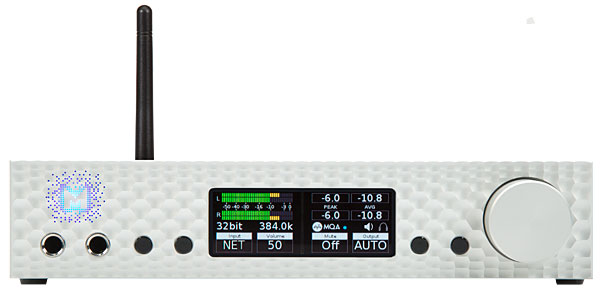
A DAC/preamp/headphone amp from Class A of Stereophile's list of Recommended Components, updated with streaming and network-server capabilities—and it still sells for less than $3000? If you believe that, I have a bridge I'd like to sell you. (Har, har!)

Most Americans have heard that line before, but many may not know the story behind it—I didn't. George C. Parker, a real American person born in 1860, is famous for perpetrating audacious frauds, specifically sales of property he did not own and could not possibly have owned. He is reported to have sold the Statue of Liberty, Grant's Tomb, the original Madison Square Garden, the Metropolitan Museum of Art, and—most famously—the Brooklyn Bridge that last one twice a week for several years, at prices ranging from $75 to $5000. Or so some say.

Advertisement
Advertisement
Advertisement