Digital Processor Reviews

Sort By:  Post Date TitlePublish Date

NAD M51 Direct Digital D/A converter
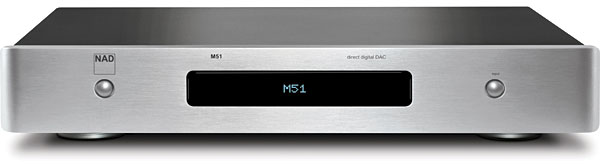
Who wants only a digital-to-analog converter when you can have a DAC with benefits? How about if those benefits also come with some high-resolution attitude?

That's what I pondered while setting up the NAD M51 ($2000). Sure, it's a basic DAC, but it also has extras—like HDMI inputs, remote-controlled volume, a polarity switch, and one of my favorite features on any DAC: a display that tells you which sampling rate the thing is locked to.
Peachtree DAC•iT D/A converter

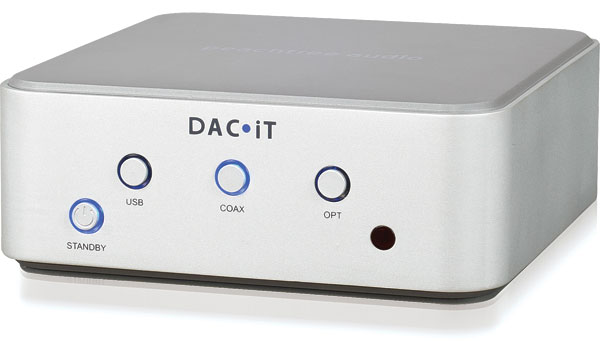
It's common knowledge that manufacturers tune the sound of each DAC model. There are the facts of product design and marketing: inputs, outputs, case materials, price points. After that, what's left are the trade-offs of different circuit designs and filter options, which are chosen with care—each has a subtle yet telling effect on a DAC's sound. Most designers try to go from bits to analog with minimal deviation from perfect. But when you look at the measurements and listen closely, you realize that perfect is elusive. One has to make choices.

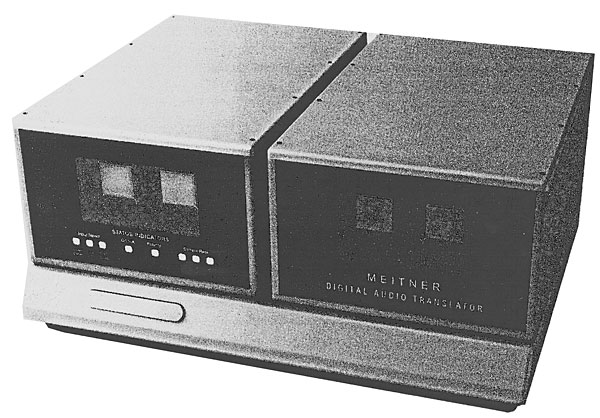
Meitner IDAT D/A processor

There are as many ways of designing a digital-to-analog converter as there are engineers. One approach is to select parts from manufacturers' data books and build the product according to the "application notes" provided by the parts manufacturers. This is the electronic equivalent of a paint-by-numbers kit.

A more creative engineer may add a few tricks of his own to the standard brew. Bigger and better regulated power supplies, careful circuit-board layout, tweaky passive components, and attention to detail will likely make this designer's product sound better than the same basic building blocks implemented without this care. Indeed, the vast range of sonic flavors from digital processors containing very nearly the same parts attests to the designer's influence over a digital processor's sound.

Extraction vs Generation

Many years ago I bought the first model of the Audio/Pulse ambience synthesizer. Like many audiophiles, I was convinced (and still am) that the standard two-speaker stereo experience provides an unsatisfying concert-hall impression. But the Audio/Pulse didn't remain long in my stereo system. You see, at best the unit provided a fair reproduction of the sound of my upstairs bathroom, topped off with a nasty flutter echo. I already get that sound every morning in the shower.

Mark Levinson No.35 D/A processor

When a manufacturer sets out to design and build a product, be it in high-end audio or any other field, the final retail price is usually a prime consideration. Parts and assembly are only part of the equation; there also must be enough buyers to amortize the design and development costs. If the product is to be a flagship model—something a company hopes will give a lift to its entire line—engineers will sometimes throw caution to the winds, designing a product without thought to its ultimate price, which is only set after the design is complete. When Madrigal Audio Laboratories set out to design their No.30 Reference Digital Processor, they appear to have chosen exactly this approach.
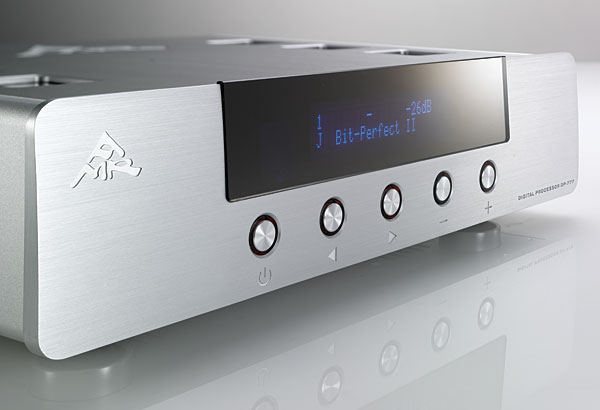
Abbingdon Music Research DP-777 D/A processor

Computer audio is more than just a pleasant distraction. For the jaded reviewer, USB digital converters and the like are an escape from that humdrum, if only because they bring with them so many variables: myriad combinations of different platforms, storage devices, operating systems, device drivers, media players, codecs, word lengths, sampling rates, connection protocols, and more. Challenging though they may be, computer-audio products are a tonic for reviewers inclined toward apathy.

Rega DAC D/A processor

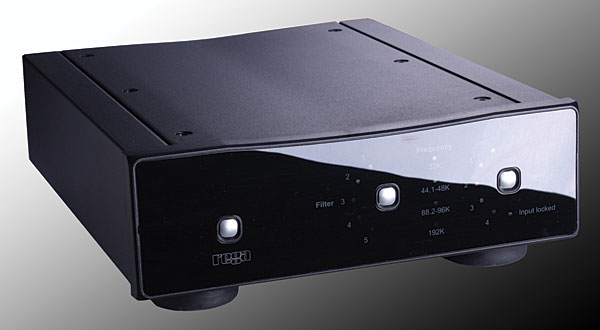
"We like to make things," Roy Gandy, Rega's founder and owner, once told me. "It's what we do." Or maybe it was Rega's chairman and chief engineering honcho, Terry Bateman. Rega products are designed and manufactured in the south of England. So far as I know, no one at the Rega facility, on the Temple Farm Industrial Estate, has committed suicide; the same cannot be said of workers at the factory in China where iPods are made. Al Gore is on the board of Apple. Al, what do you think?

Bricasti Design M1 D/A converter

Back in the late 1980s, it seemed a good idea: Separate a CD player's transport section from its D/A circuitry so that each could be optimally designed, and, as D/A technology improved, the sound of your CD player could be upgraded by replacing the outboard D/A processor. The catch was that the transport and D/A chassis needed to be connected with a serial data link: S/PDIF in optical or electrical flavors, or balanced AES/EBU. To minimize the number of cables required, the format of that link embedded the clock data within the audio data, which rendered the link sensitive to interface timing uncertainty, or jitter. (See "Bits Is Bits?," by Malcolm Hawksford and Chris Dunn.)

Weiss DAC202 FireWire D/A converter

One of the better digital front-ends I've ever heard was demonstrated for me a number of years ago at the house of an audiophile friend: a Weiss Engineering combo of Jason CD transport and Medea digital-to-analog converter. That front-end remains in my mind as one of the only digital systems I've heard that could compete with the very best that vinyl has to offer while still doing what digital does best. In other words, there were warmth and musicality, staggering dynamics, and real silent backgrounds. When, recently, I saw that the Swiss company had come out with a DAC featuring onboard volume control, a headphone amp, and a FireWire input, I knew I had to give it a listen.
Advertisement
Advertisement
Advertisement