Digital Processor Reviews

Sort By:  Post Date TitlePublish Date

dCS Scarlatti SACD/CD playback system
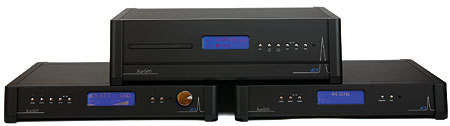
Is anyone in this economy shopping for a four-box, rack-swallowing, two-channel SACD/CD player contending for the state of the art and costing $79,996? dCS is betting that its Scarlatti will attract a small crowd of those wealthy music enthusiasts who, in any economy, reliably pony up for the best. For the rest of us, the Scarlatti will be a spectator sport.

T+A Music Player Media Streamer

"Two years ago I discovered my latest guilty pleasure: Internet radio. As long as it's 192k or higher. My whole buying/download cycle had been reduced. The pleasure and savings have increased. If they succeed in killing Net radio, I'm done with the hobby."—Reader Peter DeBoer, in response to a recent Stereophile online poll.

VTL Reference D/A processor

I find it more than a little ironic that in 1990 the only two digital-to-analog converters to employ a new state-of-the-art DAC also use vacuum tubes. Many in the audio community consider tubes an anachronism, and find it surprising and humorous that they are still used in newly designed audio products. The fact remains, however, that these two tubed digital processors achieve the best digital playback currently available—and by a wide margin. Moreover, their respective designers' technical savvy and passion for building leading-edge products is reflected in their choice of these superlative and very expensive new DACs. Is it mere coincidence that both designers also chose vacuum tubes to realize their vision of no-compromise digital playback?

Wadia Digital 1000 Decoding Computer

Rather a mouthful, the name of this digital decoder is derived from that of the designer, Robert Wadia Moses. The "computer" part of the title relates to the custom digital filter function generated by a set of 32-bit microprocessors: for simplicity's sake, I shall abbreviate the name to "WD1000." A more expensive version, called the '2000, sells for $6995, and carries some additional features and details. The resampling rate is increased to 64x in the '2000, with the additional optical and digital input switching and the main power supplies each contained in separate additional enclosures.

Wavelength Cosecant v3 USB digital/analog converter

While my enthusiasm for the long-discontinued Sony">http://www.stereophile.com/cdplayers/708play">Sony PlayStation 1 remains high (see the July 2008 Stereophile), I freely acknowledge that not every high-end audio enthusiast wants a CD player with an injection-molded chassis, a Robot Commando handset, and a remarkable lack of long-term reliability: Yes, the Sony sounds wonderful, but sound isn't everything.

Cambridge Audio Azur DacMagic D/A converter

In 1989, Cambridge Audio, then run by Stan Curtis—who is still active in hi-fi— introduced their DAC 1. At about the same time, within a few weeks of each other, Arcam introduced their Delta Black Box and Musical Fidelity their Digilog. I forget who was first among the three. Arcam, I think. But the DAC race was on, led by the British. (There was even a DAC called the Dacula.) US companies got into the DAC race, too—at higher prices, of course.

Bel Canto USB Link 24/96 USB-S/PDIF converter

The speed with which audiophiles have adopted a computer of some sort as their primary source of recorded music might be thought breathtaking. But with the ubiquitous Apple iPod painlessly persuading people to get used to the idea of storing their music libraries on computer hard drives, the next logical step was to access those libraries in listening rooms as well as on the move. A few months back, I wrote a basic guide to the various strategies for getting the best sound from a computer: "Music Served: Extracting Music from your PC." Since then, Minnesota manufacturer Bel Canto Design has released a product that aims to simplify matters even further.

Meridian 808.2/808i.2 Signature Reference CD player/preamplifier

It's been a while since I auditioned a Meridian CD player in my system. I had enthusiastically reviewed the English company's groundbreaking Pro-MCD">http://www.stereophile.com/cdplayers/285meridian">Pro-MCD player in early 1986, and over the years had kept up with the progress they were making in digital playback, either through my own reviews or by performing the measurements to accompany reviews by other Stereophile writers. The 508-24 player, reviewed">http://www.stereophile.com/cdplayers/590">reviewed by Wes Phillips in May 1998, was one of the finest digital products of the 1990s, I thought. But when Meridian began promoting surround sound and DVD-Audio at the turn of the century, their goals became somewhat incompatible with my own. Yes, I can appreciate what surround playback can do, but my own musical life is still solidly rooted in Two-Channel Land.

Advertisement
Advertisement
Advertisement