All prices in CA$
Monitor Audio was displaying two systems. The first showcased a pair of the company's Studio 89 monitors ($2999/pair, + $799 for Studio 89 stands) and Anthra W12 subwoofer ($3700), fed by a 140Wpc, class-A/B Rotel RAS-5000 integrated amplifier ($3999), while cabling and the component rack, in systems 1 and 2, were by Audience and Norstone, respectively.
 On a Roon-supplied high-res file of an Eric Clapton and B.B. King track taken from the duo's Riding With the King release, Clapton's and King's vocals were transparent, throaty, and expressive, revealing nuances proper to each musician's distinctive singing style. Guitar and piano notes were clear, resonant, brightly-hued, and well-defined, while bass was articulate and provided a nimble, rhythmic undertow. I also heard clear tone, good instrumental separation, and a transparent, lit-from-within quality in a high-res, brass-heavy cover of Brubeck's 1959 classic Take Five.
 Unsurprisingly, listening to the same tracks via Roon on the second system produced sound that offered a bit more of everything the first system did and did it with a bit more refinement, physicality, force, and musical ease.
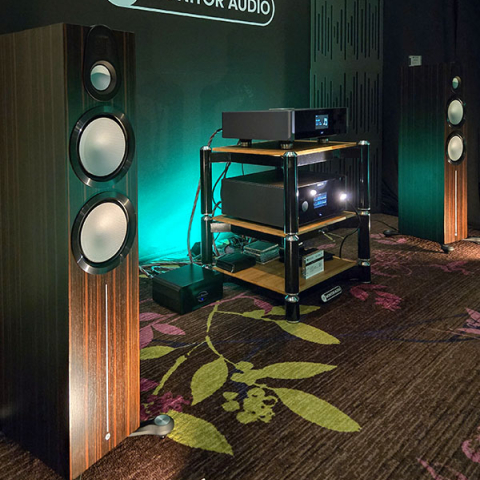
That system included the newly-launched, 51lb, top-loading Michi Q5 Transport DAC ($8499), a dual-mono, class-AB, 350Wpc Michi X552 integrated amplifier with internal, then-bypassed DAC ($9999), and a pair of three-way Monitor Audio Gold 500 6G speakers. This setup delivered great sound, and looked sharp doing it.
Unsurprisingly, listening to the same tracks via Roon on the second system produced sound that offered a bit more of everything the first system did and did it with a bit more refinement, physicality, force, and musical ease.
That system included the newly-launched, 51lb, top-loading Michi Q5 Transport DAC ($8499), a dual-mono, class-AB, 350Wpc Michi X552 integrated amplifier with internal, then-bypassed DAC ($9999), and a pair of three-way Monitor Audio Gold 500 6G speakers. This setup delivered great sound, and looked sharp doing it.
On a Roon-supplied high-res file of an Eric Clapton and B.B. King track taken from the duo's Riding With the King release, Clapton's and King's vocals were transparent, throaty, and expressive, revealing nuances proper to each musician's distinctive singing style. Guitar and piano notes were clear, resonant, brightly-hued, and well-defined, while bass was articulate and provided a nimble, rhythmic undertow. I also heard clear tone, good instrumental separation, and a transparent, lit-from-within quality in a high-res, brass-heavy cover of Brubeck's 1959 classic Take Five.
Unsurprisingly, listening to the same tracks via Roon on the second system produced sound that offered a bit more of everything the first system did and did it with a bit more refinement, physicality, force, and musical ease.