I declined to participate in the survey—Stereophile editorial policy does not allow writers to act as consultants, and this was tantamount to being a consultant, albeit an unpaid one. However, if one of the brands in the survey had been Monitor Audio, my answers would not have been terribly helpful: I had no very clear "image" of Monitor Audio speakers. British, well-made, uses gold-anodized dome tweeters—that's about all I could have said about them. I had not listened to Monitor speakers for any length of time. My impressions were vaguely positive, but nothing to make me think that these were speakers I simply must review.
My impression of Monitor Audio speakers changed at the 2007 Montreal Festival Son & Image. At a show at which many excellent speakers were displayed, the demonstration of Monitor's Platinum PL300s was characterized by sound that I described in my show report as being "arrestingly lifelike." I made a mental note to myself to consider reviewing these speakers, but, what with this and that, by the time I got around to taking steps to arrange a Monitor Audio review, the year was 2009 and the new speaker in the Platinum line was the PL200. This speaker has much the same technology as the PL300, but in a more compact package and at a lower price ($8000/pair)—a combination that always appeals to me. And a demo of a pair of PL200s at the 2009 Montreal show was most convincing. This time, I made sure that reviewing the PL200 was not a "Think about . . ." but a "Do!"
 Description and design
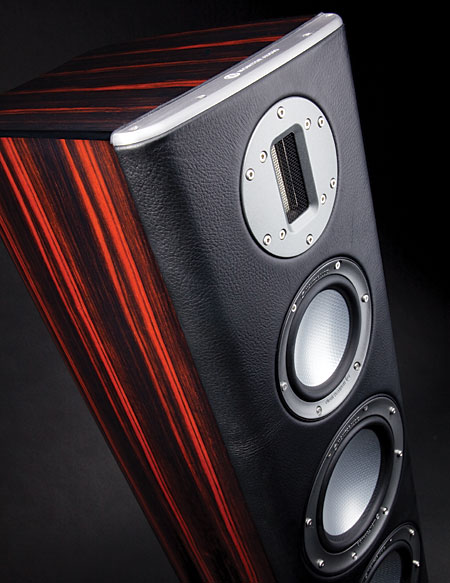
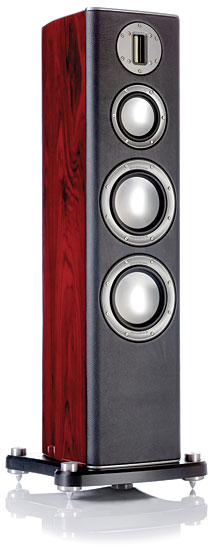
Remember the advertising slogan for Clairol's Nice 'n Easy, "The closer he gets, the better you look"? Perhaps a wee sexist in today's world, but if Monitor Audio were to borrow this slogan, they could well adapt for the advertising of the Platinum PL200. From a distance, it looks much like any other floorstander. But get closer, and you'll see that the fit and finish are of a quality far higher than the norm. The wood finish (Santos Rosewood on the review samples) is impeccable: smooth, with a gloss that indicates multiple coats of varnish, each coat (of 11, I'm told) polished to perfection. Joins in the veneer are invisible. The front baffle is finished in leather—not just any leather, mind you, but "Strathspey leather," selected for its acoustical properties as well as for its appearance.
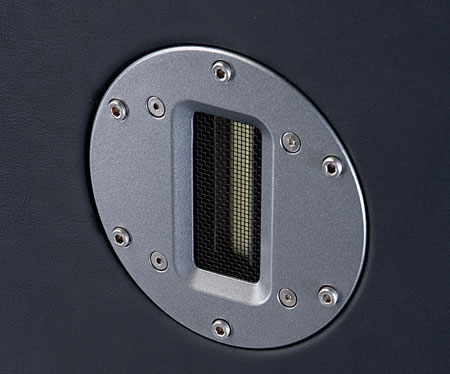
The drivers are on the exotic side: the midrange and bass have metal-covered cones, and the tweeter is a ribbon rather than the ubiquitous dome. The midrange and bass cones are made of a honeycombed Nomex combined with Monitor's Ceramic-Coated Aluminum Magnesium (C-CAM) alloy, forming a rigid structure with low mass. C-CAM is also used in the construction of the ribbon tweeter, whose frequency response is claimed to extend to 100kHz. Although this is well above what's normally considered to be the upper limit of human hearing (and the CD format is bandwidth-limited to 22kHz), there is some evidence that, at least with wide-bandwidth sources, ultrasonic response may improve the sense of reality of the reproduction. Even if the audibility or utility of the ultrasonic response is questionable, there is still the argument that a tweeter whose response extends far beyond the range of human hearing may perform better in the audible range. Oh, and in case you were wondering, other than in the finish of their WBT binding posts, the Platinum PL200 contains no platinum.
I couldn't find much information about the PL200's crossovers in the product literature or on Monitor Audio's website, but Dean Hartley, the company's head designer, told me that the low-pass bass-driver crossover and both the high- and low-pass crossovers on the midrange are 12dB/octave, and that the tweeter is protected by an 18dB/octave crossover. Crossover components include high-spec foil capacitors and air-core inductors; the internal wiring is pure silver.
The fine-furniture finish of the PL200's cabinet hides a complex, high-tech construction. Multiple layers of bonded MDF form a multicurved shell; steel bolts tie the front and rear panels to a "pinhole" bracing structure. A tool is provided for tightening the bolts, which can loosen during shipping. Under the leather, the front baffle is made of something called Anti Resonant Composite (ARC), "a thermo-set polymer loaded with minerals." The midrange driver occupies its own sealed, tapered enclosure within the main enclosure. The bass is ported, but, again, the design is unique, and called HiVe II: a straight-rifled aperture that's claimed to be able to move air in and out more quickly than conventional designs.
The PL200's integral plinth is also made of ARC, and has feet that are adjustable for leveling. (A spirit level is provided.) The plinth houses two sets of WBT terminals for optional biwiring. I single-wired the Monitors.
Monitor Audio is owned and managed in the UK, but since 2004 its manufacturing facilities have been consolidated in China. ("The best move we ever made," says Dean Hartley.) According to Hartley, parts for the PL200 are sourced or made with the objective of achieving the highest quality and tolerances. The tweeter itself—the manufacturer of which requires extremely tight tolerances—is made in Malaysia. The final assembly is done in Monitor Audio's factory in China, with QC supervised and inspected by Monitor Audio's own staff.
System and setup
In considering reviewing a pair of speakers, I first must make sure that I have an amplifier that can drive them. Though the last speaker I reviewed, the Avantgarde Uno Nano (July 2009), thrives on low-powered tube amplification, a glance at the Platinum PL200's specifications told me that this speaker would require something else. Monitor Audio recommends an amplifier with a minimum output of 100Wpc. But with a speaker of the PL200's pedigree, those shouldn't be just any kind of watts—I'd want to use an amplifier good enough that its sound quality would not compromise the speaker's performance. Which one?