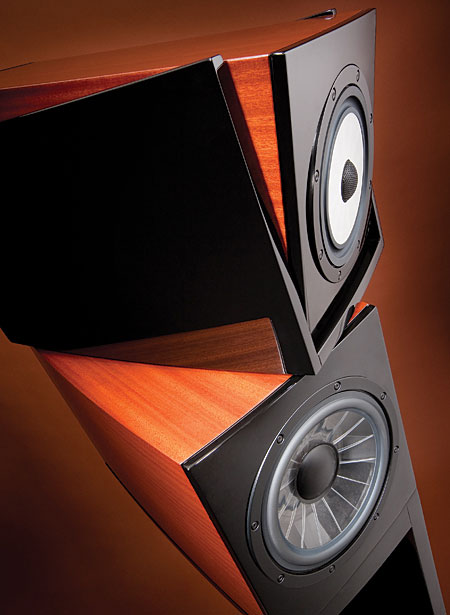
Almost every assumption you might make about Vienna Acoustics' Klimt The Kiss loudspeaker by looking at it would be wrong. It is not a stand-mounted two-way loudspeaker. It's a three-way, with a coincident tweeter-midrange. And that ain't no stand—it's an integral part of the speaker. It does not have a conventional cabinet—there are two separate enclosures, complete with micrometer control of both vertical and horizontal axes. And those sure aren't plain-vanilla drive-units—they're about as unique as they come.
 When I say you, of course, I mean I. When I first saw The Kiss ($16,000/pair), when Vienna Acoustics debuted its newest addition to their Klimt series at the 2009 Consumer Electronics Show, I misidentified every one of those characteristics. Then I listened to the speakers—and that drew me in for a far more thorough examination.
Impressed by its performance before I was intrigued by its potential—it proved a fitting prelude to a Kiss.
Let's kiss afresh, as when we first begun
When I say you, of course, I mean I. When I first saw The Kiss ($16,000/pair), when Vienna Acoustics debuted its newest addition to their Klimt series at the 2009 Consumer Electronics Show, I misidentified every one of those characteristics. Then I listened to the speakers—and that drew me in for a far more thorough examination.
Impressed by its performance before I was intrigued by its potential—it proved a fitting prelude to a Kiss.
Let's kiss afresh, as when we first begun
About that "stand"—with only a single, slightly bowed side-pillar, it struck several of my visitors as looking incomplete. You'll love it or hate it. But if you buy the concept, you buy the stand—it's included in the base price, and its height is calculated into The Kiss's performance parameters. At the heart of The Kiss is the 7" (180mm) flat, radially ribbed coincident driver first seen in Vienna's Musik. The flat-spider-cone portion of the coincident array is made of a compound that incorporates a proprietary material called X3P, and covers everything from 100Hz to 2.6kHz, where a 25mm silk-dome tweeter carries the response out to 20kHz. Why ribbed? Well, that's for rigidity—many coincident drivers are conical because a cone has better dynamic stability than most lighter, flat pistons. Vienna Acoustics' chief designer, Peter Gansterer, used finite-element analysis (FEA) to obtain a maximum rigidity that interferes as little as possible with a flat response.
 The 9" cone of the woofer, also of X3P, is similarly ribbed and designed in-house specifically for The Kiss. It uses a multiple-radius profile to maximize stiffness and minimize mass, and is mounted on a port-loaded woofer enclosure.
The midrange/tweeter array is mounted in its own enclosure, which Vienna calls the Music Center, atop the woofer cabinet, and "decoupled" from it by a swivel joint of drawn aluminum. That joint allows the Music Center to be moved in the horizontal and vertical axes relative to the bottom cabinet, the adjustments controlled by two precision-threaded screws on the rear of the cabinets. Each has its own adjustment "meter" to ensure repeatable and consistent results. The idea is to get the placement of each speaker about as right as possible, then fine-tune the rake and toe-in as needed.
The Kiss also has two small switches, labeled "T" (treble, duh) and "B" (bass, ditto). Neither greatly affects the sound—by design, claims Vienna Acoustics. They're there for minute room-acoustic compensation, especially "T," which was included to add air to overdamped rooms.
The Kiss has substantial low-profile binding posts with big, knurled knobs—it's easily on my short list for Least Fussy Speaker Connections Ever. The crossover is first-order.
Kiss me and be quiet
The 9" cone of the woofer, also of X3P, is similarly ribbed and designed in-house specifically for The Kiss. It uses a multiple-radius profile to maximize stiffness and minimize mass, and is mounted on a port-loaded woofer enclosure.
The midrange/tweeter array is mounted in its own enclosure, which Vienna calls the Music Center, atop the woofer cabinet, and "decoupled" from it by a swivel joint of drawn aluminum. That joint allows the Music Center to be moved in the horizontal and vertical axes relative to the bottom cabinet, the adjustments controlled by two precision-threaded screws on the rear of the cabinets. Each has its own adjustment "meter" to ensure repeatable and consistent results. The idea is to get the placement of each speaker about as right as possible, then fine-tune the rake and toe-in as needed.
The Kiss also has two small switches, labeled "T" (treble, duh) and "B" (bass, ditto). Neither greatly affects the sound—by design, claims Vienna Acoustics. They're there for minute room-acoustic compensation, especially "T," which was included to add air to overdamped rooms.
The Kiss has substantial low-profile binding posts with big, knurled knobs—it's easily on my short list for Least Fussy Speaker Connections Ever. The crossover is first-order.
Kiss me and be quiet
In my room, The Kisses ended up about 4' from my front wall and about 2' from the sidewalls, with a fair amount of toe-in. Adjustments via the speakers' caliper knobs were minimal: I needed only a slight declination in the Music Center's rake (I sit high, as they say), and a more moderate additional toe-in. However, after getting the speakers sited pretty well (I thought), those slight final adjustments truly locked in the sound. Neither the "T" nor the "B" switch added substantially to my musical enjoyment, so I left them in their neutral positions. Nice to have, I reckon, but not necessary in my room.
When I say you, of course, I mean I. When I first saw The Kiss ($16,000/pair), when Vienna Acoustics debuted its newest addition to their Klimt series at the 2009 Consumer Electronics Show, I misidentified every one of those characteristics. Then I listened to the speakers—and that drew me in for a far more thorough examination.
Impressed by its performance before I was intrigued by its potential—it proved a fitting prelude to a Kiss.
About that "stand"—with only a single, slightly bowed side-pillar, it struck several of my visitors as looking incomplete. You'll love it or hate it. But if you buy the concept, you buy the stand—it's included in the base price, and its height is calculated into The Kiss's performance parameters. At the heart of The Kiss is the 7" (180mm) flat, radially ribbed coincident driver first seen in Vienna's Musik. The flat-spider-cone portion of the coincident array is made of a compound that incorporates a proprietary material called X3P, and covers everything from 100Hz to 2.6kHz, where a 25mm silk-dome tweeter carries the response out to 20kHz. Why ribbed? Well, that's for rigidity—many coincident drivers are conical because a cone has better dynamic stability than most lighter, flat pistons. Vienna Acoustics' chief designer, Peter Gansterer, used finite-element analysis (FEA) to obtain a maximum rigidity that interferes as little as possible with a flat response.
The 9" cone of the woofer, also of X3P, is similarly ribbed and designed in-house specifically for The Kiss. It uses a multiple-radius profile to maximize stiffness and minimize mass, and is mounted on a port-loaded woofer enclosure.
The midrange/tweeter array is mounted in its own enclosure, which Vienna calls the Music Center, atop the woofer cabinet, and "decoupled" from it by a swivel joint of drawn aluminum. That joint allows the Music Center to be moved in the horizontal and vertical axes relative to the bottom cabinet, the adjustments controlled by two precision-threaded screws on the rear of the cabinets. Each has its own adjustment "meter" to ensure repeatable and consistent results. The idea is to get the placement of each speaker about as right as possible, then fine-tune the rake and toe-in as needed.
The Kiss also has two small switches, labeled "T" (treble, duh) and "B" (bass, ditto). Neither greatly affects the sound—by design, claims Vienna Acoustics. They're there for minute room-acoustic compensation, especially "T," which was included to add air to overdamped rooms.
The Kiss has substantial low-profile binding posts with big, knurled knobs—it's easily on my short list for Least Fussy Speaker Connections Ever. The crossover is first-order.
In my room, The Kisses ended up about 4' from my front wall and about 2' from the sidewalls, with a fair amount of toe-in. Adjustments via the speakers' caliper knobs were minimal: I needed only a slight declination in the Music Center's rake (I sit high, as they say), and a more moderate additional toe-in. However, after getting the speakers sited pretty well (I thought), those slight final adjustments truly locked in the sound. Neither the "T" nor the "B" switch added substantially to my musical enjoyment, so I left them in their neutral positions. Nice to have, I reckon, but not necessary in my room.