It's now 10 years since the launch of the two high-resolution audio disc formats, SACD and DVD-Audio. Yet, perhaps partly because both were hobbled in various ways to please the record industry, perhaps partly because too many supposed hi-rez releases sounded no better than CD, and perhaps partly because record retailers weren't sure how to display the formats to their best advantage, neither took off in any substantive way. DVD-A disappeared, and SACD survived only as a niche format for high-quality classical releases in both two- and multichannel forms. As we got deeper into the same decade, digital technology, despite various sparks and flashes, went into the doldrums. Mainstream digital technology was increasingly concerned with squashing the music into fewer and more portable bits, not with increased sound quality. Even the concept of "CD sound quality" began to seem an unattainable goal, as MP3 files became the dominant music carrier.
 But a funny thing happened. MP3s may have sounded mediocre, but they accustomed the mainstream to regard the personal computer as another source of music. And if you can play MP3s on your PC, why not files of higher resolution? The breakthrough, I believe, came in fall 2003, when Apple released v.4.5 of its iTunes program, along with a lossless version of its AAC codec, which allowed playback of true CD-quality music without as much of the penalty of hard-drive space imposed by uncompressed files. Then there was no obstacle to playing back files of greater resolution or bandwidth than CD!
The past three years have seen an explosion in the ways of playing high-resolution files from computers. There are D/A processors that accept data via WiFi or Ethernet; there are D/A processors that connect to a computer via USB or FireWire links; and there are USB-to-S/PDIF converters that allow a computer to be used with a legacy DAC. On the other side of the fence, manufacturers such as Lynx, RME, and ASUS are making soundcards with true high-end performance, and some computers come with optical S/PDIF outputs, these usually mounting the optical driver at the inner end of a conventional 3.5mm stereo jack. And manufacturers of high-end disc players and even integrated amplifiers—take a bow, Peachtree's Nova—are increasingly incorporating digital inputs, so that the high-quality D/A and analog output sections can also be used for data from a computer, or from inexpensive WiFi streamers such as the Sonos or Logitech Squeezebox.
British company dCS made its reputation as a pro-audio manufacturer, but entered high-end audio with a superb-sounding D/A converter, the Elgar, in 1997. This was based on a proprietary discrete DAC circuit called the Ring DAC, a 5-bit converter running at a 64x oversampling rate: 2.822MHz for 44.1kHz-based data, 3.07MHz for 48kHz-sampled data and its multiples. (Not coincidentally, 2.822MHz is the sample rate used for DSD.) The company went through some changes in recent years, and, following its acquisition a few years back by David Steven, a veteran of the Scottish audio industry, dCS decided to concentrate on high-end audio. Sadly, David passed away last February (see "As We See It," p.3), but not before establishing a new range of dCS products worldwide, including the four-box Scarlatti SACD playback system that Michael Fremer raved about in our August 2009 issue. dCS is now run by David's son, also a David. When, last summer, I interrupted a brief vacation in the UK to visit the dCS headquarters in Saffron Walden, near Cambridge, I was impressed by the younger David Steven's grasp of the high-end industry and the high-end audio ethos.
Puccini
But a funny thing happened. MP3s may have sounded mediocre, but they accustomed the mainstream to regard the personal computer as another source of music. And if you can play MP3s on your PC, why not files of higher resolution? The breakthrough, I believe, came in fall 2003, when Apple released v.4.5 of its iTunes program, along with a lossless version of its AAC codec, which allowed playback of true CD-quality music without as much of the penalty of hard-drive space imposed by uncompressed files. Then there was no obstacle to playing back files of greater resolution or bandwidth than CD!
The past three years have seen an explosion in the ways of playing high-resolution files from computers. There are D/A processors that accept data via WiFi or Ethernet; there are D/A processors that connect to a computer via USB or FireWire links; and there are USB-to-S/PDIF converters that allow a computer to be used with a legacy DAC. On the other side of the fence, manufacturers such as Lynx, RME, and ASUS are making soundcards with true high-end performance, and some computers come with optical S/PDIF outputs, these usually mounting the optical driver at the inner end of a conventional 3.5mm stereo jack. And manufacturers of high-end disc players and even integrated amplifiers—take a bow, Peachtree's Nova—are increasingly incorporating digital inputs, so that the high-quality D/A and analog output sections can also be used for data from a computer, or from inexpensive WiFi streamers such as the Sonos or Logitech Squeezebox.
British company dCS made its reputation as a pro-audio manufacturer, but entered high-end audio with a superb-sounding D/A converter, the Elgar, in 1997. This was based on a proprietary discrete DAC circuit called the Ring DAC, a 5-bit converter running at a 64x oversampling rate: 2.822MHz for 44.1kHz-based data, 3.07MHz for 48kHz-sampled data and its multiples. (Not coincidentally, 2.822MHz is the sample rate used for DSD.) The company went through some changes in recent years, and, following its acquisition a few years back by David Steven, a veteran of the Scottish audio industry, dCS decided to concentrate on high-end audio. Sadly, David passed away last February (see "As We See It," p.3), but not before establishing a new range of dCS products worldwide, including the four-box Scarlatti SACD playback system that Michael Fremer raved about in our August 2009 issue. dCS is now run by David's son, also a David. When, last summer, I interrupted a brief vacation in the UK to visit the dCS headquarters in Saffron Walden, near Cambridge, I was impressed by the younger David Steven's grasp of the high-end industry and the high-end audio ethos.
Puccini
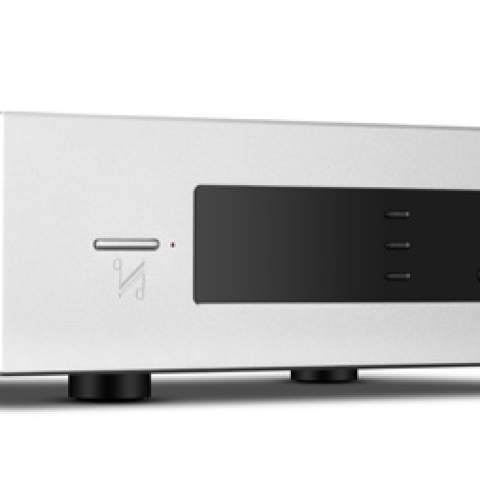
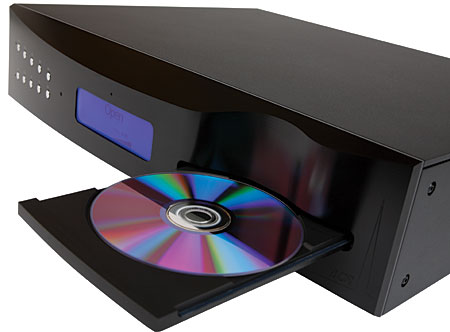
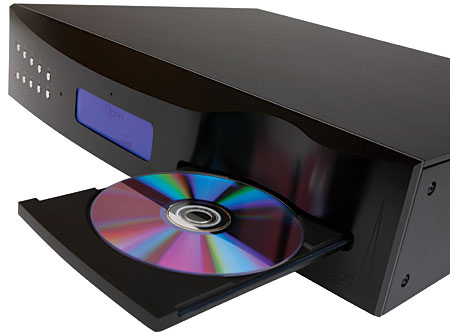
Though expensive in absolute terms at $17,999, the subject of this review, the Puccini, is the least expensive model in the new dCS line. A one-box SACD/CD player with both balanced and unbalanced analog outputs, it also has pairs of digital inputs and outputs, and can be used with an external master word clock, the Puccini U-Clock ($4999), which includes a USB input. I reviewed the first single-box SACD player to come from dCS, the P8i, in April 2006, and was well impressed by its performance. "For a classical music lover assembling a collection of SACDs who still wants the best sound from his CD library, the dCS P8i used straight into the power amps is almost as good as it can get," I concluded.
But a funny thing happened. MP3s may have sounded mediocre, but they accustomed the mainstream to regard the personal computer as another source of music. And if you can play MP3s on your PC, why not files of higher resolution? The breakthrough, I believe, came in fall 2003, when Apple released v.4.5 of its iTunes program, along with a lossless version of its AAC codec, which allowed playback of true CD-quality music without as much of the penalty of hard-drive space imposed by uncompressed files. Then there was no obstacle to playing back files of greater resolution or bandwidth than CD!
The past three years have seen an explosion in the ways of playing high-resolution files from computers. There are D/A processors that accept data via WiFi or Ethernet; there are D/A processors that connect to a computer via USB or FireWire links; and there are USB-to-S/PDIF converters that allow a computer to be used with a legacy DAC. On the other side of the fence, manufacturers such as Lynx, RME, and ASUS are making soundcards with true high-end performance, and some computers come with optical S/PDIF outputs, these usually mounting the optical driver at the inner end of a conventional 3.5mm stereo jack. And manufacturers of high-end disc players and even integrated amplifiers—take a bow, Peachtree's Nova—are increasingly incorporating digital inputs, so that the high-quality D/A and analog output sections can also be used for data from a computer, or from inexpensive WiFi streamers such as the Sonos or Logitech Squeezebox.
Though expensive in absolute terms at $17,999, the subject of this review, the Puccini, is the least expensive model in the new dCS line. A one-box SACD/CD player with both balanced and unbalanced analog outputs, it also has pairs of digital inputs and outputs, and can be used with an external master word clock, the Puccini U-Clock ($4999), which includes a USB input. I reviewed the first single-box SACD player to come from dCS, the P8i, in April 2006, and was well impressed by its performance. "For a classical music lover assembling a collection of SACDs who still wants the best sound from his CD library, the dCS P8i used straight into the power amps is almost as good as it can get," I concluded.