One of the themes of the 2005 CES, which we touched on in our first day's coverage, regarding Thiel's new version of its best-selling PowerPoint loudspeaker, is the increasing importance of the custom-install market to manufacturers best known for their two-channel products.
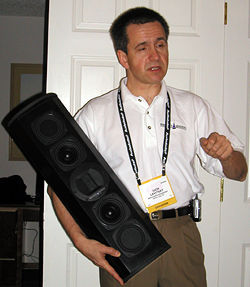 Nevada-based Bohlender-Graebener, for example, produce well-regarded "traditional" speakers—their Radia 520i speaker was reviewed by Larry Greenhill in the December Stereophile—but the company's big product introduction at the Show was a pair of on-wall custom-install speakers. The R-17i (held in the photo by BG engineer Igor Levitsky) and the R-18i both cost $499.50 but differ in their cosmetics and drive-unit line-up. Both, however, use versions of the company's ribbon unit as the tweeter, with that in the '18i rotatable about its vertical axis so that it can either face the listener for front-channel use or face to the sides, to give the diffuse field required by THX for rear channels. A brief listen to a pair on stereo reinforced the idea that keeping the speaker separate from the unknown acoustic of the wall cavity is a good idea.
Stereophile columnist Michael Fremer chaired a seminar, "What Happened to Audio," bemoaning the current state of the audio industry, wherein quality music reproduction is treated as an adjunct to the current cash cows of home theater and custom install. (A clue to the problems faced by the audio industry was the fact that only 24 Show attendees, including this reporter, attended the session.)
A panel comprised of journalist Ken Kessler, record producer Elliot Mazer, distributor Stirling Trayle, Blue Man Group producer Tod Perlmutter, and satellite audio engineer Geir Skaaden chewed the subject over—Why don't more end users care about quality? Why don't more record company execs care about quality? Is it the effect of the iPod? Will the massive data-compression used by XM and Sirius radio dumb down listeners' expections about audio quality?—to no good conclusion, but with the hope that many of the millions currently listening to data-reduced music will eventually demand more quality. All the panelists agreed that the passion that fuels high-end audio was in sparse supply at the main convention center.
That passion is still in evidence at the Alexis Park, however, and two two-channel rooms caught this scribe's attention at the end of a long day. Both rooms offered a connection back to the start of the High End in the early 1970s. First, I listened to the SACD remastering of Artur Rubinstein's 1960s performance of the first Chopin Ballade for piano in the Genesis room, courtesy of pioneering speaker engineer Arnie Nudell. Played on a venerable Sony SCD-1 player, via an Aesthetix preamp, Bruce Moore 225W tube monoblocks, into the $48k/pair Genesis 201 four-tower line-source speakers with Synergistic cables, the shade of Rubinstein at the Steinway was conjured forth in a most convincing manner.
Nevada-based Bohlender-Graebener, for example, produce well-regarded "traditional" speakers—their Radia 520i speaker was reviewed by Larry Greenhill in the December Stereophile—but the company's big product introduction at the Show was a pair of on-wall custom-install speakers. The R-17i (held in the photo by BG engineer Igor Levitsky) and the R-18i both cost $499.50 but differ in their cosmetics and drive-unit line-up. Both, however, use versions of the company's ribbon unit as the tweeter, with that in the '18i rotatable about its vertical axis so that it can either face the listener for front-channel use or face to the sides, to give the diffuse field required by THX for rear channels. A brief listen to a pair on stereo reinforced the idea that keeping the speaker separate from the unknown acoustic of the wall cavity is a good idea.
Stereophile columnist Michael Fremer chaired a seminar, "What Happened to Audio," bemoaning the current state of the audio industry, wherein quality music reproduction is treated as an adjunct to the current cash cows of home theater and custom install. (A clue to the problems faced by the audio industry was the fact that only 24 Show attendees, including this reporter, attended the session.)
A panel comprised of journalist Ken Kessler, record producer Elliot Mazer, distributor Stirling Trayle, Blue Man Group producer Tod Perlmutter, and satellite audio engineer Geir Skaaden chewed the subject over—Why don't more end users care about quality? Why don't more record company execs care about quality? Is it the effect of the iPod? Will the massive data-compression used by XM and Sirius radio dumb down listeners' expections about audio quality?—to no good conclusion, but with the hope that many of the millions currently listening to data-reduced music will eventually demand more quality. All the panelists agreed that the passion that fuels high-end audio was in sparse supply at the main convention center.
That passion is still in evidence at the Alexis Park, however, and two two-channel rooms caught this scribe's attention at the end of a long day. Both rooms offered a connection back to the start of the High End in the early 1970s. First, I listened to the SACD remastering of Artur Rubinstein's 1960s performance of the first Chopin Ballade for piano in the Genesis room, courtesy of pioneering speaker engineer Arnie Nudell. Played on a venerable Sony SCD-1 player, via an Aesthetix preamp, Bruce Moore 225W tube monoblocks, into the $48k/pair Genesis 201 four-tower line-source speakers with Synergistic cables, the shade of Rubinstein at the Steinway was conjured forth in a most convincing manner.
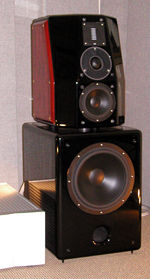 Second, was listening to Pink Floyd's "Shine on You Crazy Diamond" in the Viola room, on a system comprising A Bel Canto universal player, Viola Cadenza preamp and Symphony power amp (both $16k) into preproduction versions of Viola's new Allegro three-way monitors ($20k/pair) sitting on Basso woofers ($18k/pair). This time it was the shade of Syd Barrett that was conjured forth, and I found it hard to leave.
The connection with the Golden age of high-end audio is that Viola sprung from the ashes of Mark Levinson's Cello company, which itself sprang from the original Mark Levinson Audio Systems. The Viola electronics are designed by Tom Colangelo, the speakers by Paul Jayson, both long-term Levinson associates, and the Connecticut-based company is now steered by dCS alumnus, the very English Robert Kelly.
As long as audio companies can still design products that allow the music to communicate so effectively, the High End will survive and perhaps one day again will thrive!
Second, was listening to Pink Floyd's "Shine on You Crazy Diamond" in the Viola room, on a system comprising A Bel Canto universal player, Viola Cadenza preamp and Symphony power amp (both $16k) into preproduction versions of Viola's new Allegro three-way monitors ($20k/pair) sitting on Basso woofers ($18k/pair). This time it was the shade of Syd Barrett that was conjured forth, and I found it hard to leave.
The connection with the Golden age of high-end audio is that Viola sprung from the ashes of Mark Levinson's Cello company, which itself sprang from the original Mark Levinson Audio Systems. The Viola electronics are designed by Tom Colangelo, the speakers by Paul Jayson, both long-term Levinson associates, and the Connecticut-based company is now steered by dCS alumnus, the very English Robert Kelly.
As long as audio companies can still design products that allow the music to communicate so effectively, the High End will survive and perhaps one day again will thrive!
Nevada-based Bohlender-Graebener, for example, produce well-regarded "traditional" speakers—their Radia 520i speaker was reviewed by Larry Greenhill in the December Stereophile—but the company's big product introduction at the Show was a pair of on-wall custom-install speakers. The R-17i (held in the photo by BG engineer Igor Levitsky) and the R-18i both cost $499.50 but differ in their cosmetics and drive-unit line-up. Both, however, use versions of the company's ribbon unit as the tweeter, with that in the '18i rotatable about its vertical axis so that it can either face the listener for front-channel use or face to the sides, to give the diffuse field required by THX for rear channels. A brief listen to a pair on stereo reinforced the idea that keeping the speaker separate from the unknown acoustic of the wall cavity is a good idea.
Stereophile columnist Michael Fremer chaired a seminar, "What Happened to Audio," bemoaning the current state of the audio industry, wherein quality music reproduction is treated as an adjunct to the current cash cows of home theater and custom install. (A clue to the problems faced by the audio industry was the fact that only 24 Show attendees, including this reporter, attended the session.)
A panel comprised of journalist Ken Kessler, record producer Elliot Mazer, distributor Stirling Trayle, Blue Man Group producer Tod Perlmutter, and satellite audio engineer Geir Skaaden chewed the subject over—Why don't more end users care about quality? Why don't more record company execs care about quality? Is it the effect of the iPod? Will the massive data-compression used by XM and Sirius radio dumb down listeners' expections about audio quality?—to no good conclusion, but with the hope that many of the millions currently listening to data-reduced music will eventually demand more quality. All the panelists agreed that the passion that fuels high-end audio was in sparse supply at the main convention center.
Second, was listening to Pink Floyd's "Shine on You Crazy Diamond" in the Viola room, on a system comprising A Bel Canto universal player, Viola Cadenza preamp and Symphony power amp (both $16k) into preproduction versions of Viola's new Allegro three-way monitors ($20k/pair) sitting on Basso woofers ($18k/pair). This time it was the shade of Syd Barrett that was conjured forth, and I found it hard to leave.
The connection with the Golden age of high-end audio is that Viola sprung from the ashes of Mark Levinson's Cello company, which itself sprang from the original Mark Levinson Audio Systems. The Viola electronics are designed by Tom Colangelo, the speakers by Paul Jayson, both long-term Levinson associates, and the Connecticut-based company is now steered by dCS alumnus, the very English Robert Kelly.
As long as audio companies can still design products that allow the music to communicate so effectively, the High End will survive and perhaps one day again will thrive!