Every two or three years my family and I travel to Disney World in Orlando, Florida—one of those places I used to think I'd hate, but which I always enjoy in spite of myself. No such trip would be complete without visiting the Mitsukoshi department store at Epcot Center, which represents the pinnacle of Japanese consumer culture. At the Epcot Mitsukoshi store—the 430-year-old company's only US location—one can buy the finest of everything, including the rarest and most expensive writing papers and inks, the most exquisitely crafted pottery, and the loveliest freshwater pearls on Earth. Young shoppers are accommodated with the latest toys, trends, and technology—but there's nothing frantic or cheap about the manner in which they're offered. The watchword at Mitsukoshi is quality, and the presentation borders on being artistic.
 Every time I go there I scan the display cases, half-expecting to see a selection of Koetsu cartridges among the chronographs and the fountain pens. Why not? Some Koetsus are crafted from precious materials—and all of them can lay claim to being both high-tech and handmade. More to the point, some hobbyists say that these handmade Japanese pickups are the best you can buy.
At the very least, Koetsus were the very first artisanal phono pickups to make an impression on the American and English hi-fi scenes. As such, and regardless of who came first—a question that probably can't be answered—Koetsu paved the way for all other such things, including the Kiseki, the Kondo, the Miyabi, and the delightfully named Goldbug.
Koetsu cartridges are made in small quantities by Fumihiko Sugano—the son of Koetsu's founder, the late Yoshiaki Sugano. The elder Sugano, who came and went with the 20th century, created the basic Koetsu cartridge design, pioneering the use of high-purity metals in particular, and naming the company after his ancestor and role model, the 16th-century artisan Honami Koetsu.
Various exotic Koetsu models have caught the public's eye and ear during the last three decades, including the Onyx, the Jade, and the exquisitely lacquered Urushi Vermillion. But throughout that time, the Black has maintained its dual role as Koetsu's entry-level model and Koetsu's best-known cartridge. After all those years, it seemed reasonable to ask: Where does the Koetsu Black stand in today's busy, bloody marketplace?
Description and setup
Every time I go there I scan the display cases, half-expecting to see a selection of Koetsu cartridges among the chronographs and the fountain pens. Why not? Some Koetsus are crafted from precious materials—and all of them can lay claim to being both high-tech and handmade. More to the point, some hobbyists say that these handmade Japanese pickups are the best you can buy.
At the very least, Koetsus were the very first artisanal phono pickups to make an impression on the American and English hi-fi scenes. As such, and regardless of who came first—a question that probably can't be answered—Koetsu paved the way for all other such things, including the Kiseki, the Kondo, the Miyabi, and the delightfully named Goldbug.
Koetsu cartridges are made in small quantities by Fumihiko Sugano—the son of Koetsu's founder, the late Yoshiaki Sugano. The elder Sugano, who came and went with the 20th century, created the basic Koetsu cartridge design, pioneering the use of high-purity metals in particular, and naming the company after his ancestor and role model, the 16th-century artisan Honami Koetsu.
Various exotic Koetsu models have caught the public's eye and ear during the last three decades, including the Onyx, the Jade, and the exquisitely lacquered Urushi Vermillion. But throughout that time, the Black has maintained its dual role as Koetsu's entry-level model and Koetsu's best-known cartridge. After all those years, it seemed reasonable to ask: Where does the Koetsu Black stand in today's busy, bloody marketplace?
Description and setup
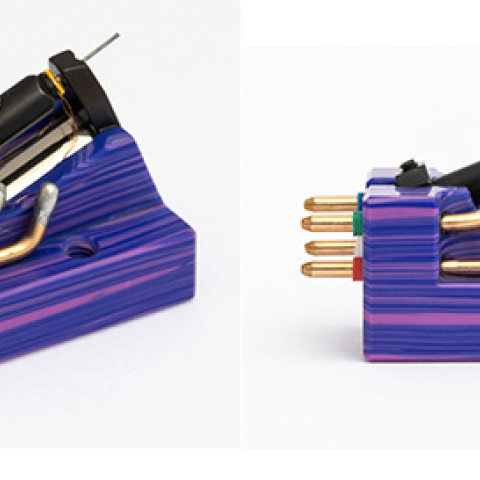
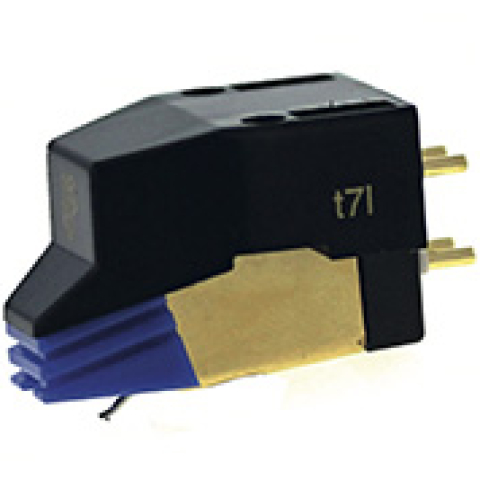
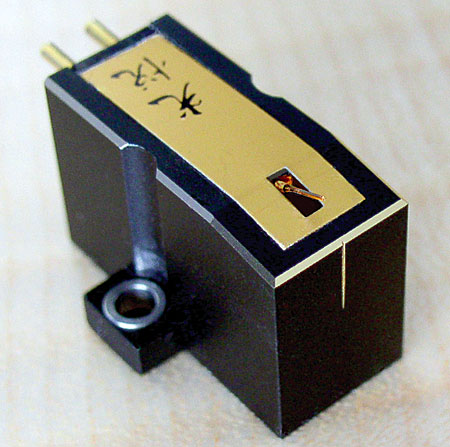
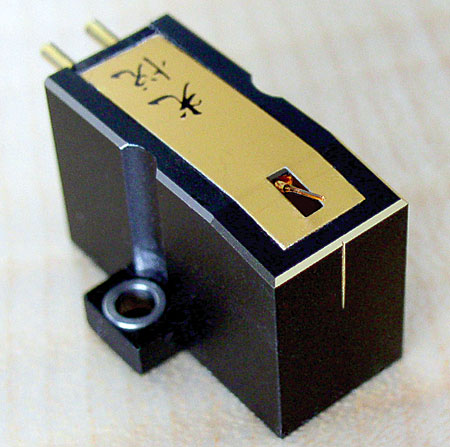
Like all Koetsu cartridges, and notwithstanding a slight chamfer on the foremost part of its underside, the Koetsu Black is built into an oblong block measuring 25/64" by 36/64" by 56/64". (I had my hopes up at first, wondering if those dimensions might have been derived from the ever-popular Golden Ratio, but that proved not to be the case.) The body is made of aluminum, painted black, with integral, unthreaded holes for the mounting bolts. A strip of much thinner aluminum, anodized gold, protects the motor and wiring, and a snug-fitting nylon stylus guard is supplied.
As with every Koetsu model, each leg of the Black's coil former is wound with 10 turns of wire. A Koetsu's output is largely determined by the magnet compound used, and in this case it's samarium cobalt. All suspension elastomers are said to be pre-aged, and the cantilever is a solid boron rod. The business end of the latter is notched in the usual manner to accept the diamond stylus shank, but Sugano goes a step further and encircles the shank with a microscopically small alloy plate—which, I'm told, keeps the adhesive joint clean and neat. Under magnification, the stylus profile appeared similar to the line-contact design manufactured by Ogura, albeit with a hyperelliptical tip that blends quickly into a pair of smoothly rounded "shoulders," for want of a better word. The Black's stylus was perfectly aligned in the cantilever, which was itself well centered in the motor assembly.
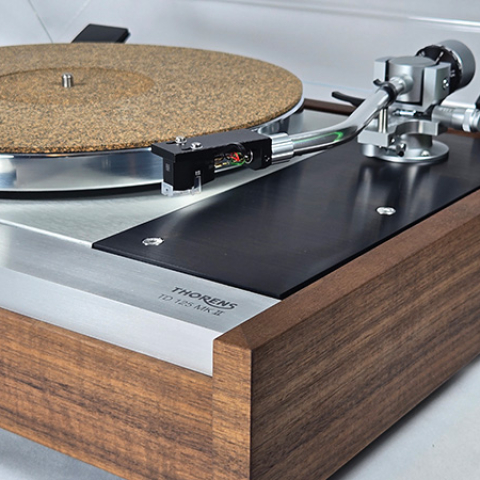
I auditioned the Koetsu Black in a Naim Aro, using that tonearm's standard counterweight. A downforce of just under 2gm produced the best results, with the bias weight at its penultimate setting and the azimuth weight about halfway out on its limb. According to my Dennessen protractor, the combination of Koetsu cartridge and (non-adjustable) Aro produced an overhang setting only about 1mm shy of the ideal Baerwald alignment; I have no doubt that a persevering owner could fiddle with his or her LP12 armboard mounting screws and achieve something very close to perfect alignment.
Neither the DC resistance nor the AC impedance of the Koetsu Black is specified, and I lack the means to measure the coils without also bursting them—a likely result with even the low-level current produced by a typical digital voltmeter. In any event, I had excellent results using the Koetsu Black with a variety of moving-coil step-up transformers, with primary impedances ranging between 40 and 100 ohms.
Performance
Brian Hartsell of the retail shop The Analog Room, who supplied my review sample, assured me that this Koetsu had been run in for about 100 hours, and my visual inspection of the stylus tip confirmed that to a T. Nonetheless, the Black seemed to require an additional day or two to wake up again—before which it had sounded respectable but a bit uninvolving.
Every time I go there I scan the display cases, half-expecting to see a selection of Koetsu cartridges among the chronographs and the fountain pens. Why not? Some Koetsus are crafted from precious materials—and all of them can lay claim to being both high-tech and handmade. More to the point, some hobbyists say that these handmade Japanese pickups are the best you can buy.
At the very least, Koetsus were the very first artisanal phono pickups to make an impression on the American and English hi-fi scenes. As such, and regardless of who came first—a question that probably can't be answered—Koetsu paved the way for all other such things, including the Kiseki, the Kondo, the Miyabi, and the delightfully named Goldbug.
Like all Koetsu cartridges, and notwithstanding a slight chamfer on the foremost part of its underside, the Koetsu Black is built into an oblong block measuring 25/64" by 36/64" by 56/64". (I had my hopes up at first, wondering if those dimensions might have been derived from the ever-popular Golden Ratio, but that proved not to be the case.) The body is made of aluminum, painted black, with integral, unthreaded holes for the mounting bolts. A strip of much thinner aluminum, anodized gold, protects the motor and wiring, and a snug-fitting nylon stylus guard is supplied.
Brian Hartsell of the retail shop The Analog Room, who supplied my review sample, assured me that this Koetsu had been run in for about 100 hours, and my visual inspection of the stylus tip confirmed that to a T. Nonetheless, the Black seemed to require an additional day or two to wake up again—before which it had sounded respectable but a bit uninvolving.