

The Great Record-Club CD Conspiracy?
For a while, I've been hearing rumors that the record-club editions of popular compact discs differ from the original versions produced by the record companies. I've met listeners who claim their club versions are compressed in dynamics, and some have reduced bass. Perhaps the clubs, in their infinite wisdom, think the typical member has a lower-class stereo system (in fact, the opposite may be true). Maybe these lower classes could benefit from some judicious dynamic compression, equalization, and digital remastering.
The Highs & Lows of Double-Blind Testing
Editor's Note: In 1985 and 1986, an argumentative thread ran through Stereophile's pages, discussing the benefits or lack of double-blind testing methods in audio component reviewing, triggered by J. Gordon Holt's review">http://www.stereophile.com//asweseeit/121/">review of the ABX Comparator. As this debate is still raging nearly 15 years later, we present here the entire discussion that bounced back and forth between the magazine's "Letters" section and features articles. It was kicked off by a letter from C.J. Huss that appeared in Vol.8 No.5.—John Atkinson
The Importance of Tells: Installing a Phono Cartridge By Ear
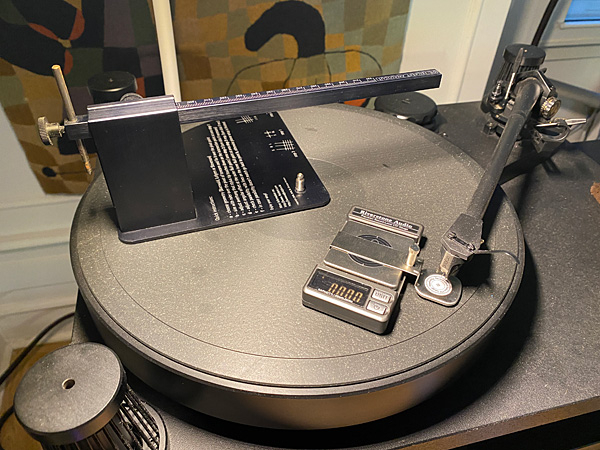
In poker, "tells" are subtle physical or verbal actions that give away the strength of players' hands.
I am not a poker player, but I am an audiophile, and I use a variety of "tells" as my prime tools in critical listening. You know my worn-out line: "You can't hear what you're not listening for."
The Law of Averages

The Compact Disc clearly hasn't read the script. At a time when, in the autumn of its commercial life, the format is supposed to be stepping aside to allow younger blood to succeed it, CD has instead in recent years enjoyed something of a revival in audiophile opinion. While SACD and DVD-Audio, rather strutting and fretting their hour upon the stage, are doing more plain fretting than anything, the best in CD sound quality has improved sufficiently for some to question whether we need the new media at all.
The Listeners' Manifesto
Editor's Note: This article is now only available as an Audio Engineering Society preprint, under the title "The Role of Critical Listening in Evaluating Audio Equipment Quality," preprint number 3176. The price is $4.00 for AES members, and $5.00 for non-members; it can be ordered (currently on paper only, not as a downloadable pdf) by entering the number in the appropriate field on the preprint">http://www.aes.org/publications/preprints/search.html">preprint search page at the AES">http://www.aes.org">AES website.
The Science of Subwoofing
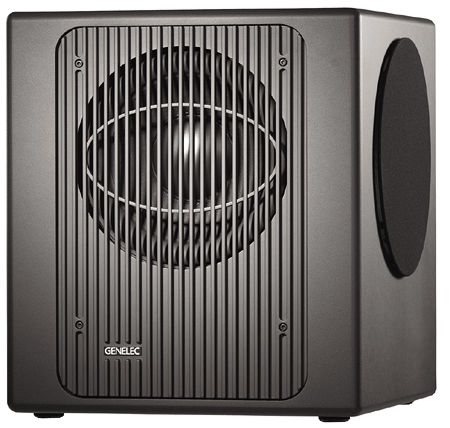
There was a time, as recently as 40 years ago, when frequencies below 100Hz were considered extreme lows, and reproduction below 50Hz was about as common as the unicorn. From our present technological perch, it's too easy to smirk condescendingly at such primitive conditions. But just so you're able to sympathize with the plight of these disadvantaged audiophiles, I should tell you that there were two perfectly good reasons for this parlous state of affairs. First of all, program material at that time was devoid of deep bass; not because it was removed during disc mastering but simply because there wasn't any to begin with. The professional tape recorders of the day featured a frequency response of 50–15kHz, ±2dB—just about on a par with the frequency performance capability of a cheap 1988 cassette tape deck.
The Shun Mook Affair
Editor's note: When Jonathan Scull reviewed the Shun Mook devices back in 1994, he unleashed a hailstorm of controversy that continues to this day. Below is his original report along with some of the follow-up articles and fallout.
The Silverman Concert
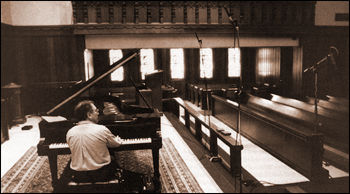
"What's that noise?" Bob Harley and I looked at each other in puzzlement. We thought we'd debugged the heck out of the recording setup, but there, audible in the headphones above the sound of Robert Silverman softly stroking the piano keys in the second Scherzo of Schumann's "Concerto Without Orchestra" sonata, was an intermittent crackling sound. It was almost as if the God of Vinyl was making sure there would be sufficient surface noise on our live recording to endow it with the Official Seal of Audiophile Approval. Bob tiptoed out of the vestry where we'd set up our temporary control room and peeked through a window into the church, where a rapt audience was sitting as appropriately quiet as church mice.
The Sound of Surprise (the loudspeaker/stand interface)
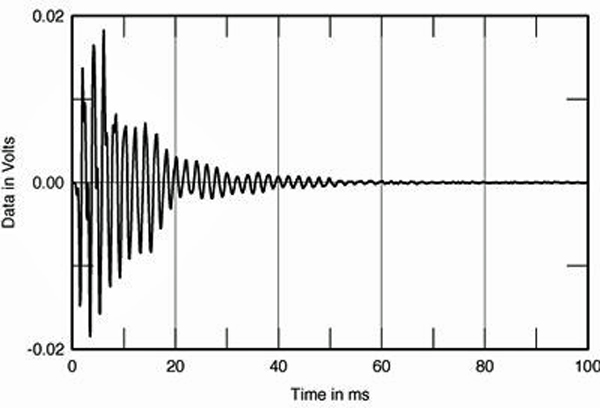
One of the great imponderables in hi-fi is how much the vibrations of a dynamic loudspeaker's cabinet walls contribute to its overall sound quality. Studies by William Stevens in the mid-1970s showed that, with some speakers, the acoustic output of the enclosure could be almost as much as that from the drive-units. Since then, responsible speaker designers have worked hard either to damp cabinet vibrations or to shift them to higher frequencies where their effect on the music will be less deleterious.
The Stereo Image
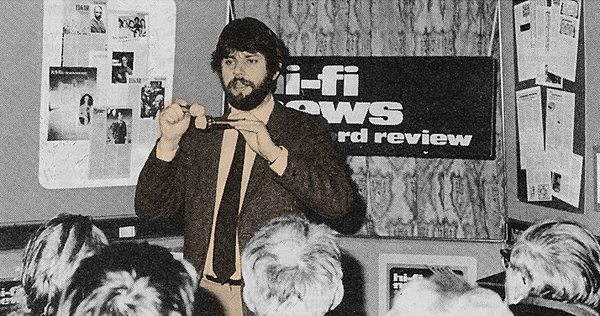
The author demonstrating stereo microphone techniques at an English audio show in 1981.
For most people the terms hi-fi and stereo are synonymous, and yet it is clear that there is still a great deal of confusion over what the word "stereo" actually means. There isn't even a consensus of opinion amongst producers of records, designers of hi-fi equipment, audio critics and music lovers as to the purpose of stereo, and considering that the arguments show no sign of diminishing in intensity, it is instructive to realise that 1981 sees both the 100th anniversary of Clement Ader's first stereo experiments and the 50th anniversary of Alan Blumlein's classic patent on stereo.