

The Thick And The Dead
Alright already, quit shoving. I know I don't belong here. This magazine already has a place for manufacturers---in the back, where those large egos are squeezed into small column inches so they can't hurt you. Not that I'm exactly proud of my job. On social occasions, if pressed as to my profession, I will usually admit to some honest toil such as mortician or hodcarrier. Speaker design is downright devious work. As proof, examine the specifications for the 1376 models in Audio's 1988 equipment directory. Much of this data, when compared with each described system's real-world performance, looks like Joe Isuzu wrote it on a bad day.
The Unseen Variable
Although I still haven't been able to listen to the Cary Audio Design 805 single-ended tube monoblocks that Stereophile praised so highly a year ago (Vol.17 No.1, p.104), I've recently auditioned many other tubed single-ended designs. Undeniably, a good SE design has a distinctive quality of harmony and atmosphere in the midrange that reaches well beyond the average attainment of its solid-state brethren.
There's No Business Like the Hi-Fi Business
You're a typical audiophile. You read this magazine and others like it cover to cover, month after month, keeping up with industry trends and insider gossip. You've ingratiated yourself with every hi-fi dealer in your area, all of whom will let you take equipment home for extended auditions, give you generous trade-in allowances, and sell to you at a small percentage above their cost. Never pay retail, you chuckle to yourself, checking the newspaper's classifieds for audio bargains.
Time Dilation, Part 1
Pick an expletive—one you would normally use to express deep intellectual frustration—but don't vocalize it. Hold it in reserve for a few minutes, letting it simmer to concentrate its intensity. I'll tell you when to let rip.
Time Dilation, Part 2
If you missed Part">http://www.stereophile.com/features/105kh">Part 1 of this article (Stereophile, January 2005), or it has faded in your memory, here's a résumé. (Readers who recall Part 1 with crystalline clarity, please skip to paragraph four.) The accurate measuring of loudspeakers requires that the measurements be taken in a reflection-free environment. Traditionally, this has meant that the speaker be placed atop a tall pole outdoors or in an anechoic chamber. Both of these options are hedged around with unwelcome implications of cost and practicality. To overcome these and allow quasi-anechoic measurements to be performed in normal, reverberant rooms, time-windowed measurement methods were developed that allow the user to analyze only that portion of the speaker's impulse response that arrives at the microphone ahead of the first room reflection. MLSSA from DRA">http://www.mlssa.com">DRA Labs is the best-known measurement system to work on this principle, and both John Atkinson and I use it in the course of preparing our loudspeaker reviews.
Tish, Boom, Awwk! Loudspeakers at the 1985 CES
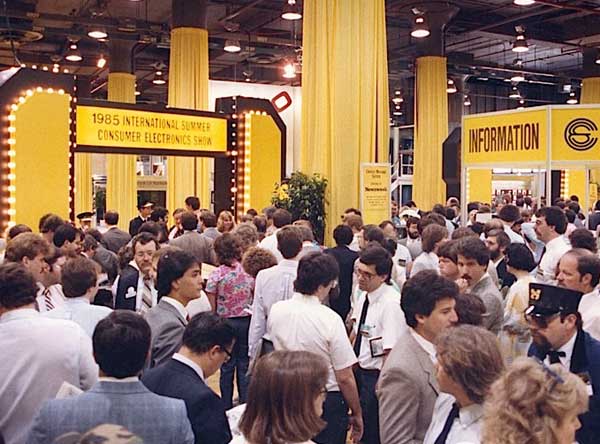
There were no surprises, innovations, or breakthrough designs in loudspeakers at the 1985 Summer Consumer Electronics Show in Chicago. By and large, those on display were nothing more than refinements of, or variations on, previous speaker designs. Of course, there's nothing the matter with that; any improvement in a product is a step in the right direction. It merely perpetuates the pattern of the past ten years: evolution but no revolution.
Truth vs Beauty: A Tale of Two Transports

It is a truism that audiophiles love music. What distinguishes us (footnote 1) from the vast majority of music lovers is the importance we ascribe to the high-quality reproduction of recorded music. But what, exactly, constitutes high-quality sound reproduction? To many audiophiles, the answer relates to accuracy. Useful indices of accuracy include many of the parameters that editor John Atkinson routinely measures: flat frequency response, time and phase accuracy, and low distortion, to name a few. On the other hand, many audiophiles apparently have little interest in these aspects and instead seek nothing more—or less—than a romantic and pleasant sound. Such individuals are unfazed by demonstrable inaccuracies in their systems; as long as it sounds good to their ears, they are happy. Are these two schools of thought both compatible with the notion of high-end audio? If so, is one "more correct" than the other? Are they mutually exclusive? What brought this issue to mind was, of all things, a digital transport. Actually, two transports.
Tubes Do Something Special

Most people who now listen to tube amplifiers began with a transistor amp, and know from experience that a tube amp of a given measured power output sounds louder than its nominally identical transistorized equivalent. The unofficial consensus is that you need two to four times the transistor power to achieve the same loudness as you would using tubes. In other words, given the (subjectively) undistorted sound level a 25W (footnote 1) tube amplifier can provide, if you want the same loudness from solid-state technology you would have to replace it with at least a 50W transistor amp (footnote 2).
Two Days in August: Stereophile's First Jazz Recording
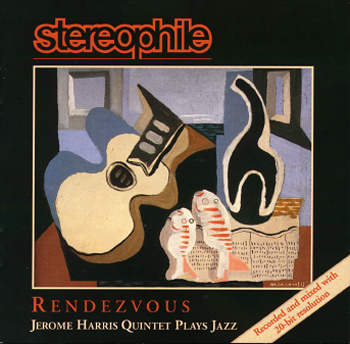
The genesis of this project goes back nearly 17 years, when my wife, Joan, and I moved into a brownstone floorthrough in Brooklyn. As we were about to sign the lease, our soon-to-be landlord said, "Oh, one more thing: your upstairs neighbor is a musician." This did not exactly discourage us from signing the lease, however, and soon I began to see a steady stream of musicians trudging up the stairs outside our apartment: Oliver Lake, Sonny Rollins, Pheeroan akLaff, Bob Moses, Marty Ehrlich, and a whole bunch of other people I was reading about in the jazz press. Just who was this guy?
Upward Mobility: From 2 Channels to Surround

When the brief flowering of quadraphonics began in the early 1970s, I was still at school. As a nascent but impecunious audiophile, I therefore had a ringside seat at the audio industry's first attempt to go multichannel—and, even for the disinterested onlooker, it wasn't a pretty spectacle.