

Listening to MQA
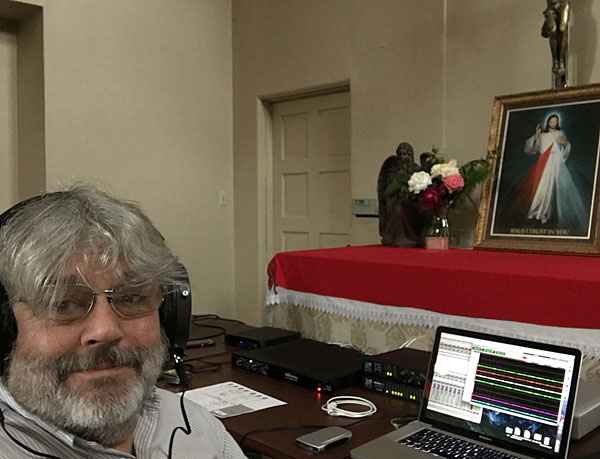
Last June, Jim Austin briefly discussed the operation of MQA in his review of the Meridian Explorer2 USB DAC, but you can find a more detailed explanation on Stereophile's website here and here. MQA involves two fundamental concepts, discussed in a paper presented to the Audio Engineering Society in October 2014. The first is responsible for a large reduction in the bandwidth required to store and stream high-resolution files, the second for a potential improvement in sound quality. . .
Looking Back at the 1980s
A freelance reviewer's workload is erratic. On the odd occasion one might have a few moments' respite, while at other times the coincidence of multiple deadlines for copy results in several weeks of panic. As I write this missive I have just completed one such overload period covering so much equipment that I thought that it would be worthwhile to look back and take stock at the audio in the past decade (footnote 1).
Luke Manley and Bea Lam of VTL: Vital Sound

Our meeting was propitious and totally unexpected. The locus was Los Angeles' Sheraton Gateway Hotel last May, on which we had all descended for Home Entertainment 2006. As a contributor to Stereophile's Show">http://blog.stereophile.com/he2006">Show blog, my assignment was as liberal as they come: Go where you are drawn, listen as you will, and record your impressions.
Measuring Loudspeakers, Part One
This series of articles was initially written (in slightly different form), as a paper presented at the 103rd Audio Engineering Society Convention, New York, September 1997. The preprint, "Loudspeakers: What Measurements Can Tell Us—And What They Can't Tell Us!," AES Preprint 4608, is available from the AES, 60 East 42nd Street, Room 2520, New York, NY 10165-0075. The AES internet site, offers a secure transaction page for credit-card orders.
Measuring Loudspeakers, Part Three
This series of articles is based on a paper presented at the 103rd Audio Engineering Society Convention, New York, September 1997. The preprint, "Loudspeakers: What Measurements Can Tell Us—And What They Can't Tell Us!," AES Preprint 4608, is available from the AES, 60 East 42nd Street, Room 2520, New York, NY 10165-0075. The AES internet site, www.aes.orghttp://www.aes.org">www.aes.org;, offers a secure transaction page for credit-card orders.
Measuring Loudspeakers, Part Two
This series of articles was initially written (in slightly different form), as a paper presented at the 103rd Audio Engineering Society Convention, New York, September 1997. The preprint, "Loudspeakers: What Measurements Can Tell Us—And What They Can't Tell Us!," AES Preprint 4608, is available from the AES, 60 East 42nd Street, Room 2520, New York, NY 10165-0075. The AES internet site, www.aes.orghttp://www.aes.org">www.aes.org; , offers a secure transaction page for credit-card orders.
MP3 vs AAC vs FLAC vs CD

As Wes Phillips recently reported on this website, CD sales are down and legal downloads of audio files are up. Stereophile has been criticized more than once for not paying enough attention to the subjects of MP3 and other compressed file formats, such as AAC, and for offering no guidance at all to readers about how to get the best sound quality from compressed downloads.
MQA Contextualized

When you come to a fork in the road, take it.Yogi Berra
Over one busy week in 1986, Karlheinz Brandenburg laid the foundation of a technology that a few years later would upend the record business. Brandenburg, a PhD student in electrical engineering at the Friedrich-Alexander University Erlangen-Nuremberg, was figuring out how to code digital music efficiently enough that it could be delivered over digital telephone lines. A patent examiner had concluded that what the application proposed was impossible, so over a week of late nights, Brandenburg produced the proof of concept and more. It was another decade before the technologyMPEG-2 level III, more commonly known as MP3would find its true home, the Internet.
MQA Tested Part 2: Into the Fold

Loss is nothing else but change, and change is Nature's delight.Marcus Aurelius
Master Quality Authenticated (MQA), the audio codec from industry veterans Bob Stuart and Peter Craven, rests on two pillars: improved time-domain behavior, which is said to improve sound quality and what MQA Ltd. calls "audio origami," which yields reduced file size (for downloads) and data rate (for streaming). Last month I took a first peek at those time-domain issues, examining the impulse response of MQA's "upsampling renderer," the output side of this analog-to-analog system (footnote 1). This month I take a first look at the second pillar: MQA's approach to data-rate reduction. In particular, I'll consider critics' claims that MQA is a "lossy" codec.
MQA Tested, Part 1

I don't think I've ever seen an audio debate as nasty as the one over Master Quality Authenticated (MQA), the audio-encoding/decoding technology from industry veterans Bob Stuart, formerly of Meridian and now CEO of MQA Ltd., and Peter Craven. Stuart is the company's public face, and that face has been the target of many a mud pie thrown since the technology went public two years ago. Some of MQA's critics are courteousa few are even well-informedbut the nastiness on-line is unprecedented, in my experience.