

Threshold FET 10 preamplifier

This product is a pre-trol. What, you may well ask, is a "pre-trol?" Well, Threshold Corp. calls its FET-10 a preamplifier, but it isn't, really. In fact, it isn't an It at all; it's a Them. Only half of Them is a preamp, and you can buy each half separately. If that sounds a little confusing, maybe it's because some of the old, familiar language of audio is starting to lose its relevance.
Threshold SA-1 monoblock power amplifier
Eleven years ago, Threshold Corporation entered the high-end audio market with the first amplifier ever to use sliding bias (footnote 1) in its output stages. Some 10 years later, Threshold spawned another innovation: their so-called Stasis circuitry, which yielded the S-series amplifiers. The SA-1 and its lower-powered sister SA-2 are the latest from Threshold, and are the first Threshold amps to abandon sliding bias for straight class-A operation. Both use the Stasis circuit.
Tish, Boom, Awwk! Loudspeakers at the 1985 CES

There were no surprises, innovations, or breakthrough designs in loudspeakers at the 1985 Summer Consumer Electronics Show in Chicago. By and large, those on display were nothing more than refinements of, or variations on, previous speaker designs. Of course, there's nothing the matter with that; any improvement in a product is a step in the right direction. It merely perpetuates the pattern of the past ten years: evolution but no revolution.
Too Good to Be True
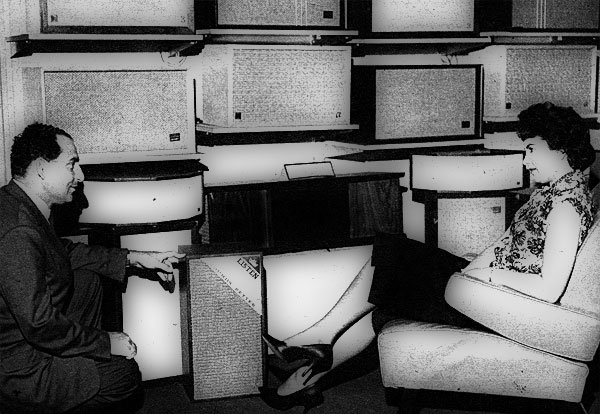
Two letters from readers (see below) started us thinking again about something we've mulled at, off and on, for the past year or so: Does today's high-fidelity equipment, for all its vastly improved performance, actually sound that much better than the best of the early components?
Transcriptors Vestigal tonearm

Because this is an unusual and controversial tonearm design, and has had astonishing claims made for its performance by the manufacturer, this in-depth report goes deeper and is longer than is usual for Stereophile. We will return to a reasonable balance of reportage in the next issue.
The manufacturer's initial advertisement for their mis-named "Vestigal" arm (footnote 1) was so laced with nonsense that we will admit to having been skeptical about the product from the outset.
Transparent, My Dear Watson
Much of the descriptive">http://www.stereophile.com/reference/50">descriptive terminology used in subjective reporting describes things we hear in live music, and expect—or, rather, hope—to hear from reproduced music, too. I'm referring to terms like width, depth, perspective, spectral balance, and tonal accuracy. If you read our reports, you know these terms as well as I do, and since they are (for most people) self-explanatory, I will devote no more time to them.
Tweaking your Record-Player
While the LP-vs-CD debate continues unabated among high-end audiophiles, the rest of the world has already closed the book on the venerable LP. All but a few specialized classical record companies (footnote 1)(and some weird magazines) have ceased releasing new LPs, few record stores sell them any more, and consumers who wouldn't be caught dead owning something that wasn't trendy have long ago dumped their LP collections for cents on the pound.
Two More Channels?
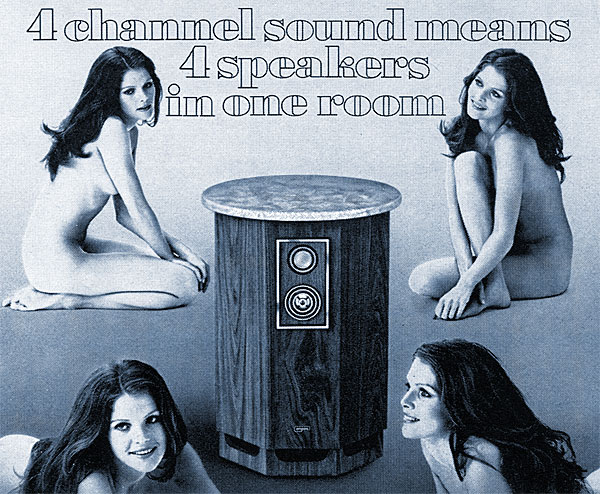
Four-channel stereo is here, but for how long? By the time this gets in print, it is extremely unlikely that any of our readers will have escaped being told that 4-channel stereo is here. "Two channels brought us direction," the announcements trumpet. "Now, four channels bring us dimension." Now, for the first time in the history of hi-fi, modern technology can bring us hall acoustics in stereo, to surround us with the sense of spaciousness that we hear in the concert hall.
Universal Components
A reader who asked to remain anonymous wrote to tell us the results of some tests he saw conducted on one of our top-rated loudspeaker systems. Frequency-response checks showed that the system had virtually no deep bass, a midbass peak, a midrange slump, and a high-end rise. Further checks had shown gross distortion at input levels of over about 6W, and a definitely limited (although adequate for Row-M listening) maximum output-level capability. Said reader then went on to ask how we could possibly consider such a speaker to be one of the best available.
Upward and (Hopefully) Onward

Editor's Note from 1974: As you can read in the following "As We See It," the last issue of Vol.1 No.12 (cover dated "Spring 1966") was perhaps not as "strong" as it might have been. If we had been doing things according to Proper Business Practice, we should have held back our best articles and our gutsiest reports until that issue, as a high-powered incentive for our subscribers to renew their subs. We didn't. There were better articles and a greater variety of topics covered in earlier issues, but Issue 12 was significant in that it set the pattern of topic emphasis, and the balance of reports versus other editorial material, that was to continue more or less unchanged for the next 7 years.