

Benz-Micro MC-20E II & MC Silver phono cartridges

No matter how much I upgrade my digital rig, my trusty $1195 Well-Tempered Record Player blows it away without half trying. . . That's why I corralled a bunch of promising midpriced cartridges and spent a couple of months settin' 'em up, breakin' 'em in, and listenin' to 'em on my favorite records.
Benz-Micro MC20E2-L MC phono cartridge

The ceiling remains, but the floor has changed: Benz-Micro continues to offer a selection of rather expensive phono cartridges, including their well-established LP Ebony ($4700) and Ruby 3 ($3000) models. But in recent years, my attention has been drawn by the succession of budget Benzes: first, the Gliders ($795), then the ACEs ($550), and now the MC20E2-L ($199).
BG Z1 loudspeaker

Last summer, John Atkinson and I were playing a jazz gig poolside at my local club, and during a break we began discussing equipment. As JA adjusted his microphones and I became increasingly nervous about the running, jumping kids splashing chlorinated water on his Nagra">http://www.stereophile.com/hirezplayers/461">Nagra digital recorder, he asked me if I'd like to review the Z1 loudspeaker from BG Corp. "It's an interesting little bookshelf speaker featuring a ribbon tweeter." Hmm—an affordable bookshelf speaker matching a ribbon tweeter to a dynamic woofer? Very interesting. "Sounds good," said I, and resumed my ivory duties.
Black Diamond Racing The Shelf
At the 1994 Summer CES, I was sitting in ProAc's room listening to Vangelis's Blade Runner score, when a couple of guys walked in carrying a shiny black board. "This is pretty interesting stuff," one of them said. "Want to hear it?"
Bluesound PowerNode streaming integrated amplifier

Old-school audiophiles like me cling to our vinyl records and CDs. We spin them on turntables and slide them into transports, which send electric signals through wires to solid state or tubed amplifiersa string of hardware devices. But, despite our object-attached ways, we're quite aware that we are living in a software-enabled, Bluetooth-connected, Wi-Fifacilitated world. Even our Milky Way galaxy is wireless; as that pontificator of everything galactic, scientist Neil DeGrasse Tyson, has proclaimed, "We're all connected."
Boston Acoustics A 25 loudspeaker
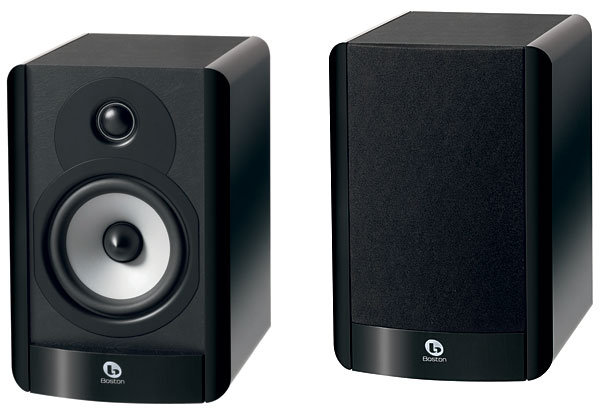
While listening to Boston Acoustics' A 25 loudspeaker ($299.98/pair), I kept thinking about magic.
Paul Messenger introduced Boston Acoustics' A Series in the April 2011 "Industry Update." With the creation of the A Series, Paul reported, BA wanted to create a "global loudspeaker," one that would be appreciated by music lovers worldwide.
Boston Acoustics A40 loudspeaker
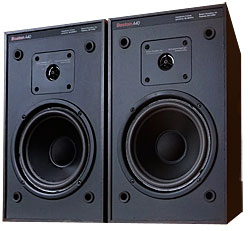 The Boston Acoustics A40 loudspeaker ($150/pair) has become "legendary" (ie, it's stayed around for a while), probably because a pair of them images as well as Rogers LS3/5As. Unfortunately, it is no match for the LS3/5A in terms of smooth midrange response. Of course, at $150/pair, it shouldn't be.
I was originally going to do a review comparing the Spectrum 108A ($200/pair) and the Boston Acoustics A40. On first listen, I was mightily impressed by the A40. But after Stereophile's Larry Archibald schlepped me out a pair of the 108As, I didn't much want to listen to the A40s.
The Boston Acoustics A40 loudspeaker ($150/pair) has become "legendary" (ie, it's stayed around for a while), probably because a pair of them images as well as Rogers LS3/5As. Unfortunately, it is no match for the LS3/5A in terms of smooth midrange response. Of course, at $150/pair, it shouldn't be.
I was originally going to do a review comparing the Spectrum 108A ($200/pair) and the Boston Acoustics A40. On first listen, I was mightily impressed by the A40. But after Stereophile's Larry Archibald schlepped me out a pair of the 108As, I didn't much want to listen to the A40s.California Audio Labs Sigma D/A processor

Though their first CD player featured a vacuum-tube output stage, California Audio Labs is recently known for making good-sounding, moderately priced solid-state CD players, like the Icon Mk.II that Jack English reviewed in July 1992 (Vol.15 No.7). The Sigma, a $695 tubed D/A converter, furthers their reputation in both areas.
Cambridge Audio Azur DacMagic D/A converter

In 1989, Cambridge Audio, then run by Stan Curtiswho is still active in hi-fi introduced their DAC 1. At about the same time, within a few weeks of each other, Arcam introduced their Delta Black Box and Musical Fidelity their Digilog. I forget who was first among the three. Arcam, I think. But the DAC race was on, led by the British. (There was even a DAC called the Dacula.) US companies got into the DAC race, tooat higher prices, of course.
Cambridge Audio MXN10 streamer–D/A processor

For music listening circa 2024, streaming is both the present and the future. Physical formats are still around, and they are still the best choice in some cases, as with deluxe reissues of beloved albums, which may add value with extra live performances, full-resolution surround sound, and other perks. The niche vinyl market continues to thrive, and that business model obviously works for releases of a few thousand copies. (It also works, apparently, for releases of hundreds of thousands of T-Swift platters to be displayed on shelves and hung on walls.)
But facts is facts: Streaming is now the only mass medium for listening to recorded musicthe primary carrier for musicand has been for a few years now. According to RIAA statistics, the crossover year was 2016. That's when, in revenue terms, streaming outpaced physical formats. By 2022, the latest full year tabulated, streaming accounted for 84% of US recorded-music revenue.
So what's a long-time audiophile, born into the analog world, with strong roots in physical media, supposed to do?