

Brilliant Corners #19: Music Among the Fairchildren
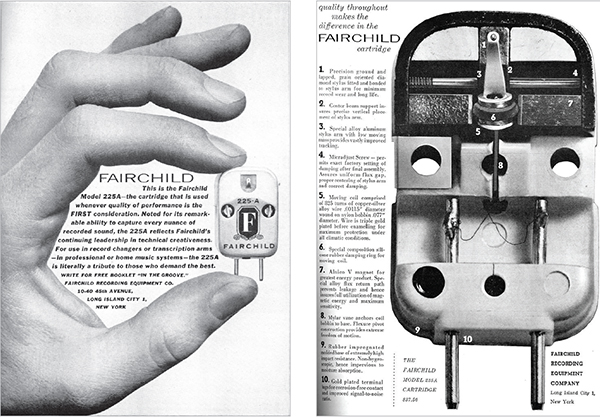
Pull down the shades, find a comfortable seat, and come with me on an imaginary journey to the year 1956. The Eisenhower-Nixon ticket wins reelection, the United Methodist Church begins to ordain women, and a can of Campbell's tomato soup costs 10 cents. Elvis Presley's two-week residency at Las Vegas's New Frontier Hotel and Casino is received so poorly by the middle-aged guests that Newsweek likens it to "a jug of corn liquor at a champagne party." And a Seattle couple gives birth to Kenneth Bruce Gorelick, who will become known professionally as Kenny G.
The hobby that will become "high-end audio" is still called plain old "audio." The top marginal tax rate is 91%, the US boasts more income equality than present-day socialist Sweden, and most of the country's top earners are not panic-room wealthy but merely rich. The prices of hi-fi gear reflect this: Two of the finest power amplifiers you can buythe McIntosh MC-60 and the Marantz Model 2 (both monophonic, of course)retail for $198. That's about $2266 in today's dollars, and while certainly not cheap, these products are accessible to a far larger group of hi-fi enthusiasts than "the best" of today (including from McIntosh itself).
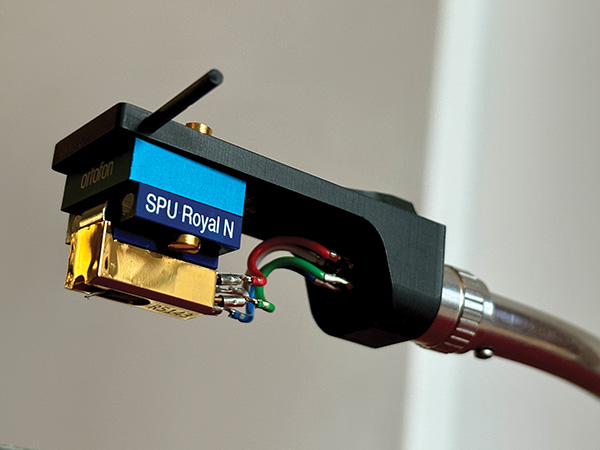
Brilliant Corners #27: Ortofon SPU Royal N phono cartridge (and Patsy Cline)
Back in the '90s, when I was young and marginally employed, one of the things I looked forward to most was going downstairs to my mailbox and finding a copy of Audiomart. The booklet arrived every two weeks, sometimes monthly, and was filled with classified ads for audio gear typeset in tiny, difficult-to-read print. In those pre-internet days, you needed a reference from a subscriber to sign up for Audiomart, which fostered a sense of community and safety, and if you wanted to respond to an ad, you had to call someone. Mostly I just enjoyed perusing the ads, but the prices for some of the vintage gear, particularly the less legendary stuff, were low enough that from time to time I could afford them.
Brilliant Corners #38: Listening to the Aidas Violet Phono Cartridge
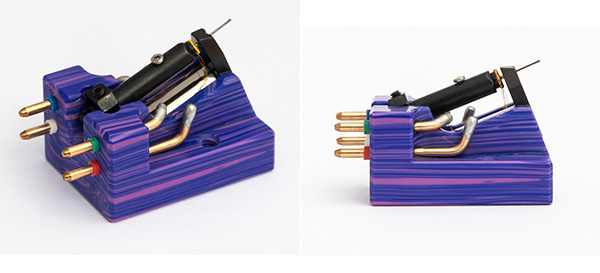
Aidas Svazas is an artisan residing in Lithuania's second largest city, Kaunas. Svazas started out as a cartridge repairman, and our first encounter took place when, on a friend's recommendation, I sent him a Fairchild 225-A, a mono cartridge from the 1950s, to be restored.
Brilliant Corners #39: Koetsu Reborn

I find myself appreciating more and more the way perfectionist audio—a peculiar mix of art, craft, and engineering—tends to attract idealists. Temperamentally, hi-fi people tend to be unlike people involved in the manufacture of ring-joint gaskets or digital kitchen timers—activities that, without a doubt, have their own scales of excellence.
Brilliant Corners #5: High Water Sound; TW-Acustic Raven GT2 turntable; Dynavector Te Kaitora Rua & Miyajima Shilabe phono cartridges

"New York is an ugly city, a dirty city," John Steinbeck wrote in 1953. "But there is one thing about itonce you have lived in New York and it has become your home, no place else is good enough." Decades later, the novelist's insight about this appalling, incomparable city still feels true. New Yorkers love to complain about the summers, with their wafting miasma of hot garbage and urine; about the superannuated subway system, which only sometimes resembles a psilocybin trip gone really wrong; about the purgatorial agony of finding an apartment; about the affronts of existing shoulder-to-shoulder with the stupendously rich. . .
What I'm getting around to saying is that easily the best part of living here is the people. One of them is Jeffrey Catalano, who has been a drummer, painter, DJ, and construction worker and today runs a hi-fi business, High Water Sound, from a loft in a former sail-making factory on Water Street in Manhattan's financial district.
Brinkmann EMT Titanium phono cartridge

There are a thousand different ways to make a loudspeaker. A hundred to make an amplifier. And at least a million to make a piece of wire. But here's the deal with a moving-coil phono cartridge: stylus, cantilever, rubber grommet, tensioning wire, coils, magnet, output pins, and maybe a body. Done.
Brinkmann Pi phono cartridge
 The Brinkmann Pi cartridge's Benz-Micro heritage was obvious from the get-go. The motor is built to Brinkmann's specifications by Benz-Micro and includes a Micro-Ridge stylus. The cantilever material is not specified. The Pi's output is approximately 0.25mV, and its compliance is moderate at 15µm/mN. Recommended are a tracking force of 1.82gm, a VTA of 23°, and a resistive load of 600 ohms.
Helmut Brinkmann says he tweaked the Pi's design for a year and a half before he achieved the results he desired, including making the tiny set screws out of various materials. The Pi, with a body of machined aluminum designed to control the dissipation of resonant energy, weighs a hefty 14gm. Brinkmann supplies aluminum screws and titanium washers, which, he claims, in combination with special damping between the cartridge body and headshell, have been "sonically tuned to create a unique musical instrument."
The Brinkmann Pi cartridge's Benz-Micro heritage was obvious from the get-go. The motor is built to Brinkmann's specifications by Benz-Micro and includes a Micro-Ridge stylus. The cantilever material is not specified. The Pi's output is approximately 0.25mV, and its compliance is moderate at 15µm/mN. Recommended are a tracking force of 1.82gm, a VTA of 23°, and a resistive load of 600 ohms.
Helmut Brinkmann says he tweaked the Pi's design for a year and a half before he achieved the results he desired, including making the tiny set screws out of various materials. The Pi, with a body of machined aluminum designed to control the dissipation of resonant energy, weighs a hefty 14gm. Brinkmann supplies aluminum screws and titanium washers, which, he claims, in combination with special damping between the cartridge body and headshell, have been "sonically tuned to create a unique musical instrument."
Clearaudio Virtuoso Wood MM phono cartridge

There is no better time than now to invest in audiophile-quality vinyl playback gear. I'll bet even Mikey Fremer would be surprised at the amount of new vinyl releases and reissues and used vinyl available to music-lovers today. And the choices available to audiophiles seeking turntables, tonearms, phono cartridges, and phono preamps is greater than it's been in a decade.
Decca Mark V phono cartridge
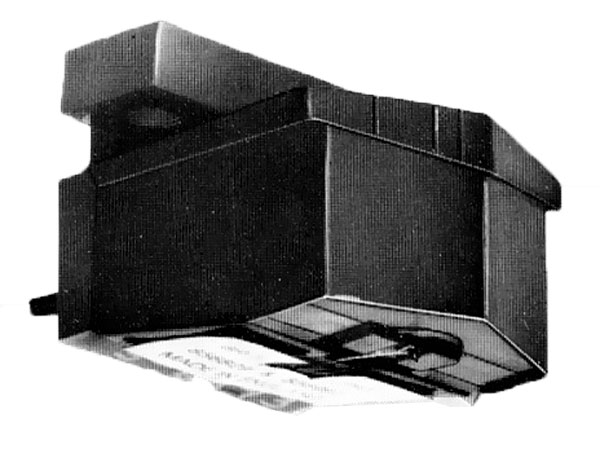
The Decca Mark V is the latest version of that English firm's unique "tip-sensing" stereo-matrix-ing pickups. The "matrixing" apellation refers to the fact that the Decca pickups do not use 45°45° sensing coils, but use instead a combination of vertical and lateral-sensing coils. There is a single coil for lateral sensing, with its pole pieces brought down next to the tip. This is the tip-sensing feature, whose major attribute is that the stylus motions don't have to be conveyed along the length of an armature before reaching the transducing pole pieces. Thus there is virtually no possibility of the stylus vibrations being modified through flexing of the armature prior to their transduction into audio signals.
Denon DL-103 phono cartridge

This low-output moving-coil cartridge can be fitted with different styli. The basic DL-103 has a 0.5-mil spherical tip, the DL-103S a Shibata tip. As of the spring of 1975, the '103S is being imported by American Audioport, Inc., in Columbia, MO. the '103 is being brought in directly from Japan by a few dealers. Our '103 was loaned by Music & Sound of California, the '103S came from Audioport.
They are not too similar in sound. The DL-103S is incredibly clean-tracking, with a light, airy high end, a subtle zizz on string tone, and a very slightly withdrawn quality similar to the sound of the Supex 900E, but not as overly rich-sounding as the Supex.