Reference

Sort By: Post DateTitle Publish Date

Room Tuning: ASC Tube Traps & the MATT Test

One of the challenges I faced in optimizing the performance of the Thiel">http://www.stereophile.com//loudspeakerreviews/216/">Thiel CS7.2 loudspeakers that I reviewed in February 2000 was controlling and tuning their interaction with my listening room. Intuition, experience, trial and error—all came into play, as did several of the procedures and calculations covered by Jonathan Scull in his "Fine Tunes" column.


Measuring Loudspeakers, Part Three

This series of articles is based on a paper presented at the 103rd Audio Engineering Society Convention, New York, September 1997. The preprint, "Loudspeakers: What Measurements Can Tell Us—And What They Can't Tell Us!," AES Preprint 4608, is available from the AES, 60 East 42nd Street, Room 2520, New York, NY 10165-0075. The AES internet site, www.aes.orghttp://www.aes.org">www.aes.org;, offers a secure transaction page for credit-card orders.


Measuring Loudspeakers, Part Two

This series of articles was initially written (in slightly different form), as a paper presented at the 103rd Audio Engineering Society Convention, New York, September 1997. The preprint, "Loudspeakers: What Measurements Can Tell Us—And What They Can't Tell Us!," AES Preprint 4608, is available from the AES, 60 East 42nd Street, Room 2520, New York, NY 10165-0075. The AES internet site, www.aes.orghttp://www.aes.org">www.aes.org; , offers a secure transaction page for credit-card orders.


Measuring Loudspeakers, Part One

This series of articles was initially written (in slightly different form), as a paper presented at the 103rd Audio Engineering Society Convention, New York, September 1997. The preprint, "Loudspeakers: What Measurements Can Tell Us—And What They Can't Tell Us!," AES Preprint 4608, is available from the AES, 60 East 42nd Street, Room 2520, New York, NY 10165-0075. The AES internet site, offers a secure transaction page for credit-card orders.

ETF, or How I Learned to Love My Equalizer

Because I'm suspicious of just twiddling knobs to make the sound "nice," I didn't rely solely on my ears when I used the Z-Systems rdp-1 that I review elsewhere in this issue for speaker and room contouring. Instead, I used the ETF speaker/room-analysis software from Acoustisofthttp://www.acoustisoft.com">Acoustisoft; to help me manipulate the equalizer properly. This program can measure the first-arrival, on-axis speaker response, as well as the room response with its early and late reflections and its resonances.


A Future Without Feedback?

Over the years as a reviewer, I have tracked the swings of opinion and popularity of various audio ideas and technologies. Amid a sea of advanced designs that achieve powerful technical performance and laudable specifications, I'm reminded of a major blind listening test of 18 power amplifiers that I set up for the long-since-defunct UK magazine Hi-Fi for Pleasure back in 1975. We had "advanced technology" then: the transistor amplifier had matured and was well accepted by audiophiles. Prices of the review samples ranged from $300 to $3000 (equivalent to $1000-$10,000 in today's dollars). The auditioning sessions were graced by the presence of many industry leaders, among them the late Spencer Hughes of Spendor, Julian Vereker of Naim, Philip Swift then of Audiolab, Alan Harris then of retailer Audio T., Bob Stuart of Meridian, and John Wright of IMF (now TDL in the UK).


Bits is Bits?

High-quality digital audio systems require that all digital interfaces in the signal path exhibit signal transparency. The widely adopted AES/EBU and S/PDIF interfaces have been criticized for a lack of signal transparency; here we (footnote 1) address possible problems with such interfaces and present methods for improving the interface standard.


What a Difference a Wire Makes

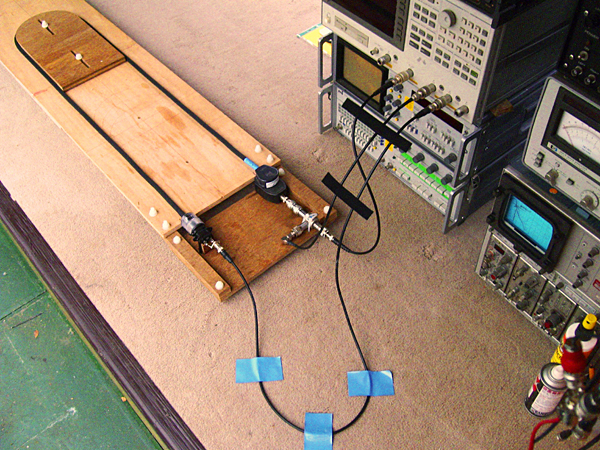
Testing the RF transmission of Kimber Kable, up to 3GHz, at Ben Duncan Research Labs, in 2008. The resulting proof of RF rejection was published on-line by Russ Andrews Accessories in England. (Photo: Naomi Swain).


Editor's Preface: In an article in the October 1995 issue of Stereophile, Professor Malcolm Omar Hawksford used Maxwell's Equations to develop a mathematical model describing the behavior of cables at audio frequencies. Among the predictions of this model were that for good conductors there exists an optimum size of wire for audio signal transmission, and that for a wire larger than this size an energy storage mechanism would exist. In his article Malcolm described a simple experiment, the results of which appeared to confirm his hypothesis.


Then serendipity struck. English engineer Ben Duncan, whose writings have occasionally appeared in Stereophile, sent me an article he had written for the pro-audio magazine Studio Sound. The results of a series of cable measurements he had performed seemed to confirm the Hawksford Hypothesis. We offer them here for your delight and delectation.—John Atkinson

Bad Vibes!

A thorough exploration in a magazine article of such a pervasive and complex topic as vibration control in audio systems is next to impossible; vibration and sound are so intimately bonded that it would be very easy to extend this discussion to just about any area of interest in audio. My intention here is simply to lay a foundation for understanding the basic mechanical forces affecting our quest for improved sonic fidelity, and in the process provide the tools for anyone to achieve good, practical vibration control in his or her system.


Advertisement
Advertisement
Advertisement