Reference

Sort By: Post DateTitle Publish Date

The Essex Echo 1995: Electrical Signal Propagation & Cable Theory

Editor's Note: The matter of whether—and if so, how—speaker cables and interconnects can affect the sound of an audio system has vexed the audiophile community since Jean Hiraga, Robert Fulton, and others first made us aware of the subject in the mid-1970s. Most of the arguments since then have involved a great deal of heat but not much light. Back in August 1985, Professor Malcolm Omar Hawksford Ph.D (of the UK's University of Essex and a Fellow of the Audio Engineering Society) wrote an article for the British magazine Hi-Fi News & Record Review, of which I was then Editor, in which he examined AC signal transmission from first principles. Among his conclusions was the indication that there is an optimal conductor diameter for audio-signal transmission, something that I imagined might lead to something of a conciliation between the two sides in the debate. Or at least when a skeptic proclaimed that "The Laws of Physics" don't allow for cables to affect audio performance, it could be gently pointed out to him or her that "The Laws of Physics" predict exactly the opposite.

Real-Life Measurements

As mentioned by two readers in this month's "Letters," amplifiers are used to drive loudspeakers but are almost exclusively measured into resistive loads. The reasons for this are twofold: 1) real loudspeakers both produce neighbor-annoying sound levels and tend to break when driven with typical amplifier test signals; and 2) the question as to which "standard" loudspeaker should be used is impossible to answer---at least the conventional resistive loads are consistent and repeatable.


The Uncertainty Principle

Have you ever suspected that the component you bought after diligent research is somehow not "typical"? That its sound seems to bear little resemblance to the descriptions in the reviews you read? Sure, you listened to the unit before purchase, but the one you took out of the box at home—was that the same unit? And if you suspect your new unit's sonic quality is below par, just how do you or your dealer go about proving it?

Tweaks'n'Squeaks

If you read Stereophile regularly, you already know that all audio equipment does not sound the same. But did you know that a given piece of gear can sound better or worse depending upon how it's set up and used? With a few simple tweaks, you can bring out the best in your audio system.


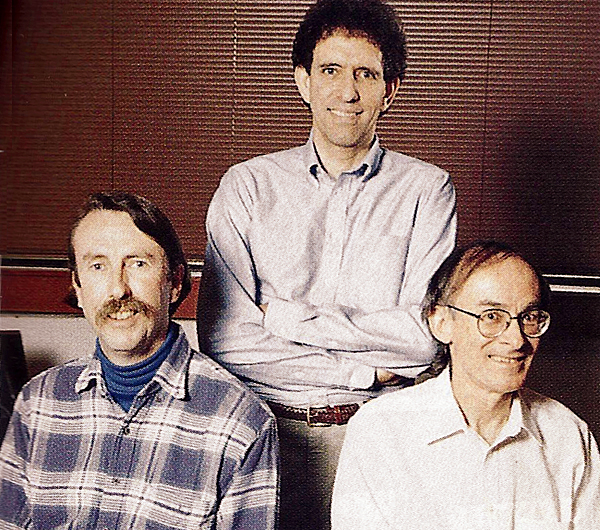
HDCD: Keith Johnson, Pflash Pflaumer, Michael Ritter


The men behind HDCD (L–R: Pflash Pflaumer, Michael Ritter, Keith Johnson


High Definition Compatible Digital® (HDCD®), the proprietary process for improving the sound of 16-bit digital audio, has finally arrived. More than a dozen digital processors using the technology are on the market, and the professional encoder used to master HDCD discs is following closely behind.

The Unseen Variable

Although I still haven't been able to listen to the Cary Audio Design 805 single-ended tube monoblocks that Stereophile praised so highly a year ago (Vol.17 No.1, p.104), I've recently auditioned many other tubed single-ended designs. Undeniably, a good SE design has a distinctive quality of harmony and atmosphere in the midrange that reaches well beyond the average attainment of its solid-state brethren.


DTS & Data Compression

In the October 1994 Stereophile (Vol.17 No.10, p.39), I discussed my experiences with the DTS audio data-reduction code/decode switch box, which, briefly, is a two-channel box that makes use of the algorithm DTS has proposed for their version of discrete multichannel sound for laserdiscs.


Stereophile Test CD 3

Back in the spring of 1990, Stereophile introduced its first Test">http://www.stereophile.com//reference/176/">Test CD, featuring a mixture of test signals and musical tracks recorded by the magazine's editors and writers. Even as we were working on that first disc, however, we had plans to produce a second disc which would expand on the usefulness of the first and feature a more varied selection of music. The result was our Test">http://www.stereophile.com//features/338/">Test CD 2, released in May 1992.


Advertisement
Advertisement
Advertisement