Features

Sort By: Post DateTitle Publish Date

Cutting Up: Stereophile's Liszt Piano Sonata LP

There has been much argument in audiophile circles about whether an LP or a CD is a more faithful representation of a master tape. Although we recorded Robert Silverman's thrilling performance of the Liszt B-Minor Piano Sonata for CD">http://www.stereophile.com//features/131/">CD release, we also had in mind to issue an LP. As the source for both would be the same, the question we can answer is: Will an LP cut straight from a 20-bit master tape via a Class A 20-bit DAC sound closer than a CD noise-shaped to 16 bits from the same 20-bit original?


Serenade: the 1996 Santa Fe Chamber Music Festival CD

A musical highlight for us at Stereophile in 1995 was the opportunity to record several concerts at the world-famous Santa Fe Chamber Music Festival. The result was a Stereophile CD, Festivalhttps://secure.stereophile.com/stereophile/recordings.shtml">Festiva…; (STPH007-2), which features the original chamber version of Aaron Copland's Appalachian Spring, Darius Milhaud's jazz-inspired La création du monde, and the premiere recording of the 1995 Festival commission, Tomiko Kohjiba's The Transmigration of the Soul (see Stereophile, January 1996, Vol.19 No.1, p.132). We were pleased, therefore, to be asked back by the Festival in 1996. Once again we have produced a CD of live recordings, Serenade (STPH009-2), which features chamber works by Mozart, Brahms, and Dvorák.


Illusions, Riddles, & Toys

Remember the old mathematical riddle about moving a football from a hundred yards out to the goal line? Known as Xeno's Paradox, it goes like this: if each time the ball is moved it travels half the distance to the goal, how many moves will it take to get there? The answer: an infinite number, because no matter how many times you cut the distance to the goal by half, you'll always be some infinitesimal distance away from it.


Fate, I Defy You: The Robert Silverman Liszt CD

"Rarely, if ever, can this densely written sonata have been presented so lucidly with each note precisely in place...the dramatic and lyrical aspects were never slighted or taken for granted."
—Peter G. Davis, writing in the New York Times about Robert Silverman's New York debut in 1978, when he performed the Liszt B-Minor Piano Sonata in Alice Tully Hall.


Bits is Bits?

High-quality digital audio systems require that all digital interfaces in the signal path exhibit signal transparency. The widely adopted AES/EBU and S/PDIF interfaces have been criticized for a lack of signal transparency; here we (footnote 1) address possible problems with such interfaces and present methods for improving the interface standard.


Festival! The Best of the 1995 Santa Fe Chamber Music Festival

The inspiration for this project came from Stereophile's Gretchen Grogan and Erich Vollmer of the Santa Fe Chamber Music Festival. Music Festivals are perhaps the healthiest aspect of classical music making, allowing ad hoc ensembles to chart the farthest reaches of the repertoire, as well as retracing the familiar ground of the great works. Why not, they thought, capture a representative selection of works performed at the 1995 Santa Fe Chamber Music Festival? This would not only document some of the great performances to be heard, but also allow music lovers everywhere to participate in what has increasingly been recognized as one of the US's best summer music festivals.


There's No Business Like the Hi-Fi Business

You're a typical audiophile. You read this magazine and others like it cover to cover, month after month, keeping up with industry trends and insider gossip. You've ingratiated yourself with every hi-fi dealer in your area, all of whom will let you take equipment home for extended auditions, give you generous trade-in allowances, and sell to you at a small percentage above their cost. Never pay retail, you chuckle to yourself, checking the newspaper's classifieds for audio bargains.


Vandersteen Cinema loudspeaker system (SGHT Review)

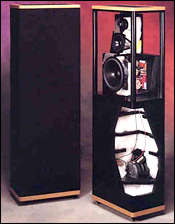
The Vandersteen 3A is a higher-end variation on the theme established by the company's first loudspeaker, the 2C. The latter is still available, though much updated into the current, highly popular 2Ce. A four-way design, the 3A has separate sub-enclosures for each drive unit; the whole affair is covered with a knit grille-cloth "sock" with wood trim end pieces. A rear-mounted metal brace allows the user to vary the tiltback—an important consideration for best performance with this loudspeaker.


Advertisement
Advertisement
Advertisement