Features

Sort By: Post DateTitle Publish Date

Space...the Final Frontier

High-end audiophiles are space freaks---we relish the warmth and spaciousness of a fine, old performing hall almost as much as we do the music recorded in it. But my attendance at a series of orchestral concerts held last summer brought home to me---as never before---the sad fact that our search for the ultimate soundstage is doomed to failure: we're trying to reproduce three-dimensional space from a two-dimensional system, and it simply can't be done.

Lighting Strikes: a Bolt From the Blue

One evening late last summer I took the most expensive workout of my life. In my hurry to meet a friend at the gym, I left the house, leaving my computer and hi-fi on despite the ominous look of the sky. In the South, experience teaches you to dash about disconnecting everything at the first sign of a thunderstorm. Usually I do, but this time my mind was elsewhere.

R.I.P High-End Audio?

Slowly, painfully, high-end audio seems to be dying. We all know it but we're apparently unable to resuscitate the patient. US dealers are closing at alarming rates—it must be the economy. Women continue to avoid the High End—it must be the technobabble combined with male equipment fetishism. Younger people aren't hopping aboard—it must be all those other things competing for their money. (Then again, it might be the High End's abhorrence of rock'n'roll.)

A Transport of Delight: CD Transport Jitter

Not that long ago, digital audio was considered perfect if all the bits could be stored and retrieved without data errors. If the data coming off the disc were the same as what went on the disc, how could there be a sound-quality difference with the same digital/analog converter? This "bits is bits" mentality scoffs at sonic differences between CD transports, digital interfaces, and CD tweaks. Because none of these products or devices affects the pattern of ones and zeros recovered from the disc, any differences must be purely in the listener's imagination. After all, they argued, a copy of a computer program runs just as well as the original.


How To Write Manufacturers' Comments

"Equipment Reports," "Record Reviews," "Letters," "Industry Update," "Sam's Space," "As We See It," "The Final Word"---I read and enjoy them all. But the section of Stereophile I especially look forward to reading is "Manufacturers' Comments." How is the manufacturer going to respond to a review that's considerably less than 100% positive? Can they take criticism gracefully, or do they have an attitude? If I were a consumer considering purchase of one of their products, would their comments convince me that they'd be a good company to deal with? Are they uptight beyond reason, or do they have a sense of humor? Can they respond to a positive review without gloating?

A Question of Bits

Someday we may speak wistfully to our grandchildren about the "golden age" of digital audio when consumer formats (CD and DAT) contained a bitstream that was an exact bit-for-bit duplicate of the original studio master recording—not a digitally compressed, filtered, copy-resistant version whose sound is "close enough" to the original. Digitally compressed formats such as DCC and MiniDisc represent, in effect, a return to the pre-CD era when consumer-release formats were always understood to be imperfect copies of the studio original. Even the most ardent audiophile accepted the fact that LPs and mass-produced tapes did not, and could not, sound as good as the master tapes they were derived from.


The Sound of Surprise (the loudspeaker/stand interface)

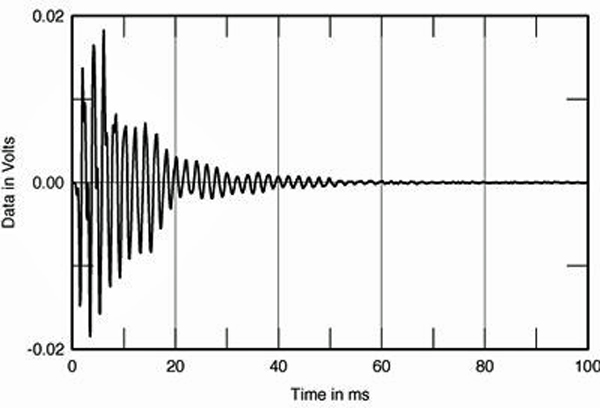
One of the great imponderables in hi-fi is how much the vibrations of a dynamic loudspeaker's cabinet walls contribute to its overall sound quality. Studies by William Stevens in the mid-1970s showed that, with some speakers, the acoustic output of the enclosure could be almost as much as that from the drive-units. Since then, responsible speaker designers have worked hard either to damp cabinet vibrations or to shift them to higher frequencies where their effect on the music will be less deleterious.

Stereophile's Test CD 2

Back in the Spring of 1990, Stereophile introduced its first">http://www.stereophile.com//reference/176/">first Test CD. Featuring a mixture of test signals and musical tracks recorded by the magazine's editors and writers, it sold in large numbers—around 50,000 had been produced at last count. Even as we were working on that first disc, however, we had plans to produce a second disc that would expand on the usefulness of the first and feature a more varied selection of music. The result is our Test CD 2, introduced this month for just $7.95">http://ssl.blueearth.net/primedia/home.php">$7.95 plus postage and handling. With a playing time of over 74 minutes, the new disc should prove an invaluable tool to help audiophiles optimally set up their systems and rooms by ear—and the music's pretty good, too!—John Atkinson


Harmonic Convergence: the Effect of Component Tweaking

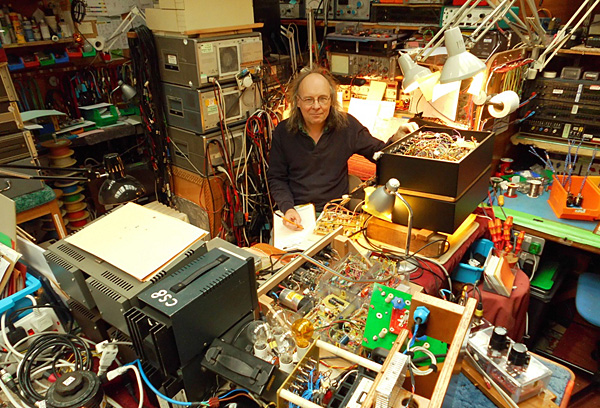
Power amplifiers fascinate me. In the past 15 years I've helped design and build over a dozen advanced models, with output powers ranging from 50 to 2500W, for a number of the UK's professional equipment manufacturers. To learn from others' ideas and mistakes, I've also repaired, measured, used, and reviewed hundreds of makes of amplifier. My experiences have led me to regard the power amplifier as one of the messiest, most imperfect pieces of electronic equipment in the record/replay path.
Advertisement
Advertisement
Advertisement