J. Gordon Holt

Sort By: Post DateTitle Publish Date

Two More Channels?

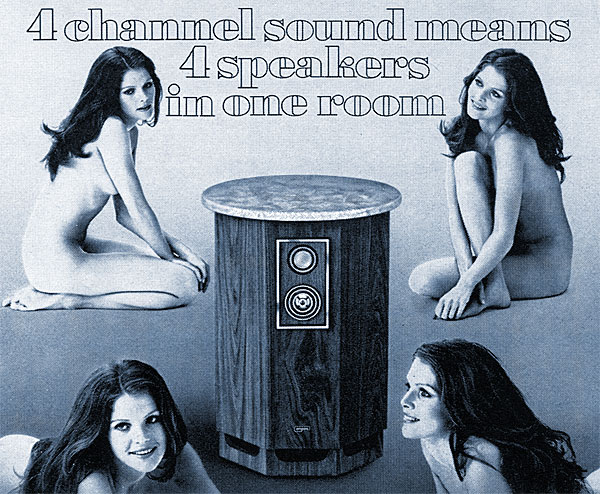
Four-channel stereo is here, but for how long? By the time this gets in print, it is extremely unlikely that any of our readers will have escaped being told that 4-channel stereo is here. "Two channels brought us direction," the announcements trumpet. "Now, four channels bring us dimension." Now, for the first time in the history of hi-fi, modern technology can bring us hall acoustics in stereo, to surround us with the sense of spaciousness that we hear in the concert hall.

Dynaco A-25 loudspeaker

Everyone knows that a lot of serious music listeners—that is, those who listen to music instead of using it as a conversational background—have neither the space nor the money for a pair of typical floor-standing speakers, and must make do with bookshelf-type systems that are actually small enough to put in a bookshelf. But while the typical audio perfectionist will freely admit that there is a place in the audio sun for these dinky little speakers, he cannot really take them seriously, particularly when they're priced significantly under $100 each.

Dynaco PAT-4 preamplifier

This review of one of the first solid-state preamplifiers was published in 1968. It includes some of JGH's first thoughts on the ongoing subject of "Accuracy vs. Musicality."


Preview, from July 1968 (Vol.2 No.6): Overall sound extremely good, but phono sounds slightly lacking in deep bass, despite impeccable measurements. Scratch filter judged very highly effective, but tone controls felt to be less than ideal be cause of excessively coarse action and marked tendency to affect midrange output. Spring-return Tape Monitor switch probably will not appeal to serious tapesters. This preamp is slated for a full report in the next issue.

Prognostications for 1969

Editor's Note: 40 years before it became a reality, J. Gordon Holt predicts music streaming and predicts the Compact Cassette will become the dominant prerecorded music medium.


Traditionally, the New Year is the time when editors light their pipes, tilt their chairs back, fold their hands and shut their eyes, and make bold predictions about The Future. It is said that prognostications are always risky, because events have a nasty habit of making fools of those who prognosticate. It has been our observation, though, that the only prognosticators who are remembered are those who were proven right, so we are going to do some fearless limb-climbing about something that is coming to worry increasing numbers of stereophiles: Namely, which of all the current recording media is going to become The Standard for home use, and which are going to be left stranded on the shoals of obsolescence?

SAE Mark II Power Amplifier

It takes a lot of courage for a new company to launch an amplifier like this at time when most manufacturers are courting the mass market with budget-priced receivers, and Marantz is pretty firmly established as the Rolls Royce of audio electronics.


The SAE Mark II has, nominally, the same performance specs as the Dynaco Stereo 120, yet it costs twice as much as a factory-wired Stereo 120, and about 2½ times as much as a Stereo 120 kit. Is the SAE really worth the difference? And how does it compare with some other $400 amplifiers? Well, it all depends.

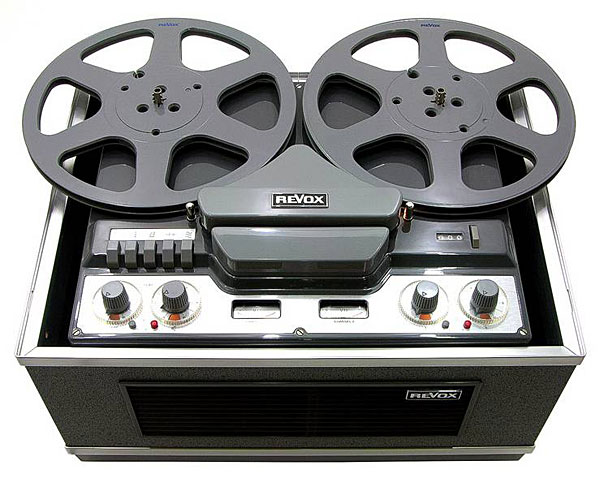
Revox G-36 open-reel tape recorder

The Swiss-made G-36 recorder had earned an enviable reputation among perfectionists during the few years that it has been available in the US, and our inability to test one (because of a backlog of other components for testing) became increasingly frustrating to us with each glowing report we heard from subscribers who owned them. Now that we have finally obtained one through the courtesy of ELPA (footnote 1), we can see what all the shouting was about, but we also have some reservations about it.

Test Your Hi-FiQ

How do you rate as an audio expert? Test yourself on these 25 questions.


All of the following are multiple-choice questions, dealing with things that every audio hobbyist should know, either before or after completing the test. Most of them are easy, but take your time in answering and don't jump to conclusions. Some of the questions are quite tricky, and wrong answers will be subtracted from your final score, so read them and the possible answers carefully before committing yourself. Don't guess if you aren't fairly sure.

Advertisement
Advertisement
Advertisement