Historical

Sort By: Post DateTitle Publish Date

35 Years...And Just Getting Started

Thirty-five years ago this month, the first issue of a new">http://www.stereophile.com/features/708">new audio magazine—cover price 50 cents—cautiously made its way out of a Philadelphia suburb. Its black'n'white cover featured a chessboard adorned with tubes and XLR plugs. Its 20 advertising-free pages included a feature on how">http://www.stereophile.com/historical/108">how to write an ad for an audio product, which had been penned by one Lucius Wordburger, a footnote helpfully pointing out that this was the nom de plume for one J">http://www.stereophile.com/historical/712">J. Gordon Holt, "who wishes to remain anonymous."


35 Years and Just Getting Started: The J. Gordon Holt Interview

September 1997 saw the 35th anniversary of Stereophile magazine, founded by J. Gordon Holt back in 1962. If any interview needs no introduction, this is it. My interview with Gordon was conducted around the kitchen table in Gordon's Boulder, Colorado home over a couple of cold beers. It seemed appropriate to start at the very beginning...
J. Gordon Holt: I don't remember when that was.

Aural Robert #1

Please let me explain. Because I've never been especially adept at making lifelong commitments and irrevocable decisions, when it came to naming this new column, Managing Editor Debbie Starr and I decided that we would gather the passionate (and supremely efficient) minds of the Stereophile production staff, add a near–life-threatening amount of margaritas, and put the question to them.

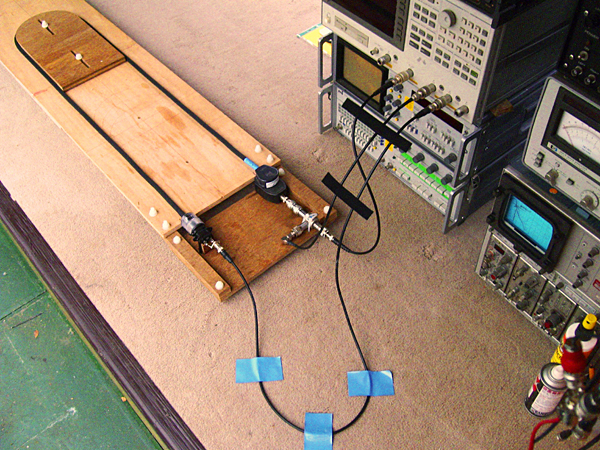
What a Difference a Wire Makes

Testing the RF transmission of Kimber Kable, up to 3GHz, at Ben Duncan Research Labs, in 2008. The resulting proof of RF rejection was published on-line by Russ Andrews Accessories in England. (Photo: Naomi Swain).


Editor's Preface: In an article in the October 1995 issue of Stereophile, Professor Malcolm Omar Hawksford used Maxwell's Equations to develop a mathematical model describing the behavior of cables at audio frequencies. Among the predictions of this model were that for good conductors there exists an optimum size of wire for audio signal transmission, and that for a wire larger than this size an energy storage mechanism would exist. In his article Malcolm described a simple experiment, the results of which appeared to confirm his hypothesis.


Then serendipity struck. English engineer Ben Duncan, whose writings have occasionally appeared in Stereophile, sent me an article he had written for the pro-audio magazine Studio Sound. The results of a series of cable measurements he had performed seemed to confirm the Hawksford Hypothesis. We offer them here for your delight and delectation.—John Atkinson

The Nonstick Embrace Of Home Theater

Editor's Note: 24 years ago, in January 1995, we published the first issue of Stereophile Guide to Home Theater, a sister publication intended to appeal to the the growing number of home-theater enthusiasts. Stereophile's founder, the late J. Gordon Holt, had gotten early into the idea of accompanying movies with high-quality sound, and when I first visited his New Mexico home in January 1986, his system included an Advent NTSC-format video projector.

A New Size For Stereophile

By now you've no doubt realized that Stereophile has changed its size—from 5½" by 8 7/16" to 7½" by 10¼". (All right—maybe you didn't know the exact dimensions of the change, but that's what they are.) We have Edward Chen, Publisher of Stereophile's Chinese edition, to thank for our new size. It is the same size as the Chinese Stereophile and a common size in the Far East. We've been admiring it in Chinese for the last two-and-a-half years, and we thought it would make sense in English as well.


Anniversaries

By the time you read this, I will have been fortunate enough to have attended a banquet put on by Harry Pearson in celebration of The Abso!ute Sound's 20th anniversary. Stereophile and TAS may have had their disagreements from time to time, but I take this opportunity to congratulate Harry and his staff on 20 years of excellent high-end publishing. I believe it's not excessively immodest to report that high-end manufacturers frequently remind me of their gratitude for the healthy and vibrant high-end publishing community which exists in the United States—and does not in most other countries. Many publications make up this community, but Stereophile and TAS are certainly the most widely read.


Benz-Micro MC-20E II & MC Silver phono cartridges

No matter how much I upgrade my digital rig, my trusty $1195 Well-Tempered Record Player blows it away without half trying. . . That's why I corralled a bunch of promising midpriced cartridges and spent a couple of months settin' 'em up, breakin' 'em in, and listenin' to 'em on my favorite records.
Advertisement
Advertisement
Advertisement