Historical

Sort By: Post DateTitle Publish Date

Mark Fisher

Some time ago I wrote about the need for high-end audio companies to constantly reinvent themselves: You may be receiving accolades for your latest and greatest product, but you'd also better be well along the path to developing its replacement. High-end audio is a field of constant change; no product remains supreme for long.


I Have Heard the Future...(DSP Room Acoustics Correction)

Dateline—Chicago, May 30, 9:00pm. Exploding fireworks lit up the sky above the Chicago river as 200 leading high-end designers gathered in the Hotel Intercontinental for Stereophile's 30th Anniversary banquet. After a repast of four gourmet courses and five wines, the time came for after-dinner speeches to celebrate Stereophile's past and high-end audio's future. Publisher">http://www.stereophile.com/asweseeit/593">Publisher Larry Archibald described his adventurous transition from the high-end car business to risky publishing. Introducing J">http://www.stereophile.com/historical/712">J. Gordon Holt, he praised JGH's uniquely lucid writing and his unflinching insistence that equipment designed to reproduce music should be judged on its ability to do just that—the unconventional view that launched high-end audio.


Who Are You?

In the four years since our last readership survey, Stereophile's circulation has grown by one third, from 45,000 to over 60,000 (footnote 1). We thought it time, therefore, to commission new numbers, from specialists Mediamark Research Inc. (footnote 2). Table 1 shows the demographic breakdown of the magazine's readers. While the launch of CD did bring more women into the audiophile fold almost 10 years ago, the proportion of Stereophile's female readers has not changed since 1988, at just over 1% (footnote 3). At one of the panel sessions at the 1992 High End Hi-Fi Show in Los Angeles, a man in the audience asked why high-end audio was so testosterone-bound when women were just as interested in music as men? The answers given by some of the many women at the show ranged from the fact that women only earn 47 cents on the dollar compared with men to conjecture that women are turned off by the hobby's tweak aspect. Certainly dealer Andrew Singer felt last October (footnote 4) that the high-end industry is hobbling itself by ignoring half the US's population.

Audio McCarthyism

In the early 1950s, a quiet, undistinguished Senator named Joseph Raymond McCarthy began a crusade against what he imagined were subversive, dangerous elements in American government. His tactics included irresponsible accusation, militant attacks on his opponents, and self-aggrandizing witch-hunting. So virulent were his methods the term "McCarthyism" entered the language. McCarthyism came to mean any unjustified persecution and the false conformity this strategy engendered (footnote 1).

PASC & Philips' DCC

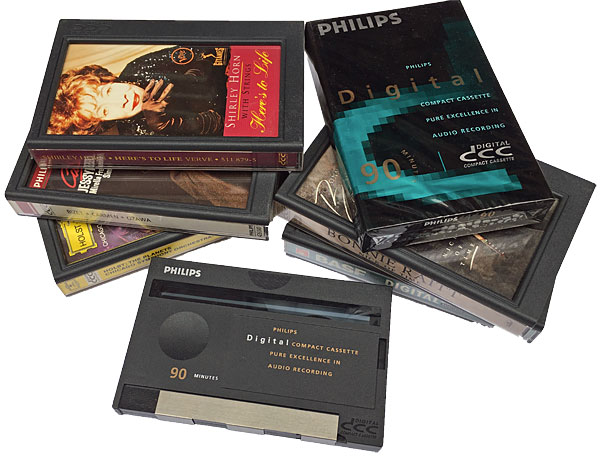
Editor's Note: In the 21st Century, lossy audio data compression, in the form of MP3 and AAC files, Dolby Digital and DTS-encoded soundtracks, and YouTube and Spotify streaming, is ubiquitous. But audiophiles were first exposed to the subject a quarter-century ago, when Philips launched its ill-fated DCC cassette format. What follows is Stereophile's complete coverage on both DCC and its PASC lossy-compression encoding from our April 1991 issue.—John Atkinson

Cary Audio Design CAD-5500 "CD Processor" preamplifier

A "CD processor," is how I distinctly heard Cary Audio's Dennis Had describe it. The venue was Stereophile's High End Hi-Fi Show in New York last April. Nothing really unusual in today's digital marketplace, I thought to myself, though a bit out of character for a company dedicated to vacuum-tube technology. But wait a minute. Dennis had described it as an analog CD processor. Analog!? Well, yes, the unit processes the analog signal from a CD player.


Deeper Meanings

As a card-carrying member of the Audio Engineering Society and an avid audiophile, I was particularly disturbed by the ideas expressed at the 1990 AES Conference entitled "The Sound of Audio." (A report on the papers presented appears in this month's "Industry Update" column.) The tone of the three-day session in May was set during the Conference Chairman's opening remarks. He said that an AES conference on the sound of audio was "unusual" and "out of the mainstream." Further, he expressed a common underlying attitude among the AES that "audiophile claims" (of musical differences between components) have been "nagging us" and are "an annoyance."


Tweaking your Record-Player

While the LP-vs-CD debate continues unabated among high-end audiophiles, the rest of the world has already closed the book on the venerable LP. All but a few specialized classical record companies (footnote 1)(and some weird magazines) have ceased releasing new LPs, few record stores sell them any more, and consumers who wouldn't be caught dead owning something that wasn't trendy have long ago dumped their LP collections for cents on the pound.


Advertisement
Advertisement
Advertisement