"The realistic reproduction of orchestral music in an average room requires peak power capabilities of the order of 15 to 20W when the electro-acoustic transducer is a baffle-loaded moving-coil loudspeaker of normal efficiency."
—Peter Walker and D.T.N. Williamson, writing in the Journal of the Audio Engineering Society in 1954
 According to evolutionist Richard Dawkins, the most important variable determining a person's religion is the accident of birth. Man of faith though I am, I agree—and I'll risk further sacrilege by suggesting that Dawkins' rule can be applied with equal success to our little corner of the world. Which is to say, the most important variable determining a person's taste in music playback is the accident of adolescent revelation: The sound that your music was dressed in the first time you fell for it is the sound you'll love forever.
For some, that would be a car radio: fair enough. For others it's a Steinway, or the sound of a fiddle on a summer evening. And for some it's our best friend's father's hi-fi: Levinsons and Maggies, a Dynaco amp and a pair of Klipschorns, Bose 901s and some nothing receiver. Or maybe a single Quad speaker and a Quad II amp from 1957 or thereabouts.
That last one continues to outshine its contemporaries, partly because of the Quad II's status as the first great amplifier, and partly because Quad's reputation as a company of integrity and influence stretches well beyond its customer base. For those reasons, Quad is the only audio company I know—the only company—that could put a 50-year-old product back into production, virtually unchanged, with any hope for success.
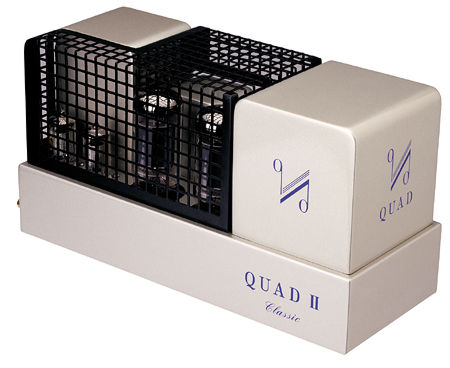
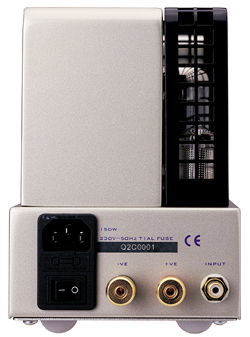
Make no mistake: The brand-new Quad II Classic doesn't just approximate its forebear. Quad didn't set out to improve on or update the original, but rather to manufacture it again, the way it was. The circuit remains precisely as Peter Walker designed it more than half a century ago, and details of its construction have changed only where certain physical types of parts are virtually extinct (old capacitor shapes and their associated clamps, cloth insulation, and so forth) or where a change is required by law (eg, the new Classic has a cage to protect people and hot tubes from one another, an IEC-style AC cord socket with an integral power switch, and contemporary, CE-approved gold-plated speaker terminals). In every other way, the Quad II Classic is a Quad II.
Quadliness
According to evolutionist Richard Dawkins, the most important variable determining a person's religion is the accident of birth. Man of faith though I am, I agree—and I'll risk further sacrilege by suggesting that Dawkins' rule can be applied with equal success to our little corner of the world. Which is to say, the most important variable determining a person's taste in music playback is the accident of adolescent revelation: The sound that your music was dressed in the first time you fell for it is the sound you'll love forever.
For some, that would be a car radio: fair enough. For others it's a Steinway, or the sound of a fiddle on a summer evening. And for some it's our best friend's father's hi-fi: Levinsons and Maggies, a Dynaco amp and a pair of Klipschorns, Bose 901s and some nothing receiver. Or maybe a single Quad speaker and a Quad II amp from 1957 or thereabouts.
That last one continues to outshine its contemporaries, partly because of the Quad II's status as the first great amplifier, and partly because Quad's reputation as a company of integrity and influence stretches well beyond its customer base. For those reasons, Quad is the only audio company I know—the only company—that could put a 50-year-old product back into production, virtually unchanged, with any hope for success.
Make no mistake: The brand-new Quad II Classic doesn't just approximate its forebear. Quad didn't set out to improve on or update the original, but rather to manufacture it again, the way it was. The circuit remains precisely as Peter Walker designed it more than half a century ago, and details of its construction have changed only where certain physical types of parts are virtually extinct (old capacitor shapes and their associated clamps, cloth insulation, and so forth) or where a change is required by law (eg, the new Classic has a cage to protect people and hot tubes from one another, an IEC-style AC cord socket with an integral power switch, and contemporary, CE-approved gold-plated speaker terminals). In every other way, the Quad II Classic is a Quad II.
Quadliness
A Quad II, original or Classic, is a class-A push-pull monophonic amp with only two active stages. The input stage contains two EF86 miniature pentode tubes, each of which is capacitor-coupled to its own output tetrode tube, but only one of which (call it input tube No.1) gets the original input signal. From there, in addition to driving its corresponding output tube, input tube No.1 drives input tube No.2 with a portion of its reverse-phase output, attenuated by some 6dB. Thus the output of the second EF86 is equal to but out of phase with the output of the first, and this balance is maintained through the output transformer's primary, where the full music wave is put back together. This design, called a paraphase circuit, used to be quite popular, arguably because it accomplished phase inversion and voltage gain in one stroke—and so allowed the designer to keep both distortion and parts cost to a minimum (footnote 1).
 The output stage uses a pair of KT66 tetrodes in a "cathode coupled" arrangement: The cathodes and anodes of the KT66s are both connected to the output transformer's primary. The windings ratio between these two points is critical, and has to be carried out precisely—Peter Walker put tremendous work into designing and making his trannies—but the rewards are great: Walker and others observed that, with a cathode-coupled design such as Quad's, feedback is applied in a more linear fashion than with that other approach to connecting an output tetrode's grid to the primary of an output transformer, the Ultralinear circuit of Hafler and Keroes. Ultimately, then, the Quad II offers the low distortion of class-A triode operation with a large measure of the efficiency of class-B tetrode operation.
The Quad II's power supply is simple enough to make today's single-ended-triode amps look positively rococo by comparison. The rectifier tube is a GZ34 (as opposed to the GZ32 of the original, the latter being the ivory-bill to the former's pileated woodpecker). The anodes of the output tubes are fed from the reservoir, while the supply to the KT66 screen grids and EF86 anodes is smoothed by a choke and a smallish capacitor. Meanwhile, back at the mains transformer, a separate secondary provides 6.3V AC for the audio tubes, and 5V AC for the rectifier. And that's all she wrote.
My review samples were made at Quad's new factory in China. I'm told that, during the time they were setting up the assembly line for the Quad II, the company flew almost all of their UK production staff to the new facility to make sure they got it right—that the younger people building these amps would do precisely as Quad's founder would have wanted them to. (Four members of the visiting team have more than 30 years' experience at Quad, so for them, doing things the P.J. Walker way is more than an abstract concept.) Their efforts have paid off handsomely. Arguably like the design itself, the Quad II's construction is a product of postwar English frugality and common sense: The original Quad II was a minimalist amp long before such a thing became fashionable, and the Classic carries on that tradition. There are six capacitors, 13 resistors, and not a single circuit-board trace inside—although the Classic does contain a "tag" board for lacing up 10 of those resistors, just like the original II. The hand-wiring has been neatly done, and dabs of enamel on all the solder joins add a fine finishing touch.
The output stage uses a pair of KT66 tetrodes in a "cathode coupled" arrangement: The cathodes and anodes of the KT66s are both connected to the output transformer's primary. The windings ratio between these two points is critical, and has to be carried out precisely—Peter Walker put tremendous work into designing and making his trannies—but the rewards are great: Walker and others observed that, with a cathode-coupled design such as Quad's, feedback is applied in a more linear fashion than with that other approach to connecting an output tetrode's grid to the primary of an output transformer, the Ultralinear circuit of Hafler and Keroes. Ultimately, then, the Quad II offers the low distortion of class-A triode operation with a large measure of the efficiency of class-B tetrode operation.
The Quad II's power supply is simple enough to make today's single-ended-triode amps look positively rococo by comparison. The rectifier tube is a GZ34 (as opposed to the GZ32 of the original, the latter being the ivory-bill to the former's pileated woodpecker). The anodes of the output tubes are fed from the reservoir, while the supply to the KT66 screen grids and EF86 anodes is smoothed by a choke and a smallish capacitor. Meanwhile, back at the mains transformer, a separate secondary provides 6.3V AC for the audio tubes, and 5V AC for the rectifier. And that's all she wrote.
My review samples were made at Quad's new factory in China. I'm told that, during the time they were setting up the assembly line for the Quad II, the company flew almost all of their UK production staff to the new facility to make sure they got it right—that the younger people building these amps would do precisely as Quad's founder would have wanted them to. (Four members of the visiting team have more than 30 years' experience at Quad, so for them, doing things the P.J. Walker way is more than an abstract concept.) Their efforts have paid off handsomely. Arguably like the design itself, the Quad II's construction is a product of postwar English frugality and common sense: The original Quad II was a minimalist amp long before such a thing became fashionable, and the Classic carries on that tradition. There are six capacitors, 13 resistors, and not a single circuit-board trace inside—although the Classic does contain a "tag" board for lacing up 10 of those resistors, just like the original II. The hand-wiring has been neatly done, and dabs of enamel on all the solder joins add a fine finishing touch.
Footnote 1: On the other hand, the greatest weakness of the paraphase circuit is that the signals at the grids of the two output tubes—and thus the two halves of the music waveform, at output—are not perfectly in time and in phase with one another, given that the signal on the grid of input tube No.2 has already been amplified, whereas the signal on the grid of input tube No.1 has not. Of course, I remain open to the possibility that this technical anomaly results in some or another musically consonant distortion that I and others just happen to find pleasing.
According to evolutionist Richard Dawkins, the most important variable determining a person's religion is the accident of birth. Man of faith though I am, I agree—and I'll risk further sacrilege by suggesting that Dawkins' rule can be applied with equal success to our little corner of the world. Which is to say, the most important variable determining a person's taste in music playback is the accident of adolescent revelation: The sound that your music was dressed in the first time you fell for it is the sound you'll love forever.
For some, that would be a car radio: fair enough. For others it's a Steinway, or the sound of a fiddle on a summer evening. And for some it's our best friend's father's hi-fi: Levinsons and Maggies, a Dynaco amp and a pair of Klipschorns, Bose 901s and some nothing receiver. Or maybe a single Quad speaker and a Quad II amp from 1957 or thereabouts.
A Quad II, original or Classic, is a class-A push-pull monophonic amp with only two active stages. The input stage contains two EF86 miniature pentode tubes, each of which is capacitor-coupled to its own output tetrode tube, but only one of which (call it input tube No.1) gets the original input signal. From there, in addition to driving its corresponding output tube, input tube No.1 drives input tube No.2 with a portion of its reverse-phase output, attenuated by some 6dB. Thus the output of the second EF86 is equal to but out of phase with the output of the first, and this balance is maintained through the output transformer's primary, where the full music wave is put back together. This design, called a paraphase circuit, used to be quite popular, arguably because it accomplished phase inversion and voltage gain in one stroke—and so allowed the designer to keep both distortion and parts cost to a minimum (footnote 1).
The output stage uses a pair of KT66 tetrodes in a "cathode coupled" arrangement: The cathodes and anodes of the KT66s are both connected to the output transformer's primary. The windings ratio between these two points is critical, and has to be carried out precisely—Peter Walker put tremendous work into designing and making his trannies—but the rewards are great: Walker and others observed that, with a cathode-coupled design such as Quad's, feedback is applied in a more linear fashion than with that other approach to connecting an output tetrode's grid to the primary of an output transformer, the Ultralinear circuit of Hafler and Keroes. Ultimately, then, the Quad II offers the low distortion of class-A triode operation with a large measure of the efficiency of class-B tetrode operation.
The Quad II's power supply is simple enough to make today's single-ended-triode amps look positively rococo by comparison. The rectifier tube is a GZ34 (as opposed to the GZ32 of the original, the latter being the ivory-bill to the former's pileated woodpecker). The anodes of the output tubes are fed from the reservoir, while the supply to the KT66 screen grids and EF86 anodes is smoothed by a choke and a smallish capacitor. Meanwhile, back at the mains transformer, a separate secondary provides 6.3V AC for the audio tubes, and 5V AC for the rectifier. And that's all she wrote.
My review samples were made at Quad's new factory in China. I'm told that, during the time they were setting up the assembly line for the Quad II, the company flew almost all of their UK production staff to the new facility to make sure they got it right—that the younger people building these amps would do precisely as Quad's founder would have wanted them to. (Four members of the visiting team have more than 30 years' experience at Quad, so for them, doing things the P.J. Walker way is more than an abstract concept.) Their efforts have paid off handsomely. Arguably like the design itself, the Quad II's construction is a product of postwar English frugality and common sense: The original Quad II was a minimalist amp long before such a thing became fashionable, and the Classic carries on that tradition. There are six capacitors, 13 resistors, and not a single circuit-board trace inside—although the Classic does contain a "tag" board for lacing up 10 of those resistors, just like the original II. The hand-wiring has been neatly done, and dabs of enamel on all the solder joins add a fine finishing touch.
Footnote 1: On the other hand, the greatest weakness of the paraphase circuit is that the signals at the grids of the two output tubes—and thus the two halves of the music waveform, at output—are not perfectly in time and in phase with one another, given that the signal on the grid of input tube No.2 has already been amplified, whereas the signal on the grid of input tube No.1 has not. Of course, I remain open to the possibility that this technical anomaly results in some or another musically consonant distortion that I and others just happen to find pleasing.