There's no need to consult my notes. The memory of the sound of the Audio Research 330M monoblock amplifiers ($90,000/pair) at AXPONA 2025 is so vivid I can still recall what I heard and felt. I sat front and center in a room sponsored by Quintessence Audio, before a system featuring Kubala-Sosna Realization cables, Critical Mass Maxxum-Ultra equipment racks and isolation, dCS Vivaldi APEX streaming DAC/Master Clock/ Upsampler, Sonus faber Stradivari speakers, an Audio Research Ref 10 preamplifier, and the Audio Research Reference 330M monoblock amplifiers. The sound was so colorful, rich, and effortless—the images so convincing in size, weight, and timbre—that I felt my eyes open wide in amazement.
I'm still astonished—not just by the sound I heard but also by the fact that this huge, dynamic, airy presentation was delivered by a CD-quality (16/44.1) file of Reference Recordings's fabled Minnesota Orchestra/Eiji Oue rendition of Rimsky-Korsakov's Danse Macabre. I've heard this recording, from the album Mephisto & Co., so many times and on so many systems that it has earned an "Oh no, not this one again!" rating in the Book of JVS. Yet, within seconds, all "hackneyed-warhorse" thoughts transformed into feelings of awe and respect—respect for the music itself, the hold-nothing-back performance, Keith O. Johnson's engineering, and the joint achievement of Quintessence Audio and Audio Research.
This is a theme you will encounter frequently in this review: Whenever I heard the 330Ms playing "show tracks" I thought I knew inside out, I sat amazed at how much better and more involv-ing they sounded. Larger images, a mind-blowingly stronger/firmer bass foundation, greater color saturation and transparency, spot-on timbres (from an upfront perspective, where colors are at their most intense), and more clarity, air, and depth.
Though those attributes may read as essential items on any basic audiophile checklist, there is nothing remotely "check the box" basic or routine about listening to the Audio Research 330Ms. At least not through a fiber-optimized streaming system in a well-treated room that included an Innuos Nazaré music streamer, dCS Varèse D/A system, Dan D'Agostino Relentless and CH Precision L10 preamps, Wilson Alexia V speakers with LōKē subwoofers, Nordost Odin 2/Valhalla 2 and AudioQuest Dragon/Firebird cabling, Stromtank S-4000 MK-II XT power generator, AudioQuest Niagara 7000 power conditioner, Nordost QKore and QSource, and more. With the 330Ms, every listen was a special occasion. Time and time again, I left my music room so stunned by what I had heard that I kept consulting my schedule to figure out how soon I would be able to return to listen one more time. I could not get enough of the sound that these amps consistently and reliably delivered with ease.
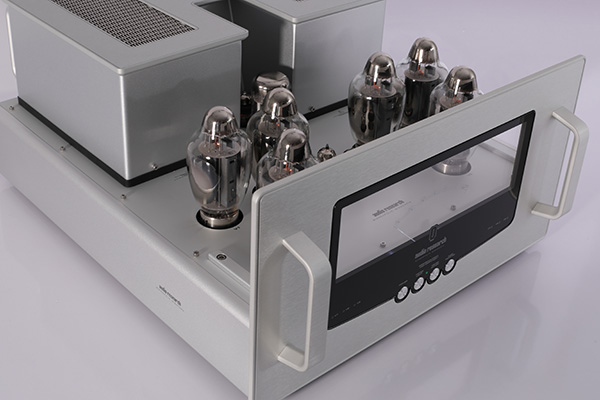 Classic sound updated
Sometimes after a company is sold, the new owner leaves design decisions to the existing team. Often that's considered a positive, since it means the new management—especially when its main interest lies neither in audiophile equipment nor music—isn't messing with what was already a good thing. In this case, however, the new owner was Valerio Cora, the audiophile founder/owner of Acora Acoustics. Cora, who began the process of purchasing Audio Research (ARC, for Audio Research Corporation) in May 2023, quickly injected himself heavily into key ARC decisions. To discover more about what he did to help create the sound that was consistently blowing me away, I initiated a Zoom chat with him, Dylan Constan-Wahl, the electrical engineer who designed the 330M's circuitry with Cora's guidance, and the indispensable Allan Haggar, VP of global sales, who installed the amps in my music room.
"I was aiming to bring Audio Research back to its glory days when they were designing the REF 600, 610T, REF 1, REF 2 MK II, and all the other amplifiers that really put Audio Research on the map," Cora explained. "Before the ink was even dry—the sale did not get court approval until late June 2023—the basic blueprint to build a new statement piece was already in play." The goal was to build "the best amplifier on this planet."
Dave Gordon, Audio Research's longtime brand ambassador, told me later that the 330M was originally labeled the REF320M. "It was envisioned as a twice-as-powerful version of the REF160M MkII, which utilized KT150 output tubes and was passively displayed at the Munich show in 2022. After Val bought the company, he brought in the engineering muscle to push the performance to be much more ambitious, far exceeding any amplifier we had ever produced, including our flagship 750SE."
Cora again: "After extensive listening by a large panel of people, including myself, Allan, Dylan, sonic evaluator Warren Gehl, and two people you met at AXPONA, Les Robinson (who did the 330M's mechanical design) and Evan Skucius, co–general manager, sonic evaluator, and lead problem solver, we sat down with some of our previous products, including the 610Ts and the 600s, and decided that theirs was the pinnacle of William Johnson's Audio Research sound. At that point, we all said, 'This is the goal post. Let's just blow right by it and go as far as we possibly can.' That's what culminated in the 330M."
Cora pushed his team to listen to the sound of Audio Research's heyday products as well as products from other companies. It took almost a full year of design and prototypes before he and Constan-Wahl were confident they were on the right track, and six more months to complete the design. When I remarked that was a pretty fast turnaround, Cora said that while Constan-Wahl and two other engineers were developing the design, tweaking, and changing components and wire traces, the process resembled "a car race."
"We took all the new technology that had been developed between 1997 and 2023 and melded it together with the best that came before it to get to this new pinnacle," he said. "That required a lot of open-mindedness by the engineering and listening teams."
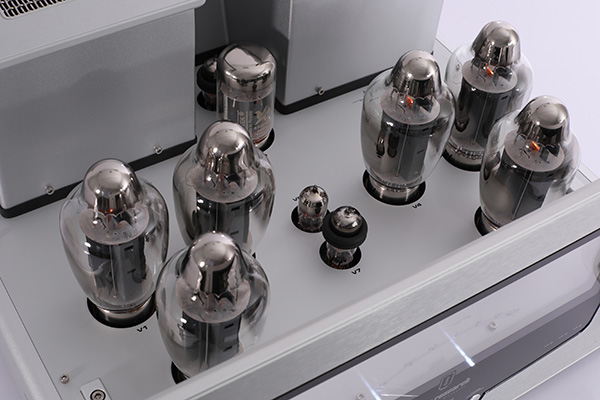 Tubes and more
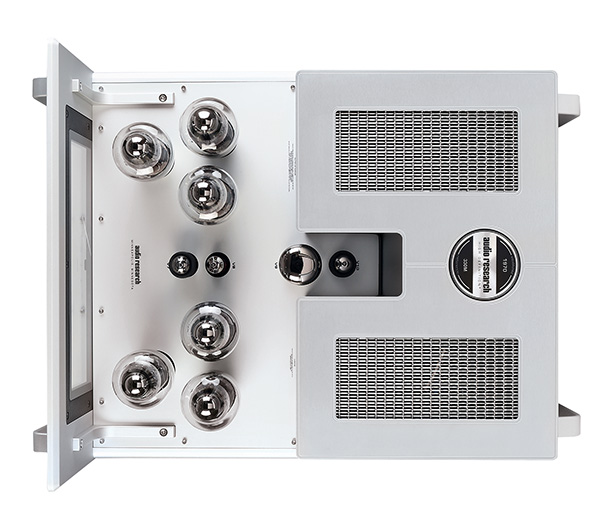
The 330M's output stage uses three matched pairs of KT170s. It also sports four other tubes; Constan-Wahl parsed that out as "one 12AX7/ECC83 for the front end, one 6H30 for the gain stage, one 6H30 error amplifier for the power supply regulator, and a 6550 pass tube for the power supply regulator." All tubes are current production.
"We design and voice with current-production tubes," Constan-Wahl noted. "It's not fair to design something that only sounds good with a rare NOS tube unless you're only releasing 20 units. Our tube-matching and selection is so rigorous that you wouldn't be able to beat it. It's a really expensive process, as Val can vouch for. In fact, because we test all tubes before signing off on them, we sometimes change brand manufacturers to ensure top quality."
Constan-Wahl said he loves the 12AX7 because some of the early classic designs used it. It's also possible to swap the 12AX7 for vastly different-sounding NOS Telefunken or RCA equivalents if a user is so inclined. Rolling the other tubes is not recommended.
Cora commented further. "We voice with the tubes we supply. If you want the 330M to sound the way we heard it, we know it's going to sound the best to stick with our tubes. I'm not going to tell anybody don't go try your own tubes, but I think most of the time, you're going to end up moving backwards and not forwards. Unless, that is, you're trying to fix a particular problem in your room and you're going to use tubes as a tone control, which is not a good thing anyways."
Cora recalled sitting down with Haggar to listen to the KT170, which is used in very few amplifiers because it requires a special circuit to get it to sound good. "Previously, I thought a KT170 had a very fly-on-the-windshield type effect: very dynamic but with nothing musical behind it," he recalled. "Yet in a prototype 330, we both remarked on how wide the soundstage was and that the back wall felt like it was 40 feet deep. We were playing the Reference Recording of the "Pie Jesu" from John Rutter's Requiem, and every boundary just melted away."
Constan-Wahl noted that going from KT150s to 170s made a huge difference. The KT170 felt more effortless, open, and relaxed than other tubes at higher power levels, yet it produced less heat. He said that each tube generates roughly 65W without acting like a small furnace, and that they're more dynamic and faster—if you pay careful attention to construction.
"I found very quickly that the KT170 produced the dynamics, intensity, and real authority that some music requires," Cora enthused. "In most cases, tube gear that can do that sounds forward, bright, or aggressive across the board. In the 330, the KT170 sounds relaxed, but the music sounds intense in a way that's authentic, with wonderfully sharp definition that allows you to hear deep into the recording. Once the KT170 had the right environment, it produced on a whole different level than the KT150."
Another advantage the new design team had was autobias, which wasn't perfected until after those classic designs had made their mark. Autobias proved essential for fine-tuning the design because it enabled them to maintain the bias symmetry essential to low frequency response. The engineers also had access to new 1200V silicon carbide JFET transistors. This and more enabled them to design a superior amp that was far smaller than the REF 600's "small school bus" profile.
"We used a little bit of magic," Constan-Wahl said. "Sometimes it really helps to think outside the box. Other times, doing so is ultimately a distraction from what the older engineers worked very hard to discover and put in the box."
Cora credits Constan-Wahl and the other team members with pushing ARC's longtime capacitor designer, TRT, to produce proprietary caps specifically for the 330M. "The new capacitor is incredibly expensive, but it doesn't matter in this type of product when the cost goes almost out the window to get the sound that we seek," he said. "We were willing to go down a rabbit hole to find which parts worked and which ones didn't. The parts that didn't went into R&D expenses. We forgot about them and left them sitting on the shelf."
ARC was unable to surpass the performance of the internal wire they'd employed in the 160 MKII and REF6. The 330M's wiring is a carefully chosen mix of different proprietary products, each of which sounds best in a different place. Listening tests involved up to 10 evaluators who did not discuss their findings until their work had concluded. Says Cora, "We write it all down, go into the boardroom with people who have listened at different times, and compare notes. We pay attention to everybody, because someone might hear something that others hear differently. Everyone's favorite tracks are evaluated. Les Robinson prefers Hank Williams and all sorts of really twangy country music; others prefer Yello or Vivaldi, and Dave Gordon likes things he keeps hearing at the Minnesota Orchestra."
 Constan-Wahl told me that the 330M's power supply is choke filtered. "It's a CLC—capacitor-choke-capacitor filter. Audio Research last notably used a choke in an amplifier power supply in the Dual 100. But unlike a Dual 100, we use modern capacitors, so we can tune the filter to well below 20Hz, which was not possible in traditional tube amps. That's one of the reasons many tube amps had a funny bass response that was less controlled. Choke filtering gives us bass control, with deeper bass and far less background noise from the power supply. This is the first fully filtered power supply we've done for an amp's output tubes in probably decades."
When I first began using tube amps, I was warned never to turn one on before interconnects and speaker cables were in place. That's not an issue with the 330M. "The REF330M amplifier is stable without an output load connected," Constan-Wahl said with assurance. "As usual with tube amplifiers, it's not recommended to run high-volume audio with the load off because the audio transformer voltages greatly increase. But we have hot-switched speakers many times with the amp. It also tolerates an output short well."
Magic sauce
Constan-Wahl told me that the 330M's power supply is choke filtered. "It's a CLC—capacitor-choke-capacitor filter. Audio Research last notably used a choke in an amplifier power supply in the Dual 100. But unlike a Dual 100, we use modern capacitors, so we can tune the filter to well below 20Hz, which was not possible in traditional tube amps. That's one of the reasons many tube amps had a funny bass response that was less controlled. Choke filtering gives us bass control, with deeper bass and far less background noise from the power supply. This is the first fully filtered power supply we've done for an amp's output tubes in probably decades."
When I first began using tube amps, I was warned never to turn one on before interconnects and speaker cables were in place. That's not an issue with the 330M. "The REF330M amplifier is stable without an output load connected," Constan-Wahl said with assurance. "As usual with tube amplifiers, it's not recommended to run high-volume audio with the load off because the audio transformer voltages greatly increase. But we have hot-switched speakers many times with the amp. It also tolerates an output short well."
Magic sauce
Toward the end of our discussion, I asked Constan-Wahl to remind me why Audio Research eschews toroidal transformers. He pointed out that ARC's output transformer designs date back "at least" to the classic designs of the late 1970s. "There's a lot of special magic sauce in that transformer that was developed the hard way over decades, through listening sessions and trial and error. Our transformers have a lot of reserve for handling transients. They're not going to sag under significant loads." Magic sauce? After hearing Constan-Wahl invoke "magic" twice, I asked him and Cora what the word meant to them. "Engineering is a science," he replied. "I have a bachelor's in electrical engineering and several years of grad school. When we're dealing with the subjective experience of listening to an amplifier, using only the science side of engineering can be limiting. Science doesn't understand everything that's involved in subjective listening and what a component is doing on the level that the human ear can discern.
"There are lots of details there that are not bench measurable. I'd call them more toward magic because their effect is clearly audible and pronounced. So, I think a successful audio product is always a mix of careful, rigorous engineering and some subtle delving into magic and art."
Cora referenced the sound of a Stradivarius violin, which countless artists attest is different from the sound of other violins. That difference is not something that we can quantify through measurements—not yet at least—but it's something we can hear nonetheless.
"At the end of the day, our engineering team members listen to each other and choose what sounds right. That is the magic. When you know something is right, that's what matters.
"Your tongue is capable of tasting 200 parts per million of salt molecules in a glass of water. That's almost impossible to measure, but your tongue can taste it. Does that make your tongue wrong, or does that make the measurement not sensitive enough? It's same thing in audio. Measurements are a great tool, but they are a tool. Ultimately, we have to respect what we hear. We can hear things that can't be measured. That's what Bill Johnson stated from the beginning. When it doesn't measure perfect but sounds perfect, that's the design you want.
"I really pray that people develop measurements to help our engineers make better products. I am not against measurements. I want more informed measurements, and I charge our engineers with finding new techniques to measure properties and measure things to further our art."
Classic sound updatedSometimes after a company is sold, the new owner leaves design decisions to the existing team. Often that's considered a positive, since it means the new management—especially when its main interest lies neither in audiophile equipment nor music—isn't messing with what was already a good thing. In this case, however, the new owner was Valerio Cora, the audiophile founder/owner of Acora Acoustics. Cora, who began the process of purchasing Audio Research (ARC, for Audio Research Corporation) in May 2023, quickly injected himself heavily into key ARC decisions. To discover more about what he did to help create the sound that was consistently blowing me away, I initiated a Zoom chat with him, Dylan Constan-Wahl, the electrical engineer who designed the 330M's circuitry with Cora's guidance, and the indispensable Allan Haggar, VP of global sales, who installed the amps in my music room.
Tubes and moreThe 330M's output stage uses three matched pairs of KT170s. It also sports four other tubes; Constan-Wahl parsed that out as "one 12AX7/ECC83 for the front end, one 6H30 for the gain stage, one 6H30 error amplifier for the power supply regulator, and a 6550 pass tube for the power supply regulator." All tubes are current production.
Constan-Wahl told me that the 330M's power supply is choke filtered. "It's a CLC—capacitor-choke-capacitor filter. Audio Research last notably used a choke in an amplifier power supply in the Dual 100. But unlike a Dual 100, we use modern capacitors, so we can tune the filter to well below 20Hz, which was not possible in traditional tube amps. That's one of the reasons many tube amps had a funny bass response that was less controlled. Choke filtering gives us bass control, with deeper bass and far less background noise from the power supply. This is the first fully filtered power supply we've done for an amp's output tubes in probably decades."
When I first began using tube amps, I was warned never to turn one on before interconnects and speaker cables were in place. That's not an issue with the 330M. "The REF330M amplifier is stable without an output load connected," Constan-Wahl said with assurance. "As usual with tube amplifiers, it's not recommended to run high-volume audio with the load off because the audio transformer voltages greatly increase. But we have hot-switched speakers many times with the amp. It also tolerates an output short well."
Toward the end of our discussion, I asked Constan-Wahl to remind me why Audio Research eschews toroidal transformers. He pointed out that ARC's output transformer designs date back "at least" to the classic designs of the late 1970s. "There's a lot of special magic sauce in that transformer that was developed the hard way over decades, through listening sessions and trial and error. Our transformers have a lot of reserve for handling transients. They're not going to sag under significant loads." Magic sauce? After hearing Constan-Wahl invoke "magic" twice, I asked him and Cora what the word meant to them. "Engineering is a science," he replied. "I have a bachelor's in electrical engineering and several years of grad school. When we're dealing with the subjective experience of listening to an amplifier, using only the science side of engineering can be limiting. Science doesn't understand everything that's involved in subjective listening and what a component is doing on the level that the human ear can discern.