Sidebar Measurements
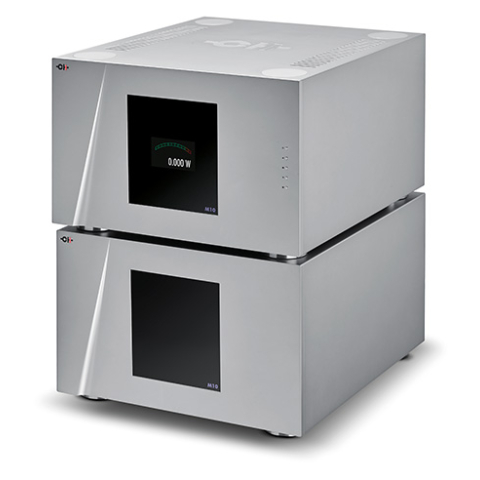
I performed a complete set of measurements on one of the Audio Research Reference 330M amplifiers (serial number 056438) with my Audio Precision SYS2722. The amplifier preserved absolute polarity, ie, was noninverting, with the balanced input and the 8 ohm and 4 ohm output transformer binding posts. However, the 330M inverted polarity with the single-ended input. The gain is specified as 26.3dB with the balanced input and 34dB with the single-ended input, both into 8 ohms. I measured 26.5dB and 32.5dB, respectively, into 8 ohms from the 8 ohm output tap. The gains from the 4 ohm output tap were 2.6dB lower.
The balanced input impedance is specified as a very high 168.5k ohms; I measured 167.3k ohms at 20Hz, 179k ohms at 1kHz, and 143k ohms at 20kHz. The unbalanced input impedance, specified as 19.5k ohms, was 22k ohms at 20Hz and 34k ohms at 1kHz, dropping to 7k ohms at the top of the audioband.
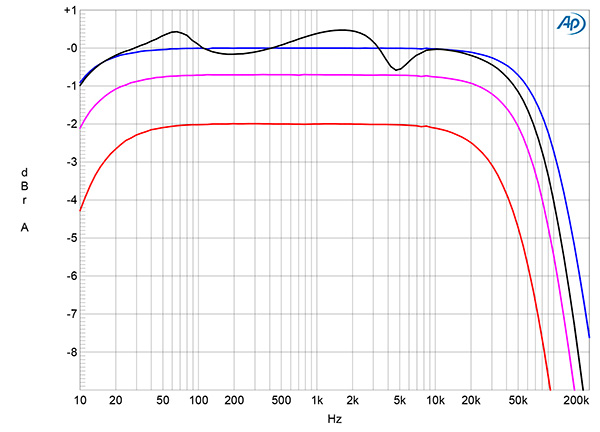
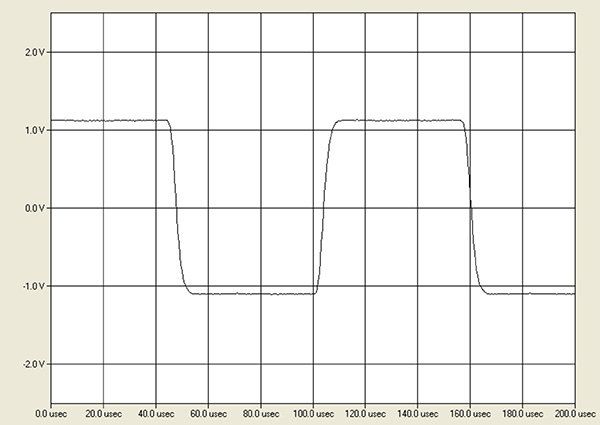
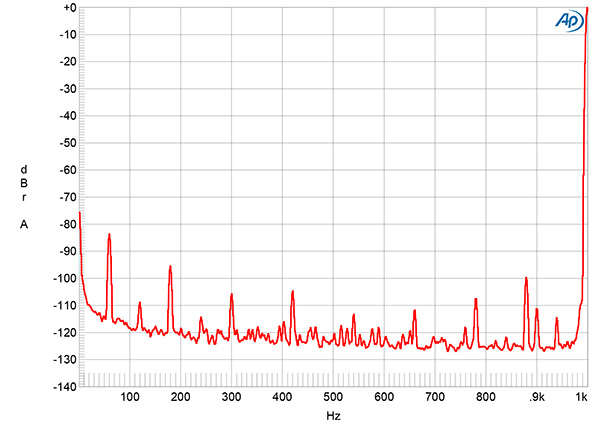
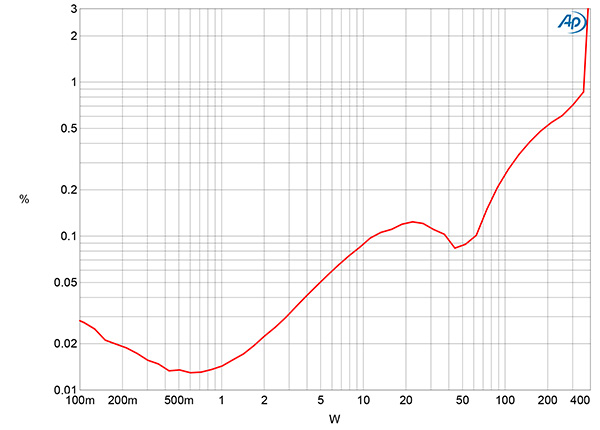

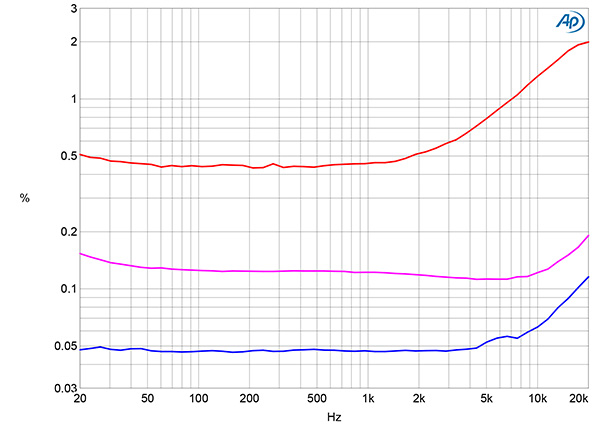
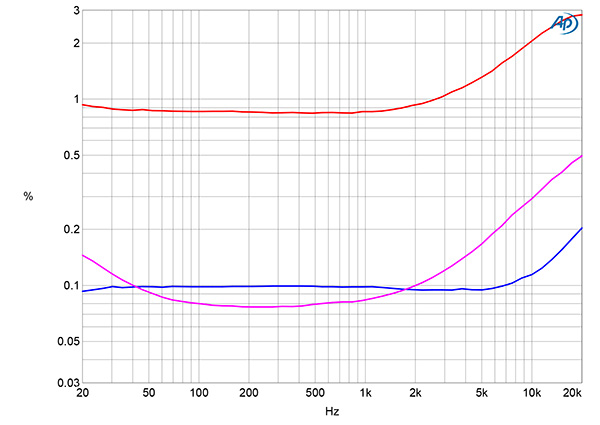
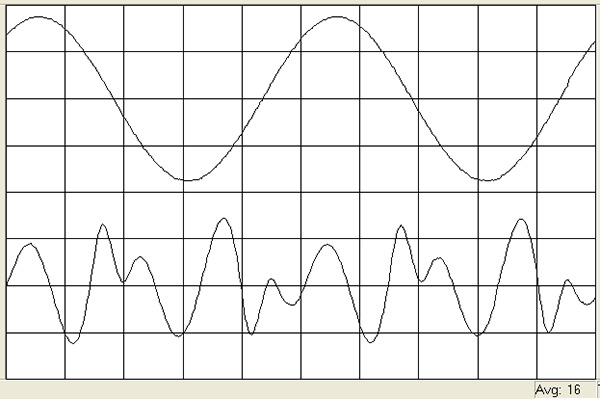
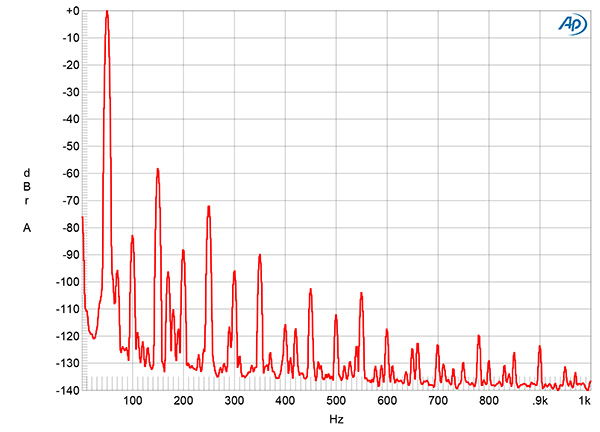
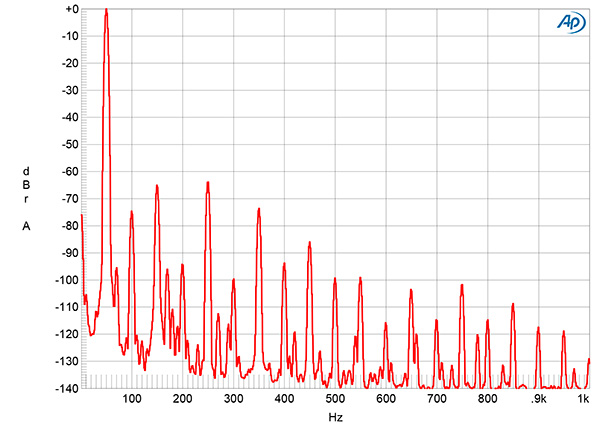
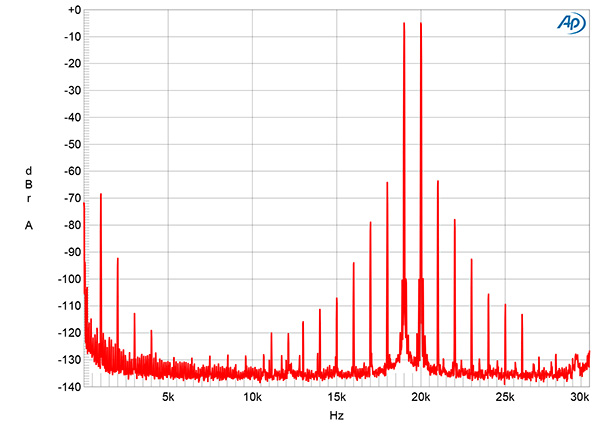
Fig.1 Audio Research Reference 330M, 8 ohm output tap, frequency response at 2.83V into: simulated loudspeaker load (gray), 8 ohms (blue), 4 ohms (magenta), and 2 ohms (red) (1dB/vertical div.).
Fig.2 Audio Research Reference 330M, 8 ohm output tap, small-signal 10kHz squarewave into 8 ohms.
The output impedance was relatively low for an amplifier with a tubed output stage: 0.87 ohms at 20Hz, 0.73 ohms at 1kHz, and 0.8 ohms at 20kHz from the 8 ohm transformer tap. As a result, the variation in the frequency response with our standard "simulated loudspeaker (fig.1, gray trace) was just ±0.5dB. The 4 ohm output transformer tap's source impedance was lower, at 0.49 ohms at 20Hz and 20kHz and 0.42 ohms at 1kHz. The variation in the frequency response with our simulated loudspeaker was therefore lower, at ±0.25dB (not shown). The response into resistive loads (fig.1, blue, magenta, red traces) was flat in the audioband, with a slight rolloff in the very low bass, reaching –0.7dB at 10Hz. The responses rolled off above 20kHz, with the output into 8 ohms down by 3dB at 100kHz. The Audio Research amp's reproduction of a 10kHz squarewave (fig.2) featured very short risetimes and, commendably, no overshoot or ringing. The absence of these spuriae indicates that the amplifier uses a high-quality output transformer.
Fig.3 Audio Research Reference 330M, 8 ohm output tap, spectrum of 1kHz sinewave, DC–1kHz, at 1W into 8 ohms (linear frequency scale).
The unweighted, wideband signal/noise ratio (ref. 1W into 8 ohms), taken with the unbalanced input shorted to ground, was a good 74dB from the 8 ohm output, 76dB from the 4 ohm output. These ratios improved to 77.6dB and 80.2dB respectively when the measurement bandwidth was restricted to 22Hz–22kHz and to 91.2dB and 93.7dB when A-weighted. Spectral analysis of the low-frequency noisefloor while the Audio Research drove a 1kHz tone at 1W into 8 ohms revealed a fairly low random noisefloor, but odd-order harmonics of 60Hz were present (fig.3), presumably due to magnetic fields from the power transformer picked up by the tubes' steel pins. The levels, however, were low: The highest in level was 60Hz at –86dB.
Fig.4 Audio Research Reference 330M, 8 ohm output tap, distortion (%) vs 1kHz continuous output power into 8 ohms.
Fig.5 Audio Research Reference 330M, 4 ohm output tap, distortion (%) vs 1kHz continuous output power into 4 ohms.
Audio Research specifies the Reference 330M's maximum power as 330W, but without mentioning a load impedance or THD percentage. (330W is equivalent to 25.2dBW into 8 ohms and 22.5dBW into 4 ohms.) Stereophile defines an amplifier's clipping power as when the THD+noise reaches 1%. The amplifier's 8 ohm output tap clipped with a 1kHz signal at 360W into 8 ohms (25.6dBW, fig.4); the 4 ohm output tap clipped at the specified 330W into 4 ohms (fig.5). The THD+N was commendably low at lower powers from both taps. Less power was available from the 8 ohm tap into 4 ohms—155W (18.9dBW)—but the 4 ohm tap clipped at 225W into 8 ohms (23.5dBW). Tested with a 20kHz signal, the amplifier's 8 ohm output clipped at 65W into 8 ohms (18.1dBW). Relaxing the clipping definition to 3% THD+N gave a maximum power of 200W into 8 ohms (23dBW).
Fig.6 Audio Research Reference 330M, 8 ohm output tap, THD+N (%) vs frequency at 12.65V into: 16 ohms (blue), 8 ohms (magenta), and 4 ohms (red).
Fig.7 Audio Research Reference 330M, 4 ohm output tap, THD+N (%) vs frequency at 12.65V into: 8 ohms (blue), 4 ohms (magenta), and 2 ohms (red).
Fig.6 shows how the THD+N percentage from the 8 ohm tap varied with frequency at 12.65V, which is equivalent to 10W into 16 ohms (blue trace), 20W into 8 ohms (magenta), and 40W into 4 ohms (red). The THD+N percentage was extremely low in the bass, midrange, and low treble into 16 ohms (blue trace) but somewhat higher into 8 ohms and much higher into 4 ohms. It also rose in the top audio octave, especially into 4 ohms. The behavior at the same voltage from the 4 ohm output tap into 8 and 4 ohms was similar (fig.7), but the THD+N into 2 ohms (red trace) was close to 1% from the bass through the low treble and rose significantly in the top two octaves.
Fig.8 Audio Research Reference 330M, 8 ohm output tap, 1kHz waveform at 50W into 8 ohms, 0.11% THD+N (top); distortion and noise waveform with fundamental notched out (bottom, not to scale).
Fig.9 Audio Research Reference 330M, 8 ohm output tap, spectrum of 50Hz sinewave, DC–1kHz, at 20W into 8 ohms (linear frequency scale).
Fig.10 Audio Research Reference 330M, 4 ohm output tap, spectrum of 50Hz sinewave, DC–1kHz, at 40W into 4 ohms (linear frequency scale).
Fig.11 Audio Research Reference 330M, 8 ohm output tap, HF intermodulation spectrum, DC–30kHz, 19+20kHz at 20W peak into 8 ohms (linear frequency scale).
The distortion signature from the 8 ohm tap into 8 ohms was predominantly the third harmonic (fig.8), at –60dB (0.1%), joined by both even-order and odd-order harmonics at lower levels (fig.9). At the same voltage from the 4 ohm tap into 4 ohms, the fifth harmonic was the highest in level, at –64dB (0.06%, fig.10). Intermodulation distortion with an equal mix of 19 and 20kHz tones was relatively low in level from both output taps. At 20W peak into 8 ohms from the 8 ohm tap, the difference product at 1kHz lay close to –70dB (0.03%) with the higher-order products just 6dB higher in level (fig.11).
The Audio Research Reference 330M offers high power with relatively low levels of harmonic and intermodulation distortion as long as the load impedance is the same as, or higher than, the nominal output tap impedance.—John Atkinson