Almost immediately on entering the analog marketplace in 1982, Franc Kuzma, a mechanical engineer based in Slovenia, then part of the former Yugoslavia, established a reputation for manufacturing finely engineered, high-performance products that sold at reasonable prices. Kuzma's early industrial designs, however, while serviceable, looked less than distinguished.
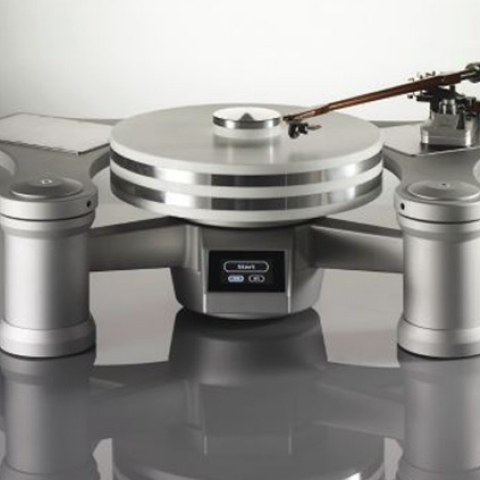
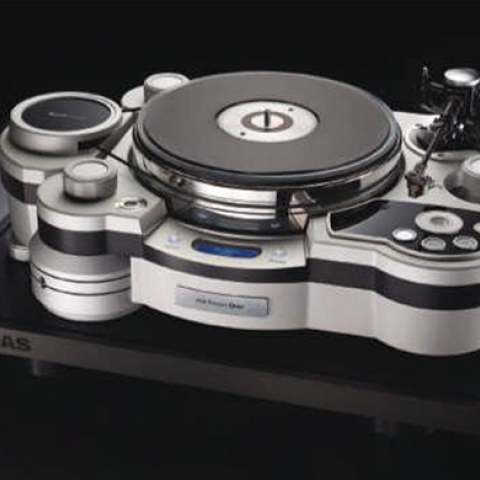
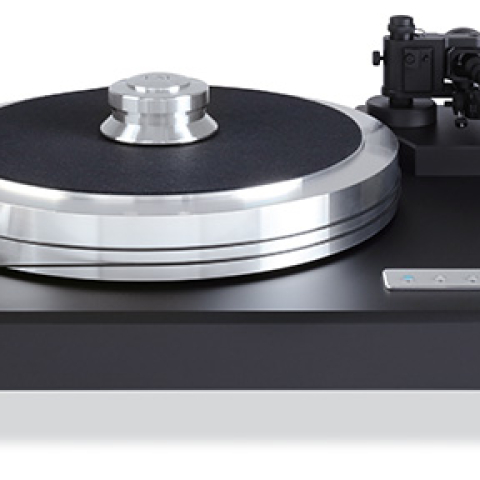
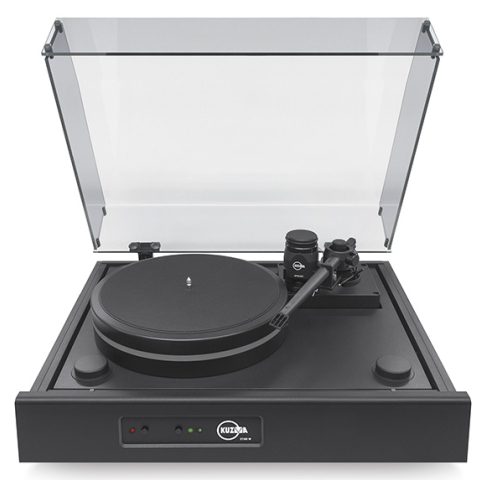
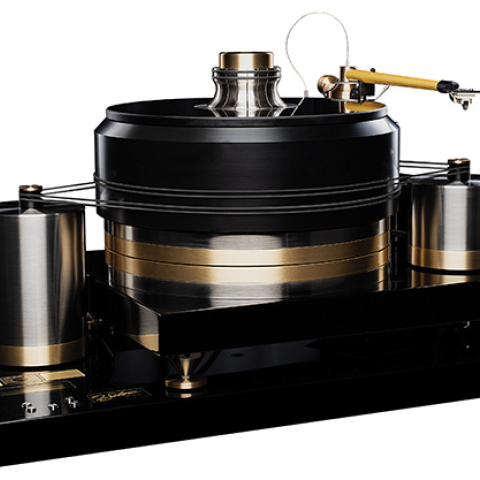
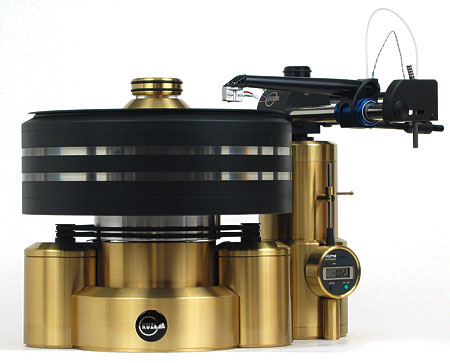 Nothing in Kuzma's previous work, not even the pipe-bomb of the Stabi S, which had been introduced two years earlier, could have predicted the visually enticing, curvaceous design of the Stabi XL. Big and literally "brassy," the heavyweight Stabi XL created a sensation when it was introduced in 1999. Monumental, finely sculpted, and remarkably compact, the Stabi XL is as much a work of visual art as it is a thoughtfully designed, precisely engineering record player.
Stabi XL turntable
Nothing in Kuzma's previous work, not even the pipe-bomb of the Stabi S, which had been introduced two years earlier, could have predicted the visually enticing, curvaceous design of the Stabi XL. Big and literally "brassy," the heavyweight Stabi XL created a sensation when it was introduced in 1999. Monumental, finely sculpted, and remarkably compact, the Stabi XL is as much a work of visual art as it is a thoughtfully designed, precisely engineering record player.
Stabi XL turntable
The spindle shaft of the Stabi XL is more than an inch in diameter, with an inverted bearing tipped with a ruby ball. Its massive base weighs 59.4 lbs and consists of two round slabs of solid brass smoothly machined and pressed together—Kuzma takes seriously the concept of "mass-loading." A suspended turntable's resonant frequency needs to be down around 3Hz to provide effective isolation from structure-borne vibrations. A mass-loaded design without a suspension, such as the Stabi XL, needs sufficient concentrated weight to drain energy and provide rigid coupling to whatever it's placed on.
The dense, essentially plinthless Stabi XL accomplishes that. Its two freestanding, 15.4-lb brass motor assemblies and 30.8-lb, height-adjustable tonearm tower provide additional mass, as well as a degree of isolation between and among the sources of unwanted noise and vibration.
The 4.3"-thick platter weighs 48.4 lbs. It's a triple-decker of aluminum and acrylic, screwed together and topped with an integral mat of semihard textile and rubber. The platter rests securely on the aluminum subplatter, which also provides the contact surface for the two drive belts.
The brass tonearm tower is another piece of rugged, precision machinery. It consists of two hollow brass cylinders, the inner one riding on a linear ball-bearing system more than 1" in diameter and almost 4" long. Your choice of tonearm attaches to the inner, movable cylinder via a cylindrical locking armboard collar, which permits relatively easy replacement of the arm. Designed to ensure rigidity and parallel concentricity to prevent leaning as it travels over its range of vertical motion of more than 3", the movable cylinder can be adjusted via knurled knob, each turn of which results in a precise change in height of 0.1mm.
My review sample (footnote 1) came with an optional and very cool battery-powered digital-readout gauge that permits fast and easy adjustment of vertical tracking angle (VTA), precisely repeatable down to 0.01mm.
As I point out on 21st-Century Vinyl, my turntable setup DVD, while you can lock in by ear the right VTA for each record in your collection, if your idea of a good time is to determine, write down, and reset VTA each time you play a record, knock yourself out!
The Kuzma's digital readout makes that process precise, easy, and convenient, but I still wouldn't bother (though I do for reviewing purposes). In real life, I just want to listen to music; once the VTA is in the ballpark, or locked in for a particular thickness of 180gm or 200gm LP cut on a known lathe (say, AcousTech's or Grundman's), I find I'm satisfied for all such LPs in my collection. Can I get more performance? Yes. But it takes more time, which means less music.
While the Stabi XL's adjustable tower can accommodate Kuzma's own arm, the Air Line, the company offers a solid, nonadjustable tower for this arm, which already includes adjustable VTA.
Placement and Assembly: The Stabi XL has no suspension and no way to level its base or tonearm tower. To ensure that the platter and tower play on a perfectly level field, the XL must be placed on a suitable platform—one that can be leveled, is itself perfectly level, and won't bend under the Stabi's considerable weight. This is especially critical when using the Stabi XL with Kuzma's Air Line arm, which, like all tangential trackers, is very sensitive to changes in level.
Despite its extensive mass-loading, what you place the Stabi XL on will no doubt affect its sound. I used a mechanically grounded Finite Elemente rack similar to the one Kuzma himself often uses at audio shows. A concrete-slab floor, such as the one I have, makes an ideal mechanical ground for a mass-loaded 'table and stand. I suspect a springy floor might create footfall problems for the Stabi XL, in which case you'd need a robust, wall-mounted platform capable of being leveled. Finite Elemente makes such a product; I've been offered one for review, but I have no wall space available on which to mount it.
With the Stabi's flat-bottomed base in place on a perfectly level platform and its two flat-bottomed motors nestled into the base's curved cutouts, you add oil to the top bearing reservoir (where the ruby ball is) until it begins to run down the shaft. You then add the rest of the oil to the lower reservoir, carefully place the aluminum subplatter assembly atop the spindle, and lower it into place.
After looping the two flat, ground belts around the subplatter and the two stacked pulleys atop each motor, you carefully line up the platter's hole with the subplatter's oversized sleeve and gently lower the platter into place. A flare machined into the bottom of the platter hole is matched by a beveled receptacle at the subplatter surface/shaft interface to make this operation unusually easy for such a heavy platter.
Two umbilicals connect the motors to the outboard power supply, whose quartz controller lets you accurately trim the turntable's speeds (331/3rpm and 45rpm), and drives the motor coils individually to minimize vibrations.
Next, you have to determine the proper position for the tonearm tower—a new skill if you're used to a fixed armboard (who isn't?). Because I first used the Stabi XL with Kuzma's own Air Line arm, this was a matter of positioning the tower directly behind the base, then using the supplied setup gauge to "true" the tangential tracker.This was easy—the Air Line's mounting tower can be rotated around its vertical axis. Because of the tower's considerable weight, once it was in the right place I didn't worry about it moving.
Later, I switched arm towers, putting the Air Line on the fixed tower and mounting the Graham Phantom B44 arm on the adjustable tower, and locating this where the Stabi XL could use both arms simultaneously. You can probably find room for a third tower, but at that point things will be pretty crowded. I watched Franc Kuzma demo the Stabi with three motors, but even two is one more than I like to see because of the additional noise. However, the Stabi's standard two-motor symmetrical drive system proved quiet, delivering rock-solid speed accuracy over the long term, and subjectively low wow and flutter. It also provided enough torque to quickly get the platter spinning and up to speed without needing a helping hand.
Kuzma Air Line tonearm
I reviewed Kuzma's air-bearing, tangential-tracking Air Line tonearm in the August 2004 Stereophile. Since then, Franc Kuzma has improved what already was an accomplished product by adding a damping trough. I feel this is an essential addition, given that most LPs are not truly concentric, and thus, with every half-revolution of the platter, subject a cartridge's cantilever to a tonearm's large horizontal moving mass. (Damping is also beneficial in the vertical dimension as well, of course.) If you're seriously interested in the Air Line, it would be a good idea to read my review, as well as Kuzma's "Manufacturer's Comment" in the September 2004 issue, in which he does the math to show that an eccentric LP produces a disturbance of 0.5Hz or 0.75Hz (at 331/3rpm or 45rpm, respectively)—well outside the Air Line's horizontal resonant frequency of 2–5Hz, and therefore not a problem. But the trough is worth it, if only for the easier settling of the stylus in the groove when the arm is first lowered onto the record—and that improvement you can see for yourself.
Sound: Stabi XL and Air Line
Using the Stabi XL couldn't have been easier. After placing over the threaded spindle, ‡ la the VPI system, a thin aluminum disc (supplied), you place an LP on the platter and tighten down the heavy, screw-on record clamp. This flattens the playing surface of the LP firmly against the platter surface. Switch the motor controller to the desired speed, and you're ready for tunes. Leaving aside for the moment the issue of the Air Line vs the Graham, there's no mistaking a proper mass-loaded design: the bass was taut, as deep as it goes, and pitch-perfect. The attacks of bass notes were almost brutally clean and detailed, and set a stable foundation for everything above the ground floor. There was nothing soft, spongy, or romantic about the Stabi XL's low-frequency performance; if you like soft richness applied to the sound of your LPs, this is not the turntable for you. Notes exploded out of the speakers, left no residue, then decayed quickly into black backgrounds, providing the kind of foundation from which listening relaxation springs: When everything arrives on time, the mind is assured and the listener feels safe. Crisply rendered trebles and sharp, detailed transients helped complete a coherent, compelling picture, and the Stabi XL's low-level resolution put it in the very top tier of turntables.
The Stabi XL also delivered large dynamic swings with ease while managing to illuminate the small, subtle shifts that transform cardboard cutouts into convincing musical apparitions. Like a high-powered amplifier capable of producing real-world SPLs with ease while coasting at less than its rated power, this turntable delivered its message of unlimited capabilities with an ease and swagger that, as intense and difficult-to-reproduce music poured forth without restraint, put a smile on my face.
As well-balanced and capable as the Stabi XL and Air Line were, they seemed to produce a sharper, edgier picture than my reference, the Continuum Audio Labs Caliburn turntable with Cobra tonearm and Castellon stand, which costs almost four times as much. (I'm not suggesting that throwing money at audio always yields better performance, but unfortunately, it usually does.) I felt that, compared with my reference, the Stabi XL and Air Line accentuated the musical attack while somewhat shortchanging sustain and decay. This was most noticeable on well-recorded solo piano, whether jazz or classical. There was more "tinkle," less felt and sounding board. Voices were more throat, less chest. However, without comparison to a turntable that caused me to go into debt, the Stabi XL provided a stable, revealing platform for a tonearm that seemed to be beyond reproach. However, it did get the Air Line into trouble (see below).
Was one presentation soft, the other correct? Was one more true, the other more edgy? Did one lose information? Or one add something that wasn't in the recording? At first, I wasn't going there—I remembered that when Ken Kessler visited me to hear the Caliburn for his writeup in Hi-Fi News, he described it as sounding noticeably "softer" than the even more expensive Clearaudio Statement 'table, which he'd auditioned at the factory. Not having heard the Clearaudio, I was in no position to comment.
However, an experiment I conducted while evaluating the Stabi XL for this review provided a clue as to whether one combo was soft or the other hard, or whether one delivered an excess of sustain and/or the other shortchanged it.
Listening Comparisons
While it's true that a genuine tangential-tracking arm (as opposed to one that meanders while appearing to reproduce the cutter head's travel across a lacquer) will eliminate the distortion products produced by the arc described by a pivoted arm's travel across a record's surface, experience tells me that distortions elsewhere in the reproducing chain are greater than those produced by the playback stylus's lack of tangency to the groove throughout most of its travel in a pivoted arm, and that tangential trackers are thus not worth the hassle and expense. Of course, that's my opinion; you may conclude otherwise. In fact, my position on this matter in 2007 is diametrically opposed to what I expressed in my review of the Air Line in 2004. Based on recent experiences with better pivoted arms, I've changed my mind. Perhaps another product will send me back again as I meander my own way across the record....
Footnote 1: Kuzma's US importer advertises on my website, www.musicangle.com.
Nothing in Kuzma's previous work, not even the pipe-bomb of the Stabi S, which had been introduced two years earlier, could have predicted the visually enticing, curvaceous design of the Stabi XL. Big and literally "brassy," the heavyweight Stabi XL created a sensation when it was introduced in 1999. Monumental, finely sculpted, and remarkably compact, the Stabi XL is as much a work of visual art as it is a thoughtfully designed, precisely engineering record player.
Stabi XL turntable
The spindle shaft of the Stabi XL is more than an inch in diameter, with an inverted bearing tipped with a ruby ball. Its massive base weighs 59.4 lbs and consists of two round slabs of solid brass smoothly machined and pressed together—Kuzma takes seriously the concept of "mass-loading." A suspended turntable's resonant frequency needs to be down around 3Hz to provide effective isolation from structure-borne vibrations. A mass-loaded design without a suspension, such as the Stabi XL, needs sufficient concentrated weight to drain energy and provide rigid coupling to whatever it's placed on.
I reviewed Kuzma's air-bearing, tangential-tracking Air Line tonearm in the August 2004 Stereophile. Since then, Franc Kuzma has improved what already was an accomplished product by adding a damping trough. I feel this is an essential addition, given that most LPs are not truly concentric, and thus, with every half-revolution of the platter, subject a cartridge's cantilever to a tonearm's large horizontal moving mass. (Damping is also beneficial in the vertical dimension as well, of course.) If you're seriously interested in the Air Line, it would be a good idea to read my review, as well as Kuzma's "Manufacturer's Comment" in the September 2004 issue, in which he does the math to show that an eccentric LP produces a disturbance of 0.5Hz or 0.75Hz (at 331/3rpm or 45rpm, respectively)—well outside the Air Line's horizontal resonant frequency of 2–5Hz, and therefore not a problem. But the trough is worth it, if only for the easier settling of the stylus in the groove when the arm is first lowered onto the record—and that improvement you can see for yourself.
Using the Stabi XL couldn't have been easier. After placing over the threaded spindle, ‡ la the VPI system, a thin aluminum disc (supplied), you place an LP on the platter and tighten down the heavy, screw-on record clamp. This flattens the playing surface of the LP firmly against the platter surface. Switch the motor controller to the desired speed, and you're ready for tunes. Leaving aside for the moment the issue of the Air Line vs the Graham, there's no mistaking a proper mass-loaded design: the bass was taut, as deep as it goes, and pitch-perfect. The attacks of bass notes were almost brutally clean and detailed, and set a stable foundation for everything above the ground floor. There was nothing soft, spongy, or romantic about the Stabi XL's low-frequency performance; if you like soft richness applied to the sound of your LPs, this is not the turntable for you. Notes exploded out of the speakers, left no residue, then decayed quickly into black backgrounds, providing the kind of foundation from which listening relaxation springs: When everything arrives on time, the mind is assured and the listener feels safe. Crisply rendered trebles and sharp, detailed transients helped complete a coherent, compelling picture, and the Stabi XL's low-level resolution put it in the very top tier of turntables.
While it's true that a genuine tangential-tracking arm (as opposed to one that meanders while appearing to reproduce the cutter head's travel across a lacquer) will eliminate the distortion products produced by the arc described by a pivoted arm's travel across a record's surface, experience tells me that distortions elsewhere in the reproducing chain are greater than those produced by the playback stylus's lack of tangency to the groove throughout most of its travel in a pivoted arm, and that tangential trackers are thus not worth the hassle and expense. Of course, that's my opinion; you may conclude otherwise. In fact, my position on this matter in 2007 is diametrically opposed to what I expressed in my review of the Air Line in 2004. Based on recent experiences with better pivoted arms, I've changed my mind. Perhaps another product will send me back again as I meander my own way across the record....
Footnote 1: Kuzma's US importer advertises on my website, www.musicangle.com.