Features

Sort By:  Post Date TitlePublish Date

Noise, Resolution & Benchmark
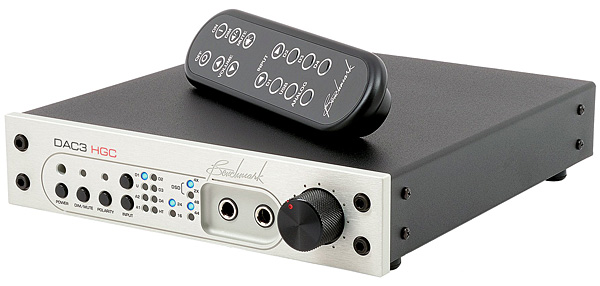
The most notable aspect of Benchmark Media Systems' DAC3 HGC ($2195), which I favorably reviewed in the November 2017 Stereophile (footnote 1), is its low noise floor. John Atkinson's measurements corroborated Benchmark's claim that the DAC3 is capable of "at least" 21-bit performance. While significantly less than the theoretical potential of a 24-bit data format, 21 bits is still the state of the art, and corresponds to a dynamic range—the ratio of the highest achievable digital-domain volume to the DAC's internal noise—of 128dB. That's well above the dynamic range that most power amplifiers can achieve. A good-measuring high-end solid-state amplifier is likely to have a dynamic range—the highest attainable ratio of signal to noise—of about 100dB ref. its maximum power.

The Stereo Image

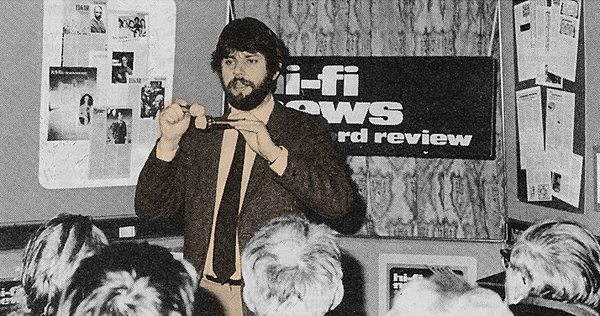
The author demonstrating stereo microphone techniques at an English audio show in 1981.

For most people the terms hi-fi and stereo are synonymous, and yet it is clear that there is still a great deal of confusion over what the word "stereo" actually means. There isn't even a consensus of opinion amongst producers of records, designers of hi-fi equipment, audio critics and music lovers as to the purpose of stereo, and considering that the arguments show no sign of diminishing in intensity, it is instructive to realise that 1981 sees both the 100th anniversary of Clement Ader's first stereo experiments and the 50th anniversary of Alan Blumlein's classic patent on stereo.

Listening Tests and Absolute Phase

The problem confronting the magazine reviewer when organising the necessary listening tests to accompany/reinforce the measured behavior of a device under test is complex. There has never been a problem with the measurement aspect; as long as someone has access to the same test gear—and full knowledge of the test conditions—then he should be able to replicate the critic's findings exactly (assuming an infinitely narrow spread of behaviour from sample to sample—a rasher assumption with some manufacturers' equipment than of others). However, when it comes to determining reliably the audible (or inaudible?) effects on music program by an amplifier/cartridge/loudspeaker etc. then the going gets tough.

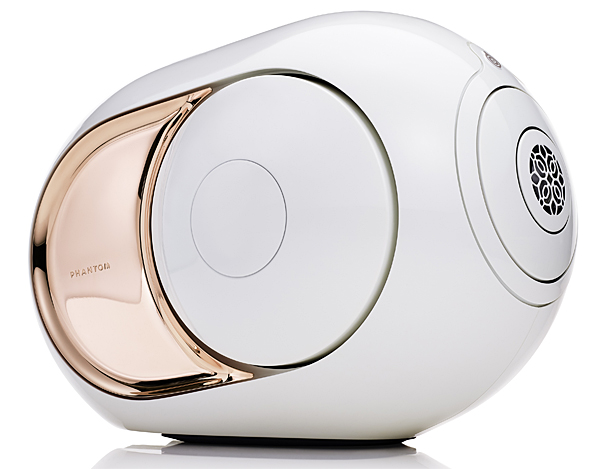
Devialet Diary

It's day five of our planned month-long stay à Paris, late April through most of May. My wife is here for work—for me, it's strictly for pleasure—and we're enjoying Paris's rich, sensual goodness: food, museums, architecture, coffee, people, food. And yet, earlier today, when we were out for a walk—we've been walking close to 10 miles each day, exploring the city—I realized that my life here has been missing something important.

Controversy: The Single Speaker Dem Myth

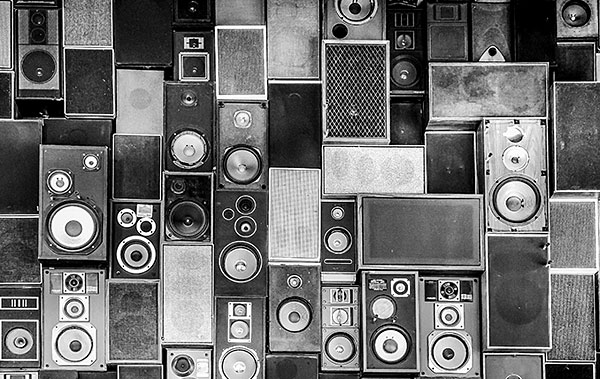
The issue is this business of "single-speaker" listening and demonstration, which has become fashionable in the UK.

The premise: bringing a second pair of loudspeakers into your auditioning room upsets the sound of the pair you're listening so badly that the first speaker's ability to correctly reproduce the timbre of musical instruments is destroyed. This observation is almost surely correct.

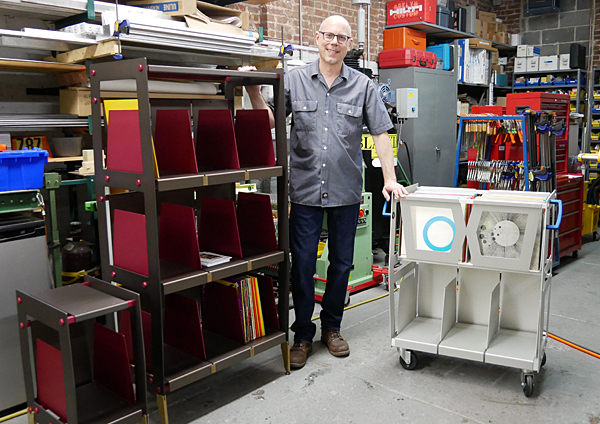
Vinyl Apocalypse: the LP Shelving Dilemma

The three most traumatic events anyone can experience in life? The death of a loved one? A surprise audit by the IRS? Your entire LP collection purloined by a disgruntled ex-lover?

And, oh yes—moving.

As 2016 turned to 2017, my wife and I were forced to move from an apartment we wrongly assumed we'd never ever have to leave, which in New York City means a lot. Perhaps we were just a tad naïve?

Book Review: The New Analog

The New Analog: Listening and Reconnecting in a Digital World, by Damon Krukowski. The New Press, 2017. Hardcover, 240 pp., $24.95. Also available as an e-book.

Defining noise is tricky business.

In high-end audio, noise is often defined as the enemy—of music, beauty, truth. Engineers and enthusiasts alike spend significant amounts of time, energy, and money attempting to minimize or control noise so that it has the least possible impact on the source signal: music. In this way—if we are intelligent, careful, and fortunate—we can extract from our stereos cleaner, clearer, more naturally beautiful sound for listening experiences that are enriching, emotionally compelling, and, above all, fun. On the other hand, when noise is allowed to excessively modulate the signal, music can sound relatively abrasive, more mechanical, and, ultimately, less engaging.

Building a Sound Room: A Personal Journey

By the time we had finished the house tour and admired the quiet beauty of the fir-canopied neighborhood, we sensed that we would follow our hearts from unsafe and increasingly unaffordable East Oakland, CA to the serene hamlet of Port Townsend, WA. We also knew that the only suitable place for my reference/review system would be in the 22' x 22' detached garage

Of Headphones to Come

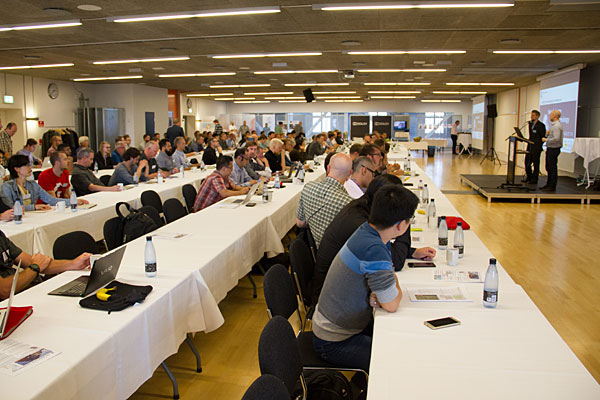
Some 100 engineers and scientists from around the globe assembled for the Audio Engineering Society's 2016 International Conference on Headphone Technology, in Aalborg, Denmark.

I figured it was coming, but it wasn't until just after I'd returned from the Audio Engineering Society's 2016 International Conference on Headphone Technology—held last August in Aalborg, Denmark—and was writing up my report and summary on the event for InnerFidelity.com (footnote 1) that I knew for sure: Headphones are about to change . . . a lot.

CD Tweaks & Listening Tests

In "Music and Fractals" in the November 1990 issue, I discuss how digital audio's quantization of amplitude information in what was originally a continuous waveform represents a fundamental difference between analog and digital representations of music. In a letter published in the English magazine Hi-Fi Review in January 1990, John Lambshead conjectured that naturally originating sounds were pseudo-fractal in character; that is, their waveforms have a wealth of fine detail, and that detail itself has an even finer-structured wealth of fine detail, and so on, until the crinkliness of the waveform is finally enveloped in the analog noise that accompanies every sound we hear.
Advertisement
Advertisement
Advertisement