Interviews

Sort By:  Post Date TitlePublish Date

A.J. van den Hul: Going Dutch

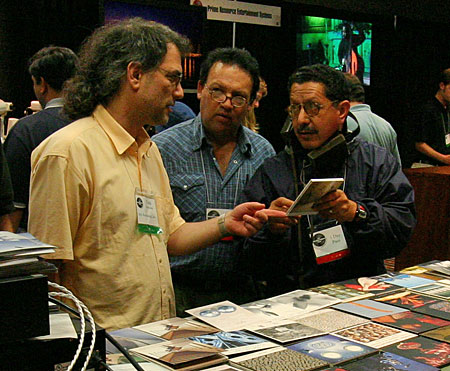
It was eight years ago that I first met Aalt Jouk van den Hul. I was visiting Ortofon in Denmark, and, with a group of hi-fi journalists from all over Europe, was traveling by bus to visit the cartridge-production facility in the far south of that country. Bus journeys are not my ideal way of passing time; naturally I gravitated to the rear of the bus, where bottles of Tuborg were making their presence felt. One journalist, however—a pixieish fellow hailing from The Low Countries—resisted the blandishments of the opened bottles. Producing a sheath of black-and-white glossies from his briefcase, he announced that he had just developed the ultimate stylus profile!
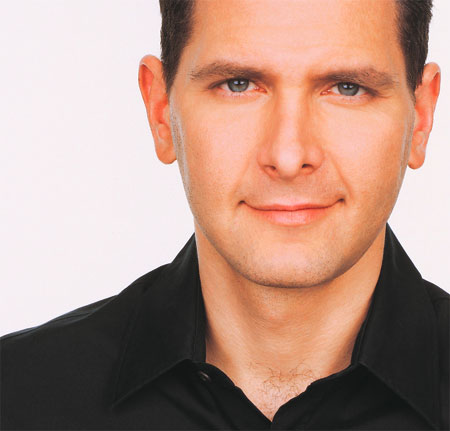
Willie Nile: Places He Has Never Been

Before I even turn on the recorder, Willie Nile is telling me his theory of how the granite under Manhattan Island conducts electricity, which accounts for the perceptible charge that many people feel makes New York City so special. It's also what draws artists like flies, none more passionate than singer-songwriter Nile, who's personally contributed a few volts during his years in NYC.

Kevin Voecks: Loudspeakers, Crossovers, & Rooms

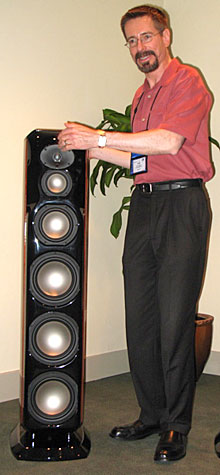
Since he joined Snell Acoustics in the mid-1980s, Kevin Voecks, their chief designer (footnote 1), has been involved in the design or redesign of the entire Snell line, from the minor revision of the Type">http://www.stereophile.com/floorloudspeakers/378snell">Type A/III (incorporation of a new tweeter), to the complete redesign of the Type C (now the CIII). Snell Acoustics is located in Massachusetts, and although Kevin spends a good deal of time there or at the measurement and analysis facilities of the Canadian National Research Council (NRC) in Ottawa, he does a great deal of his conceptual and preliminary design work, as well as his listening, in Los Angeles, where he makes his home. I visited him there last summer to gather a little insight into his background and loudspeaker design philosophy. I started by asking Kevin when had he first become interested in loudspeaker design...

Craig Kallman of Atlantic Records: Listen Closely

Label heads—those at the very highest positions of power at music companies. To anyone who's spent time near the record business, they're a mythical breed. Like gnomes. Or dragons. Often, it's their vision that spells success or failure for the label they run. And what they say goes. Over the years, many a legendary creature has assumed the title: Goddard Lieberson, Clive Davis, Mo Ostin, to name just a few of those who have survived and prospered. The list of those who did not is at least twice as long.

Todd Garfinkle of M•A Recordings—A World Citizen

Todd Garfinkle, guiding light of M•A">http://www.marecordings.com">M•A Recordings, travels the globe recording provocative music in unbelievably wonderful acoustic settings. Todd travels to exotic climes such as Macedonia and Southern Siberia to capture unique and beautiful traditional ethnic music and song. He records with only two omnidirectional microphones, the signals of which are fed into handmade recording equipment designed especially for his work. Kathleen and I caught up with him at St. Peter's on 20th Street, a popular recording venue in the West Village. After wrapping a session, Todd stopped by our loft, where we rolled some tape of our own...

Hiroyasu Kondo: Audio Notes

Our interview with Hiroyasu Kondo—founder of Audio Note Japan, and a legendary figure in his own time—took place during HI-FI '96 last June at the Waldorf=Astoria. It seemed very natural; the crowd at the Show was very internationalist. Herb Reichert of Audio Note New York found us a quiet corner after lunch, and we sat down to talk.

Noel Lee: The Monster is 10!

They say that time flies on faster wings once you pass 40, something that I have found to be more true than I care to think about. Yet even considering the unfortunately subjective nature of time, it hardly seems possible that it was 10 years ago, in those golden days of the first Conrad-Johnson preamplifier, Infinity">http://www.stereophile.com/floorloudspeakers/579infinity">Infinity RS4.5 and Hill Plasmatronic loudspeakers, Infinity class-A and Audio Research D110B power amplifiers, that a small San Francisco company, led by a drummer and mechanical engineer who had previously worked on laser-fusion target design at Lawrence Livermore Laboratory, virtually invented the high-end cable industry. I say "virtually," because Jean Hiraga in France, Robert Fulton in the US, and Saboru Egawa in Japan had laid down considerable experimental work in the mid-'70s showing that interconnects and speaker cables were hardly the passive devices conventional engineering considered them, and the highly capacitative Cobra Cable, distributed in the US by Polk and in the UK by Monitor Audio, was already destroying marginally stable power amplifiers in 1977.

David Wilson: WAMM!! WATT?!? WHOW!!! (& the Puppies!)

The French have a phrase for it: plus ça change, plus la même chose, which can be roughly translated as "the more things change, the more they stay the same." I was reminded of this when recently reading through the December 1980 issue of The Absolute Sound. There on p.368 was the statement that "Dave Wilson (Virgo) has joined the staff...to construct a testing program that will allow us to determine if some of the peculiarities and anomalies we hear in evaluating equipment can indeed be numerically measured."

Iván Fischer: The Maestro on Multichannel

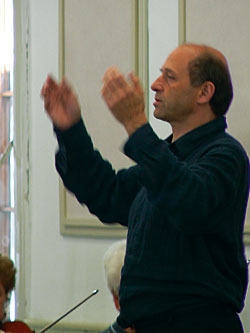
Iván Fischer, founder and conductor of the Budapest Festival Orchestra, has performed with many major orchestras and recorded for a number of major labels, most significantly with Philips, from 1995 to 2004. Fischer/BFO made the first multichannel orchestral recording for SACD, which Philips used as a demonstration disc for their first SACD players. I still treasure that disc—it demonstrates many of the advantages of the medium with a wide and varied program—but it has never been commercially released.

John Dawson: Inventing The Future—Properly

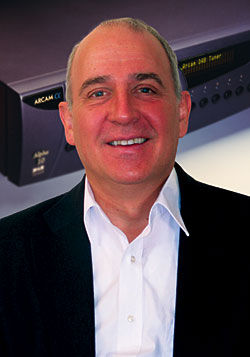
"This won't be a short job," says Arcam's president, John Dawson (footnote 1). He's talking about the challenge of engineering the next generation of Arcam home-theater products to embrace the new high-resolution video formats. It's possibly the biggest technical challenge English company Arcam has faced since, almost exactly 30 years ago, Dawson and his original business partner, Chris Evans, launched their first product—an unpretentious, 35W hi-fi amplifier called the A&R Cambridge A60.

Advertisement
Advertisement
Advertisement