Interviews

Sort By:  Post Date TitlePublish Date

Bill Firebaugh: The Well-Tempered Innovator

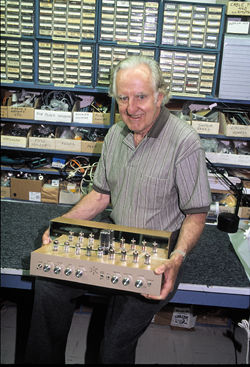
Bill Firebaugh's first product, the outrageous-looking Well-Tempered">http://www.stereophile.com/tonearms/485well">Well-Tempered (tone) Arm, established him as one of audio's most innovative designers. At the 1985 Winter CES, he showed a prototype companion product—the Well-Tempered Turntable—and was producing production units by January 1987. He discusses here the WTT's unusual design features. (Readers should note that, since we have not yet tested the new turntable, this interview is not to be interpreted as an endorsement of the product.)
Bob Stuart: The Prime Meridian

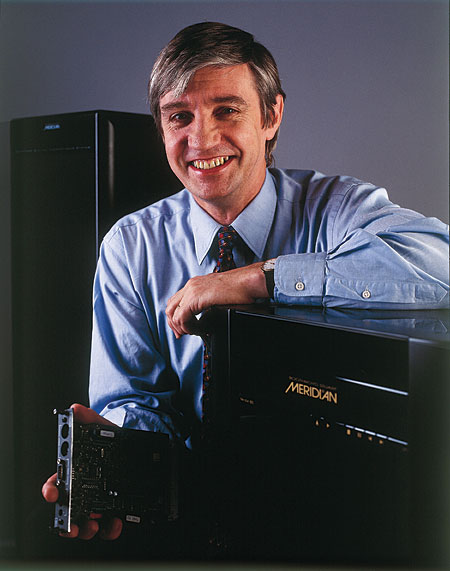
There are many colorful characters, many high-profile movers and shakers, in high-end audio, but there are only a few whose influence extends far beyond the promotion of their own brands. One of this exalted and mighty handful is Robert Stuart, chairman and technical director of the UK's Meridian Audio.

Richard Vandersteen: Keep on Truckin'

Richard Vandersteen doesn't look like a typical loudspeaker designer. True, he wears glasses, but his presence suggests a longshoreman or somebody who'd be played by Gene Hackman. And sure enough, he tells you in a quasi-Dukes of Hazzard drawl that he's been a construction worker, plumber, truckdriver, and electrician. Electronics had always been a hobby, but Vandersteen formalized his understanding by working in electronics during his stint in the Air Force. Back in civilian life, Vandersteen entered into speaker manufacture, producing the "baffleless" range, at least regarding the midrange driver and tweeter, which bears his name. The speakers, particualrly the Model">http://www.stereophile.com/floorloudspeakers/914">Model 2 and its variantshttp://www.stereophile.com/floorloudspeakers/284">variants;, have become, in a decade, one of America's most respected brands, despite RV's low-profile marketing techniques. I met with Richard at the Las Vegas CES in January and asked him what had got him started in loudspeaker design.

Walter Sear's Analog Rules

The first thing you notice about Walter Sear's legendary">http://www.searsound.com">legendary Manhattan studio is that it feels so darn comfortable. Sear Sound doesn't have a wall of gold records, gleaming million-dollar consoles, or the latest high-resolution digital workstations, but a quick stroll around the three studios reveals a treasure trove of tube and analog professional gear: a pair of Sgt. Pepper–era Studer recorders plucked from EMI's Abbey Road studios; an early Modular Moog synthesizer Sear built with Bob Moog; and a collection of 250 new and classic microphones.

Russellmania: Bryston & the Brothers Russell

Although the term "professional" is often used as part of model designations in consumer electronics, the actual overlap between the audiophile consumer market and the real pro market is quite small. There are speakers in common use as studio monitors that no self-respecting audiophile would want to be caught dead listening to, and the typical audiophile loudspeaker would go up in smoke if asked to pump out the kind of volume that pro application routinely demands. To a lesser extent, the same applies to amplifiers: pro is pro and consumer is consumer, and ne'er the twain shall meet.

A Glorious Time: AR's Edgar Villchur and Roy Allison

Editor's Note: In 1954, a New York writer and teacher reinvented the world of audio with the modest-looking Acoustic Research AR-1 loudspeaker. A small fraction of the size of the behemoths that were then de rigeur for the reproduction of bass frequencies, Edgar Villchur's loudspeaker went as low with less distortion. Perhaps more importantly, the AR-1 pioneered both the science of speaker design and the idea that a low-frequency drive-unit could not be successfully engineered without the properties of the enclosure being taken into account.

Jim Fosgate: Of (Surround) Sound Mind

Jim Fosgate fits the category of Classic American Inventor to a T. This softspoken, quietly intense man has earned 18 patents and founded three successful electronics companies. In the late 1970s, he pulled out of the car audio business to follow his quadraphonic bliss, and designed the Fosgate Tate 101, arguably the finest quad decoder of the era. He also created the best-selling matrix surround processor of all time, Dolby's Pro Logic II, and in 2003 won an Emmy for the Development of Surround Sound for Television. He now serves as a senior executive consultant for Fosgate Audionics, a division of the Rockford Corporation.

Jack Renner of Telarc: Direct from Cleveland!

Kathleen (K-10) and I first met Jack Renner—Telarc's Chairman, CEO, and Chief Recording Engineer—at Iridium, a tony jazz club here in New York. He was recording Benny Golson and the Jazz Messengers doing a rousing a tribute to Art Blakey. Now what would you think a guy who's won 31 Grammys over 21 years would be doing, exactly? Maybe feet up, a cigar languidly tracing curlicues in the air while directing his minions?

Tom Jung of DMP: Making Musical Sense

Tom Jung's career has been dotted with numbers. In 1969, he and a partner founded Sound 80, a Minneapolis recording studio named by an advertising wizard who had previously conjured up the appellation Cure 81 for a Hormel ham, supposedly while sipping Vat 69 scotch. Some years later, engineers from another Midwestern company with a numeral in its name, 3M, stopped by with an experimental tape recorder that also employed digits. Those zeros and ones proved critical to the recordings Jung went on to engineer and produce at his next company, Digital Music Products, better known as DMP.

Advertisement
Advertisement
Advertisement