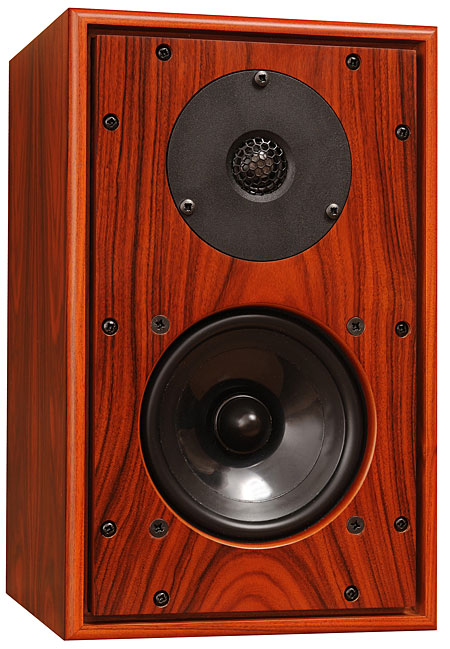
Audience ClairAudient 2+2 loudspeaker

It seems the obvious way to build a loudspeaker: one driver, no crossover, full range.
Instead, most speakers work this way: Complicated electronics split the audio signal into pieces, adding various colorations and phase shifts along the way. The pieces are distributed to different drivers, each of which adds another unique set of characteristics. We then expect these fragments of electronic signal to be brought together again in a continuous, coherent reproduction of music. We agonize over different cable routings or which contact cleaner to use, and yet we calmly accept this grotesque sausage-making way of building speakers. It's ludicrous.


 Yeah, yeah, I know what you're thinking: "Polk? You're reviewing a $300 speaker from Polk? Get ready for the flames!"
The genesis of this review lies in a casual comment
Yeah, yeah, I know what you're thinking: "Polk? You're reviewing a $300 speaker from Polk? Get ready for the flames!"
The genesis of this review lies in a casual comment 
 Cyrus is the name given to the higher-priced line of loudspeakers made by England's Mission Electronics. The entire Mission loudspeaker line includes six products under the Mission label and three under Cyrus. Mission also manufactures a wide range of electronics and CD players. The company has a long history of audio innovations, both in loudspeaker and electronic design. Among Mission's claimed "firsts" are the first polypropylene-cone drive-unit used in a product (1978), first widespread use of MDF loudspeaker enclosures (1981), and first CD player from a specialist manufacturer. Interestingly, Mission also makes IBM-compatible personal computers.
The $900/pair Cyrus 782 is a two-way design employing dual 7" (175mm) polypropylene-cone woofers and a single ¾" (19mm) fabric-dome tweeter. The drivers are arranged in a D'Appolito configuration to simulate point-source radiation characteristics. Both woofer and tweeter were designed from scratch by Mission. The polypropylene woofer cones include a "mineral loading" that reportedly increases cone rigidity, thus decreasing cone breakup. Additional woofer design features include a shaped pole piece to increase linearity during high cone excursions, rigid steel chassis to reduce driver resonances, and a tight tolerance between the voice-coil and magnet to increase sensitivity.
Cyrus is the name given to the higher-priced line of loudspeakers made by England's Mission Electronics. The entire Mission loudspeaker line includes six products under the Mission label and three under Cyrus. Mission also manufactures a wide range of electronics and CD players. The company has a long history of audio innovations, both in loudspeaker and electronic design. Among Mission's claimed "firsts" are the first polypropylene-cone drive-unit used in a product (1978), first widespread use of MDF loudspeaker enclosures (1981), and first CD player from a specialist manufacturer. Interestingly, Mission also makes IBM-compatible personal computers.
The $900/pair Cyrus 782 is a two-way design employing dual 7" (175mm) polypropylene-cone woofers and a single ¾" (19mm) fabric-dome tweeter. The drivers are arranged in a D'Appolito configuration to simulate point-source radiation characteristics. Both woofer and tweeter were designed from scratch by Mission. The polypropylene woofer cones include a "mineral loading" that reportedly increases cone rigidity, thus decreasing cone breakup. Additional woofer design features include a shaped pole piece to increase linearity during high cone excursions, rigid steel chassis to reduce driver resonances, and a tight tolerance between the voice-coil and magnet to increase sensitivity.