Stand Loudspeaker Reviews

Sort By:  Post Date TitlePublish Date

Paradigm Reference Studio/20 loudspeaker

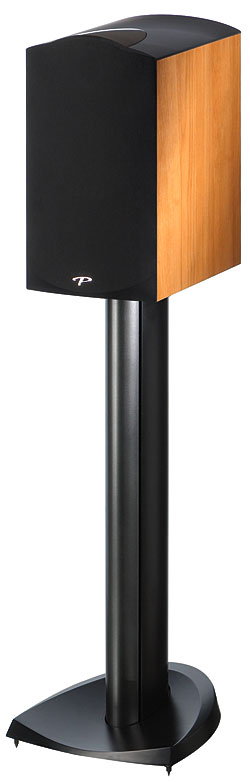
One of the first affordable loudspeakers I reviewed for Stereophile was the original Paradigm">http://www.stereophile.com/standspeakers/628">Paradigm Reference Studio/20 bookshelf model, in the February 1998 issue (Vol.21 No.2). At the time, I felt that the $650/pair speaker was a breakthrough—although not completely devoid of colorations, its ratio of price to performance set a benchmark a decade ago. I kept the Studio/20s around for several years to compare with other bookshelf speakers I reviewed, and they remained listed in Stereophile's "Recommended Components" for several years after that. The Studio/20 is now in its fourth (v.4) iteration, so I thought I'd grab a pair to hear how they compared with current affordable bookshelf designs.

Harbeth BBC LS5/12A loudspeaker

In the ice-cream world, chocolate is the universal end of the line. Vanilla experiments that taste great but look foul, maple syrup flavors that are more maple than syrup, tutti-frutti that's too tutti—all are recycled as chocolate flavor, their visual sins permanently hidden from view. In the world of wood, the equivalent of chocolate ice cream is the ubiquitous "black ash" veneer. The original color and character of the wood are irrelevant: it all ends up stained black.

Triangle Esprit Comete Ex loudspeaker

The first reference I saw to the Count of Saint Germain was in Foucault's Pendulum, Umberto Eco's dense novel about a man whose paranoid delusions become so overpoweringly real that, by the end of the book, the reader is left wondering whether the protagonist's enemies actually exist. That their number should include Saint Germain was a nice touch: Part cabalist, part confidence man, the real-life Count was thought by some to be immortal (in Pendulum he's pushing 300), and while Casanova wrote vividly of meeting Saint Germain at a dinner party in 1757, so did the English writer and pederast C.W. Leadbetter—in 1926. Like Aleister Crowley, the Count of Saint Germain can be seen peering over the shoulders of countless parlor (but not parleur, or even haut-parleur) occultists: He keeps popping up all over the place.

Silverline Audio Minuet loudspeaker

I always look forward to Stereophile's Home Entertainment Shows, where I scout out interesting new models of affordable loudspeakers. At HE2007">http://blog.stereophile.com/he2007">HE2007 in New York City, I was struck by the Silverline Audio room—not only by the sound I heard there, but by the way Showgoers reacted to that sound.

Monitor Audio Studio 15 loudspeaker

I believe Ken">http://www.stereophile.com/interviews/232">Ken Kantor said it first: a couple of years ago, in his September 1990 interview with Robert Harley (Vol.13 No.9), he remarked that "there's no reason why a two-way 6" loudspeaker can't be the equal of almost the best speaker out there from a certain frequency point upward, with the possible exception of dynamic range." When I read those words, they rang true. If you put to one side the need to reproduce low bass frequencies and can accept less-than-live playback levels, a small speaker can be as good as the best, and allow its owner to enjoy the benefits of its size—visual appeal, ease of placement in the room, and the often excellent imaging afforded by the use of a small front baffle.

Fried Q/4 loudspeaker

During the late 1970s and early '80s, I worked my way through college by selling hi-fi, or more precisely, mid-fi. During those years, I heard and sold several hundred different loudspeakers costing under $1000/pair. Despite the fact that I experienced them under less than ideal conditions, I was nevertheless able to get a feel for their relative performance. When switching between speakers, the differences between them were drastically juxtaposed. No two loudspeakers sounded even remotely similar tonally, indicating that they all had severe colorations.

Celestion 100 loudspeaker

I believe Ken">http://www.stereophile.com/interviews/232">Ken Kantor said it first: a couple of years ago, in his September 1990 interview with Robert Harley (Vol.13 No.9), he remarked that "there's no reason why a two-way 6" loudspeaker can't be the equal of almost the best speaker out there from a certain frequency point upward, with the possible exception of dynamic range." When I read those words, they rang true. If you put to one side the need to reproduce low bass frequencies and can accept less-than-live playback levels, a small speaker can be as good as the best, and allow its owner to enjoy the benefits of its size—visual appeal, ease of placement in the room, and the often excellent imaging afforded by the use of a small front baffle.

Cambridge SoundWorks Ambiance loudspeaker

According to the conventional wisdom, companies selling consumer products fall into two categories: those whose sales are "marketing-led" and those whose sales are "product-led." Marketing-led companies tend to sell mature products into a mature market where there are no real differences between competing products—soap powder, mass-market beer, or cigarettes, for example—whereas product-led companies tend to sell new technologies, such as personal computers and high-end hi-fi components. In the audio separates market, conventional wisdom would have a hard time categorizing any individual company: no matter which you choose, it would be simplistic to say that it is either product- or marketing-led. No matter how good the product, without good marketing the manufacturer stands little chance of success; a poor product superbly marketed may make a company successful overnight, but that success will have hit the end stops by the following night.

Escalante Design Fremont loudspeaker

Room lock occurs when a set of loudspeakers reproduces the deep-bass notes of a pipe organ powerfully enough that the sounds can be felt as pressure waves. On Day 2 of the 2007">http://blog.stereophile.com/he2007">2007 Home Entertainment Show, in one of the Sound By Singer rooms, our own John">http://www.stereophile.com/thefifthelement/">John Marks played his recording of organist James Busby performing Herbert Howells' Master Tallis's Testament through a pair of Fremont loudspeakers from Escalante Design. The sustained bass note at the end of the passage took my breath away—the stand-mounted Fremonts sounded as open and dynamic as anything else I heard at HE2007. I wondered if they'd sound as good in my home listening room.

Advertisement
Advertisement
Advertisement