Stand Loudspeaker Reviews

Sort By:  Post Date TitlePublish Date

Audioengine 2 powered loudspeaker

In nearly 25 years, it's been rare that I've reviewed an exciting breakthrough product. The Audioengine 2 is such a product—not because it performs at an extraordinary level (though it does), and not because it's such an incredible value for money (though it is), but because it creates a new market, a new application for high-end audio, and a chance for audiophiles to enjoy music in ways they may have never considered before.
Infinity Primus P162 loudspeaker

Home">http://blog.stereophile.com/he2007">Home Entertainment 2007 was a blast for me, as it is every year. Not only did I get to perform with two jazz bands, Attention">http://www.stereophile.com/musicrecordings/907att">Attention Screen and the John Atkinson Trio, but I enjoyed good to extraordinary sound in every room I visited. I've been attending hi-fi shows more than 20 years, so I'm rarely surprised, but HE2007 had two big surprises in store. First, the percentage of rooms sporting analog front-ends—vinyl and open-reel tape—was the highest I've seen at a show in over a decade. Second, there was a surprising number of very expensive loudspeakers. In fact, I counted more speakers costing over $50,000/pair than I did costing under $500/pair.

Paradigm Atom Monitor v.5 loudspeaker

When folks visit from out of town, they frequently remark that my Brooklyn neighborhood reminds them of "a real neighborhood" from their neck of the woods. "Except that we know all our neighbors and talk to them when we're cutting the grass, watering the lawn, and walking the dog. You probably don't even know the names of any of yours."

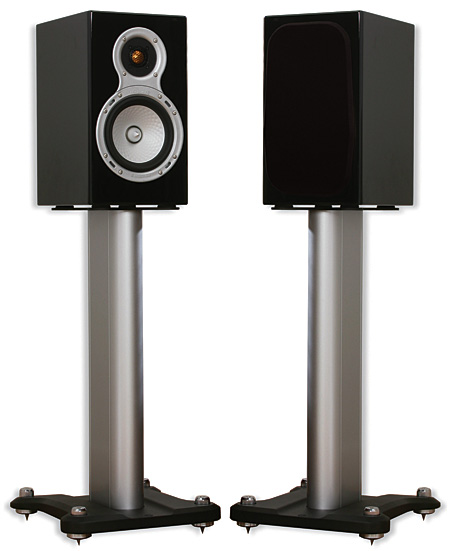
Monitor Audio Gold Signature GS10 loudspeaker

I had intended that my recent exploration of what was available in the world of high-performance minimonitors—the Era">http://www.stereophile.com/floorloudspeakers/107era">Era Acoustics Design 4 ($600/pair) in January, the Stirling">http://www.stereophile.com/floorloudspeakers/361/index12.html">Stirling LS3/5a V2 ($1695/pair) and Harbeth">http://www.stereophile.com/floorloudspeakers/1293harbeth/index5.html">H… HL-P3ES2 ($1850/pair) in April, the PSB">http://www.stereophile.com/floorloudspeakers/507psb">PSB Alpha B1 ($279/pair) in May—was to end in July, with my review of the American">http://www.stereophile.com/floorloudspeakers/707aad">American Acoustic Development Reference Silver-1 ($1550/pair). But there was one more real-world–priced, stand-mounted model that piqued my interest before I return to cost-no-object floorstanders in the substantial form of Sonus Faber's new Cremona Elipsa ($20,000/pair): the Gold Signature GS10 from Monitor Audio ($1495/pair).

Sonus Faber Guarneri memento loudspeaker

Audiophile eyes usually roll when a manufacturer describes a loudspeaker as a "genuine musical instrument." Musical instruments have specific characteristics of pitch and timbre. Ideally, a loudspeaker should be a portal to the music; the speaker itself should be neutral in pitch and timbre—in other words, the opposite of a musical instrument. That the sound produced should be "musical" is a different argument.

AAD Reference Silver-1 loudspeaker

Bookshelf loudspeaker. The phrase may be common usage, but I really dislike describing small speakers as "bookshelf" models. Place a pair of high-performance minis on a bookshelf against the wall and you destroy much of the sound quality for which you've paid. Yet place the same speakers on good stands well away from room boundaries, and while it could be argued that their footprint is no smaller than a conventional tower speaker, with the best designs you'll get true high-end sound, particularly regarding the accuracy of midrange reproduction and the stability of stereo imaging.

PSB Alpha B1 loudspeaker

When audiophiles speak of the "Golden Age" of audio components, they almost always are talking about amplifiers and preamplifiers, not loudspeakers. While a very few speaker models have stood the test of time—among them the BBC">http://www.stereophile.com/standloudspeakers/361">BBC LS3/5a, the Vandersteen">http://www.stereophile.com/floorloudspeakers/914">Vandersteen 2, the original">http://www.stereophile.com/artdudleylistening/706listening">original Quad electrostatic and the Quad">http://www.stereophile.com/floorloudspeakers/416">Quad ESL-63, some of the Magnepans, and the Klipschorn—almost no one would disagree that, taken en masse, the speakers of today outperform not just those of the 1960s and 1970s but even those of the 1980s and 1990s. The advent of low-cost, computerized test equipment, high-quality, inexpensive measuring microphones, and persuasive research into what measured parameters matter most to listeners who are listening for a neutral-sounding, uncolored loudspeaker (footnote 1), has led to an almost across-the-board improvement in speaker sound quality (footnote 2).

Advertisement
Advertisement
Advertisement