As We See It

Sort By:  Post Date TitlePublish Date

More on MQA

An economy of information transmitted . . . what was encoded was only what was needed, nothing more. (footnote 1)

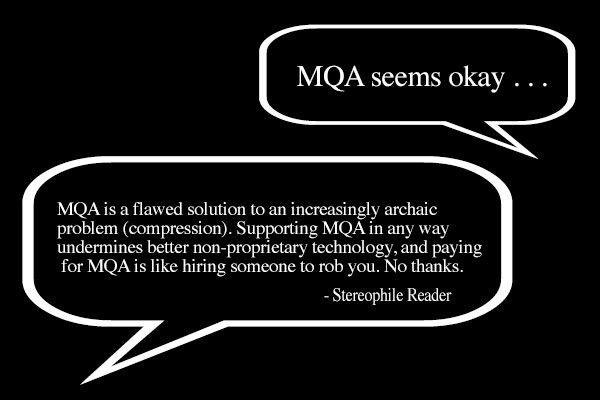
As I wrote in the January issue's "As We See It," Master Quality Authenticated (MQA), the encoding/decoding system developed by J. Robert (Bob) Stuart and Peter Craven, has been widely criticized, despite reports in this magazine and others that MQA-encoded files tend to sound better than the PCM originals from which they were derived. Also in last month's issue, Jim Austin investigated the time-domain performance of the MQA reconstruction filter and I examined some of the more general aspects, ending with: "Other criticisms of MQA involve its implications for the recording industry, for manufacturers of audio products, and for consumers. I will examine those in next month's 'As We See It.'"
MQA: Some Claims Examined

"The fundamental problem of communication is that of reproducing at one point either exactly or approximately a message selected at another point."—Claude Shannon

Since its announcement at the end of 2014, Master Quality Authenticated, the MQA encoding/decoding system, has spawned outspoken criticism. Some of the more thoughtful negative reactions have come from engineers such as Dan Lavry, Bruno Putzeys, and Daniel Weiss. Others have been expressed by manufacturers of digital products: the late Charley Hansen at Ayre Acoustics, for example, along with Jason Stoddard and Mike Moffat at Schiit Audio, John Siau at Benchmark Media Systems, and Jim Collinson at Linn Products. Some have been audio writers: Doug Schneider, at SoundStage!, and Paul Miller and Jim Lesurf, at Hi-Fi News. Most vociferous have been anonymous website posters. As Jim Austin remarks in his examination of MQA's decoding of impulse-response data elsewhere in this issue, "the nastiness online is unprecedented."

Why I Can't Stop Being an Audiophile

"Why can't you stop being an audiophile?"

The question took me off-guard. It didn't come from one of the usual suspects—a hostile anti-audiophile, or a non-audiophile who simply can't fathom why we should care so much about something as nonessential as sound reproduction—but from Louis, a sharp dressed, goateed, middle-aged man who was known, among his audio repair shop's clientele, for not only his virtuosity as a classical solo violinist, but his expertise—some would say his preternatural ability—in setting up turntables to sound their very best.

The Reviewer's Art

How many times have I asked myself what the purpose of music is? And what music really is, and what exactly I am trying to convey. What feelings? What ideas? How can I explain something that I myself cannot fathom?—Gabriel Fauré, letter to his wife, August 31, 1903

In writing reviews for Stereophile, I face a challenge. Whether I'm evaluating an audio component, a recording, or a live performance, I'm confronted by the fact that, when all is said and done, no one fully understands why or how the sound of a particular component, composition, or artist can affect us as powerfully as so many of them do. How and why music and sound moves us remains, fundamentally, a mystery.

What If Digital Had Never Happened?

Digital audio forever disrupted the way music is recorded, mixed, and mastered—and, to even greater extents, how music is distributed, sold, played, and consumed. Music unmolested by zeros and ones is now nearly extinct.

There's no going back, but what if, in 1983, the Compact Disc had bombed? What if music lovers worldwide had rejected the shiny new digital format because they thought LPs sounded so much better? And what if later attempts at digital formats with higher resolutions also shriveled and died, due to lack of interest by recording engineers and consumers? What if, to this day, music had remained blissfully all-analog?

Not-So-Giant Steps

I'm a thirty-year-old puppy doing what I'm told And I'm told there's no more coal for the older engines,"—Andy Partridge, "Train Running Low on Soul Coal"

"[We] know the truth of this: We would likely live happily ever after with a system from nearly 60 years ago. An idler-drive turntable, some Marantz electronics, and Quad ESL-57s can be very satisfying. The main improvements to be made are not necessarily in the area of musical enjoyment, but rather boring old reliability."

Enough with the Hobby Already

For the longest time, I've found the label "hobby" inadequate to describe the audiophile goal of better sound reproduction. Yes, for some, the mechanics of the High End have become an end in themselves—a way to tinker and tweak, build and rebuild in classic hobby fashion. But for many others, specifically earbud listeners, folks with whole-house systems, and those who'd rather push a button on a remote and sit back or dance rather than roll tubes or tinker, the descriptor hobby falls woefully short.

Don't Tell Your Friends!

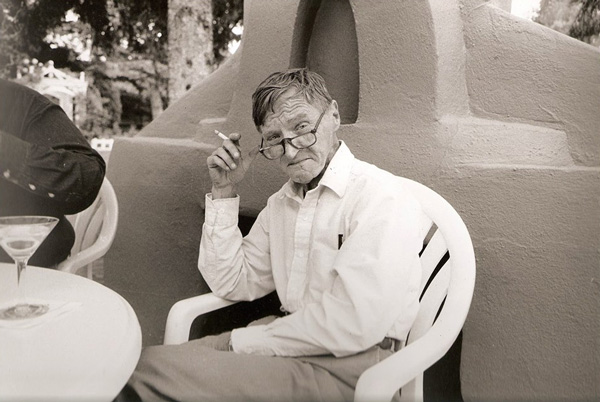
Stereophile's founder, J. Gordon Holt, photographed toward the end of his life by Steven Stone.

Editor's Note: The forthcoming August 2017 issue of Stereophile is No.451, but 55 years ago this summer, J. Gordon Holt was putting together the first issue of what initially was to be called The Stereophile. Here is Gordon's editorial leader from that issue, published in November 1962.

Balance

Balance is certainly a lovely concept, as well as a lofty ideal. But achieving an optimal sonic balance in a high-end audio system—whose final sound is determined, in part, by interactions among any number of components and that great bugaboo, the listening room—while maintaining some semblance of psychic equilibrium can be the hardest goal of all.
Advertisement
Advertisement
Advertisement