

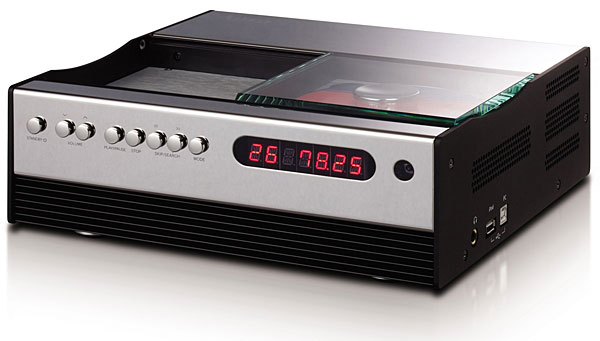
Described by manufacturer April Music as an "all-in-one music center," the Aura Note Version 2 ($2500) is a 125Wpc integrated amplifier with a built-in CD player, USB DAC, and FM tuner. The Aura Note is further enhanced by a Bluetooth receiver, a pair of line-level output jacks, and a headphone jack.
The hackneyed but not inappropriate comparison to a Swiss Army knife comes to mind—but where that well-loved tool does a great many things with less than perfection, I've now heard the Aura Note V2 do at least two different things well enough that no excuses need be made on its behalf. (By contrast, I keep my own Swiss Army knife in the glovebox of my car. I use its knife blade, scissors, bottle opener, screwdriver, and fishhook disgorger only when there are absolutely no other tools at hand.) But I'm getting ahead of myself . . .
Description
As with Jaws 2, Napoleon III, and Toto IV, the appearance of the Version 2 suggests that there once existed an original, unnumbered version of the Aura Note. Indeed, in 2005, April Music introduced the Aura Note Premier music center. That first Aura Note was distinguished by casework and ergonomics designed by Sir Kenneth Grange, the British industrial designer behind the Kodak Instamatic camera, the original Ronson cigarette lighter, the "pregnant kangaroo" enclosure for B&W's DM6 loudspeaker, and other iconic consumer goods.
In 2014, April Music upgraded their all-in-one music center to Version 2 status, while keeping in place all the elements of Sir Kenneth's original design. The V2's D/A converter performs at sampling rates of up to 192kHz (as opposed to the 48kHz limit of the original Aura Note), and can play FLAC, WAV, MP3, and WMA files from memory sticks inserted in its USB Type A socket (the Premier played only MP3 and WMA files). The V2's class-D power-amp section is specified as providing 125Wpc (up from the Premier's 50Wpc), and the V2 is the first Aura Note to be equipped with a Bluetooth receiver.
Now: With most review samples that come my way, I make every effort to pry my way inside the case—carefully and reversibly, and without risking damage or electrocution—to see what makes it tick, and to be able to make informed comments about its build quality. I found the Aura Note V2 practically impenetrable: After a few false starts—trying and failing to remove the unit's bottom panel, then its side panel, then its metal CD-tray liner—it became apparent that access to the Aura's innards could be had only by removing at least three parts of its outer casework and some two dozen screws. I declined, mostly out of fear that I might not get it all back together again. What little I could glimpse during those efforts seemed well executed, with no unpleasant surprises.
I was thus resigned to depending on the distributor, April Music USA, for technical information (footnote 1). That company's Sam Lee told me that the Aura Note V2 uses a Cirrus Logic CS4398 24-bit/192kHz DAC chip, which April Music supplements with a digital filter of their own design. Lee also informed me that the output section of the V2's power amplifier is built using class-D amp modules from ICEpower of Denmark, with operating voltages provided by a switch-mode power supply.
As with the Metronome CD8 S CD player I reviewed in the March 2016 issue, the Aura Note's case is square: 10.8" wide and deep, by 3.9" high. Its outer surfaces of heavily chromed steel are bolted to aluminum structures of various size, the latter including a heatsink that runs the full width of the front panel and is naturally integrated with it. On the V2's top surface is a half-width glass lid that slides easily to one side to grant access to the top-loading CD transport. A hefty little magnetic CD puck, also chromed, is supplied. On the chromed front panel are a display offering information of all sorts, and eight pushbuttons for various functions: Standby, Volume up and down, Play/Pause, Stop, Skip/Search back and forward, and Mode, the last for toggling through the V2's source inputs. I found the V2 easy to use—with the possible exception of programming the station presets for its FM tuner and connecting the V2 to a computer, this product could be operated without ever glancing at the owner's manual—and very attractive: Whatever they paid him, Sir Kenneth earned it.
Installation and setup
From the moment I opened its carton, everything about the Aura Note V2 exuded high quality and an abiding sense that April Music's sole goal had been to make the buyer happy. The carton itself was attractive, and clearly sturdy enough to make multiple trips. The packing was logical, effective, and pleasant to handle, right down to the fingerholds molded into the side pieces, located precisely where my fingers expected to find them. The accessories box contained everything a person might need: a dipole FM antenna, that weighty and well-made CD clamp, a USB cable, an AC power cord, and a nice new polishing cloth. The V2 itself was packed in one of those papery-fabric drawstring bags; it fit as snugly as if made for this product and this product only. In common with other contemporary audio products, powering up the V2 was a two-step procedure: The user flips a power switch tucked away on the rear panel, then presses the Standby button. When I first installed the Aura Note, and after I'd flipped the former yet before I'd pressed the latter—I hadn't yet read the instruction manual—I was surprised to see a message on its display: "PM 410."
Okay, I thought. The source selector defaults to the DAC function; that's very nice. But I'm not impressed by the fanciful sampling-rate estimate, or the fact that they left the C out of PCM. Only several minutes later did it occur to me that, in standby mode, the Aura Note was merely attempting to tell me the time of day. Whoops.
Playing CDs was simple enough: Slide the glass lid to the left, place a disc on the transport hub, secure the disc with the clamp, and slide the lid back to the right. As long as the mode switch is set to CD, the disc will then spin, the most basic index data will be displayed on the front panel, and the V2 will wait for you to press Play (but don't do it too soon, lest you have to do it again). If the mode isn't set to CD, none of those things will happen.
In an effort to use the V2's USB DAC input, I ran a USB cable from my iMac to the USB Type B socket on the Aura Note's right side panel. That done, there appeared in the Sound/Output window of Apple OS10.7.5 . . . absolutely nothing, apart from the default "Internal Speakers." Noting that the Aura Note was in standby mode, I switched it to normal playback mode and tried again. Again, nothing. I tried switching the input-selector switch to USB. Still nothing.
There followed some minutes of flailing about—rebooting, trying a different USB cable, considering looking at the owner's manual—until I remembered: USB is the label of the input associated with the Aura Note's USB Type A socket, which is reserved for the playing of music files from memory sticks. The input intended for use with USB DACs is labeled PC. Whoops.
In common with other contemporary audio products, powering up the V2 was a two-step procedure: The user flips a power switch tucked away on the rear panel, then presses the Standby button. When I first installed the Aura Note, and after I'd flipped the former yet before I'd pressed the latter—I hadn't yet read the instruction manual—I was surprised to see a message on its display: "PM 410."
Okay, I thought. The source selector defaults to the DAC function; that's very nice. But I'm not impressed by the fanciful sampling-rate estimate, or the fact that they left the C out of PCM. Only several minutes later did it occur to me that, in standby mode, the Aura Note was merely attempting to tell me the time of day. Whoops.
Playing CDs was simple enough: Slide the glass lid to the left, place a disc on the transport hub, secure the disc with the clamp, and slide the lid back to the right. As long as the mode switch is set to CD, the disc will then spin, the most basic index data will be displayed on the front panel, and the V2 will wait for you to press Play (but don't do it too soon, lest you have to do it again). If the mode isn't set to CD, none of those things will happen.
In an effort to use the V2's USB DAC input, I ran a USB cable from my iMac to the USB Type B socket on the Aura Note's right side panel. That done, there appeared in the Sound/Output window of Apple OS10.7.5 . . . absolutely nothing, apart from the default "Internal Speakers." Noting that the Aura Note was in standby mode, I switched it to normal playback mode and tried again. Again, nothing. I tried switching the input-selector switch to USB. Still nothing.
There followed some minutes of flailing about—rebooting, trying a different USB cable, considering looking at the owner's manual—until I remembered: USB is the label of the input associated with the Aura Note's USB Type A socket, which is reserved for the playing of music files from memory sticks. The input intended for use with USB DACs is labeled PC. Whoops.
Footnote 1: I don't mean to suggest that such sources can't be trusted. In 30 years of writing about playback gear, I've seen few products whose parts failed to match the manufacturer's claims. The only one to raise my eyebrows was a monumentally awful-sounding loudspeaker I reviewed in 1999, for Listener. Its enclosure was permanently sealed in such a way as to render its drive-units nonrepairable, nonreplaceable, and mostly invisible.
As with Jaws 2, Napoleon III, and Toto IV, the appearance of the Version 2 suggests that there once existed an original, unnumbered version of the Aura Note. Indeed, in 2005, April Music introduced the Aura Note Premier music center. That first Aura Note was distinguished by casework and ergonomics designed by Sir Kenneth Grange, the British industrial designer behind the Kodak Instamatic camera, the original Ronson cigarette lighter, the "pregnant kangaroo" enclosure for B&W's DM6 loudspeaker, and other iconic consumer goods.
From the moment I opened its carton, everything about the Aura Note V2 exuded high quality and an abiding sense that April Music's sole goal had been to make the buyer happy. The carton itself was attractive, and clearly sturdy enough to make multiple trips. The packing was logical, effective, and pleasant to handle, right down to the fingerholds molded into the side pieces, located precisely where my fingers expected to find them. The accessories box contained everything a person might need: a dipole FM antenna, that weighty and well-made CD clamp, a USB cable, an AC power cord, and a nice new polishing cloth. The V2 itself was packed in one of those papery-fabric drawstring bags; it fit as snugly as if made for this product and this product only.
In common with other contemporary audio products, powering up the V2 was a two-step procedure: The user flips a power switch tucked away on the rear panel, then presses the Standby button. When I first installed the Aura Note, and after I'd flipped the former yet before I'd pressed the latter—I hadn't yet read the instruction manual—I was surprised to see a message on its display: "PM 410."
Footnote 1: I don't mean to suggest that such sources can't be trusted. In 30 years of writing about playback gear, I've seen few products whose parts failed to match the manufacturer's claims. The only one to raise my eyebrows was a monumentally awful-sounding loudspeaker I reviewed in 1999, for Listener. Its enclosure was permanently sealed in such a way as to render its drive-units nonrepairable, nonreplaceable, and mostly invisible.















