

Sidebar 3: Measurements
I performed a full set of measurements on the April Music Aura Note V2 using my Audio Precision SYS2722 system (see the January 2008 "As We See It"). I looked first at the behavior of the digital inputs, using either S/PDIF data sourced from the Audio Precision via an optical link, or USB data from my MacBook Pro running on battery power. To avoid overloading the April's power-amplifier section, I examined the signals at its line-output jacks without any load attached to the speaker terminals. (Plugging headphones into the headphone jack mutes both the speaker and line-level outputs.) The TosLink input locked to data with sample rates up to 192kHz. Apple's AudioMIDI app revealed that the Aura Note V2 accepted 24-bit integer data at all sample rates from 32 to 192kHz. The USB Prober utility identified the receiver as the "Aura note V2" from "MCSLOGIC," and confirmed that its USB input operated in the optimal isochronous asynchronous mode. I didn't test the Bluetooth performance as I regard Bluetooth audio as a sonic compromise, due to the mandatory lossy codec used.
The Aura Note's playback of CDs boasted one of the greatest tolerances of disc defects I have encountered. Playing Pierre Verany's Digital Test CD, which has calibrated gaps in its data spiral, glitches in the Aura Note's output didn't appear until the gap reached 4mm in length! Digital playback preserved absolute polarity (ie, was non-inverting) at both the line and speaker outputs. A 1kHz tone at –12dBFS gave rise to a level of 2.69V at the line output with the volume control set to its maximum; with the volume control set to "70" (–15dB), data at –12dBFS resulted in a level of 12.5V at the speaker terminals. With digital data at 0dBFS, the volume control had to be set to "53" to give the same level, which suggests that volume control needs to be set to "70" or below to avoid clipping the output stage with digital signals.
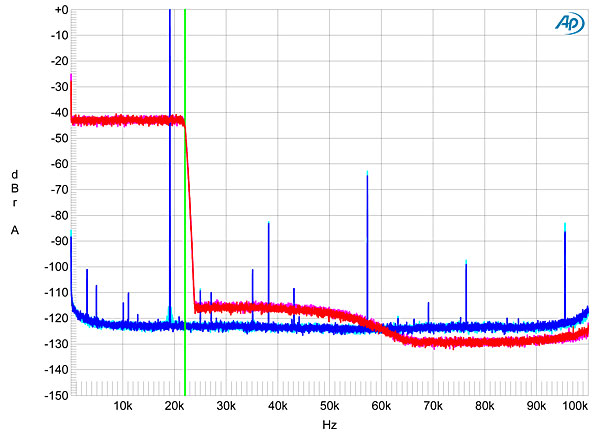
The impulse response with 44.1kHz data (fig.1) indicates that the Aura Note's reconstruction filter is almost a minimum-phase type, though there is still a small amount of pre-ringing present. The rolloff above 20kHz with 44.1kHz data is slower than usual (fig.2, red and magenta traces), though the aliasing product of a full-scale tone at 19.1kHz at 25kHz (blue, cyan) is still suppressed by 110dB. The third harmonic at 57.3kHz of the fundamental tone is relatively high in level, at –63dB (0.07%).

 Channel separation via the digital input was excellent, at >115dB below 2kHz, while fig.4 shows spectral analyses of the Aura Note's output when it was fed first dithered 16-bit data representing a 1kHz tone at –90dBFS (cyan, magenta traces), then 24-bit data representing the same signal (blue, red). The increase in bit depth drops the noise floor by around 10dB, which suggests that the digital decoder offers close to 18 bits of resolution. This graph was taken with USB data; TosLink data gave a slightly dirtier-looking noise floor, though there was still enough resolution to accurately reproduce a dithered 24-bit tone at –120dBFS (not shown). With undithered 16-bit data representing a tone at exactly –90.31dBFS (fig.5), the three voltage levels described by the data can be seen, but are overlaid with high-frequency noise. With undithered 24-bit data, the waveform was closer to a sinewave (not shown).

 Overall distortion was relatively low through the USB and TosLink inputs, though with an equal mix of 19 and 20kHz tones, the slow reconstruction-filter characteristic meant that the aliasing products at 24.1 and 25.1kHz were not as well suppressed as is usually the case (not shown). With J-Test data played from CD, the Aura Note offered excellent jitter suppression (fig.6). However, with TosLink data, a large number of data-related sidebands appeared (fig.7), suggesting that this input should not be used for critical listening.

 Turning to the receiver as a whole, its two Aux inputs offered an input impedance of between 29 and 36k ohms, depending on frequency, and preserved absolute polarity at both the speaker and line-level outputs. With the volume control at its maximum setting, an input signal of 1kHz at 100mV resulted in an output of 544.5mV at the line-level output, 14.5V at the headphone output and 14.25V into 8 ohms at the speaker output, respectively equivalent to voltage gains of 14.7 and 43dB. The volume control operated in accurate steps of 0.5dB, but I found that the Aux inputs could be overdriven with an input voltage of >3.3V. Given the high output of Art Dudley's EMT cartridge (1.05mV at 1kHz with a recorded velocity of 5cm/s) and the high gain of the combination of the his Shindo Aurieges phono preamplifier and Hommage transformer (>60dB), I suspect that these were the root causes of the crackling he heard when playing LPs. Yes, 3.3V represents a 10dB margin compared with the amplified voltage of the EMT cartridge at 5cm/s, but peaks on LPs can exceed 10dB ref. the same 5cm/s.
The preamplifier outputs offered a source impedance of a suitably low 43 ohms, the headphone output a high 30 ohms. Because the Aura Note V2 has a class-D output stage, there was almost 1V of ultrasonic noise present on its speaker output terminals, with a frequency of 508kHz when no signal was being amplified. I therefore measured the amplifier's behavior using, ahead of the analyzer, an Audio Precision AUX-0025 passive low-pass filter and for some measurements an additional brick-wall filter at 40kHz.
The Aura Note's output impedance at low and middle frequencies was a low 0.09 ohm. However, I couldn't get a meaningful measurement at the top of the audioband with my usual voltage-drop method, as the output voltage was higher into 4 ohms than into 8 ohms, due to the output filter and the load forming a resonant circuit. This can be seen in fig.8, where the output at 20kHz rises more into 2 ohms (green trace) than into 8 ohms (blue, red). The output plunges above 30kHz into all loads, but the modulation of the response by the Ohm's law interaction between the amplifier's output impedance and the impedance of our standard simulated loudspeaker is minimal (fig.8, gray trace). Commendably, the frequency response was not affected by the setting of the volume control, but the resonant behavior at the top of the audioband gives rise to a critically damped overshoot on the leading edges of a 10kHz squarewave (fig.9.).
Turning to the receiver as a whole, its two Aux inputs offered an input impedance of between 29 and 36k ohms, depending on frequency, and preserved absolute polarity at both the speaker and line-level outputs. With the volume control at its maximum setting, an input signal of 1kHz at 100mV resulted in an output of 544.5mV at the line-level output, 14.5V at the headphone output and 14.25V into 8 ohms at the speaker output, respectively equivalent to voltage gains of 14.7 and 43dB. The volume control operated in accurate steps of 0.5dB, but I found that the Aux inputs could be overdriven with an input voltage of >3.3V. Given the high output of Art Dudley's EMT cartridge (1.05mV at 1kHz with a recorded velocity of 5cm/s) and the high gain of the combination of the his Shindo Aurieges phono preamplifier and Hommage transformer (>60dB), I suspect that these were the root causes of the crackling he heard when playing LPs. Yes, 3.3V represents a 10dB margin compared with the amplified voltage of the EMT cartridge at 5cm/s, but peaks on LPs can exceed 10dB ref. the same 5cm/s.
The preamplifier outputs offered a source impedance of a suitably low 43 ohms, the headphone output a high 30 ohms. Because the Aura Note V2 has a class-D output stage, there was almost 1V of ultrasonic noise present on its speaker output terminals, with a frequency of 508kHz when no signal was being amplified. I therefore measured the amplifier's behavior using, ahead of the analyzer, an Audio Precision AUX-0025 passive low-pass filter and for some measurements an additional brick-wall filter at 40kHz.
The Aura Note's output impedance at low and middle frequencies was a low 0.09 ohm. However, I couldn't get a meaningful measurement at the top of the audioband with my usual voltage-drop method, as the output voltage was higher into 4 ohms than into 8 ohms, due to the output filter and the load forming a resonant circuit. This can be seen in fig.8, where the output at 20kHz rises more into 2 ohms (green trace) than into 8 ohms (blue, red). The output plunges above 30kHz into all loads, but the modulation of the response by the Ohm's law interaction between the amplifier's output impedance and the impedance of our standard simulated loudspeaker is minimal (fig.8, gray trace). Commendably, the frequency response was not affected by the setting of the volume control, but the resonant behavior at the top of the audioband gives rise to a critically damped overshoot on the leading edges of a 10kHz squarewave (fig.9.).


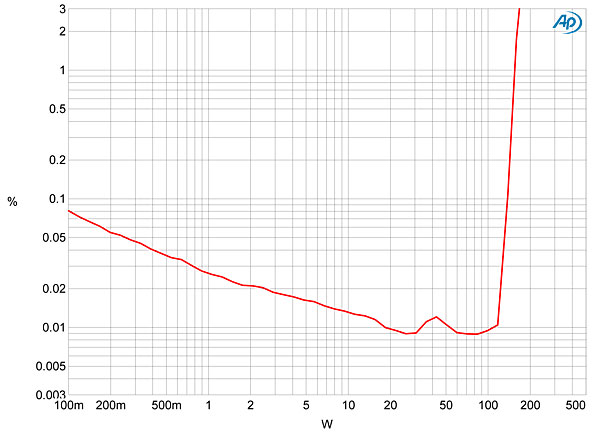
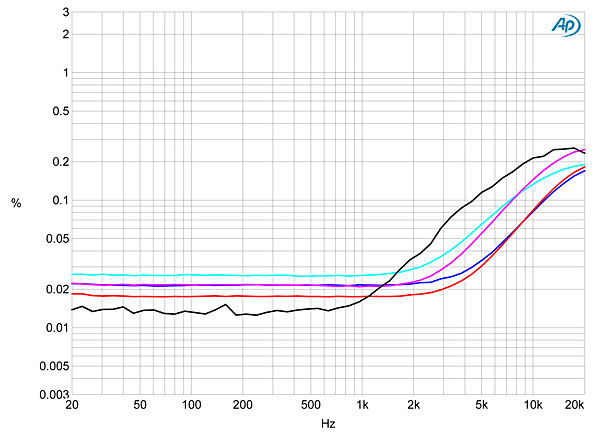
 The Aura Note V2's maximum power is specified as 125Wpc into 8 ohms (21dBW). How the percentage of THD+noise changed with output power with both channels driven into 8 and 4 ohms is respectively shown in figs. 11 and 12. With our definition of clipping as being when the THD+N reaches 1%, the amplifier clips at 148Wpc into 8 ohms (21.7dBW) and 270Wpc into 4 ohms (21.3dBW). This little amplifier is a powerhouse! I plotted how the THD+N percentage changed with frequency at a level, 12.65V, where I could be sure I was looking at distortion rather than noise. The resultant graph (fig.13) shows a constant level of THD+N at low and middle frequencies, but the usual rise in the top audio octaves. The 2 ohm trace (gray) was taken with just one channel driven, which is presumably why it shows lower THD+N below 2kHz than do the 4 and 8 ohm traces.



 Other than the disappointing performance via its TosLink input, April Music's Aura Note V2 CD receiver performed well on the test bench.—John Atkinson
Fig.1 April Music Aura Note V2, impulse response at 44.1kHz (4ms time window).
Fig.2 April Music Aura Note V2, TosLink input, wideband spectrum of white noise at –4dBFS (left channel red, right magenta) and 19.1kHz tone at 0dBFS (left blue, right cyan), with data sampled at 44.1kHz (20dB/vertical div.).
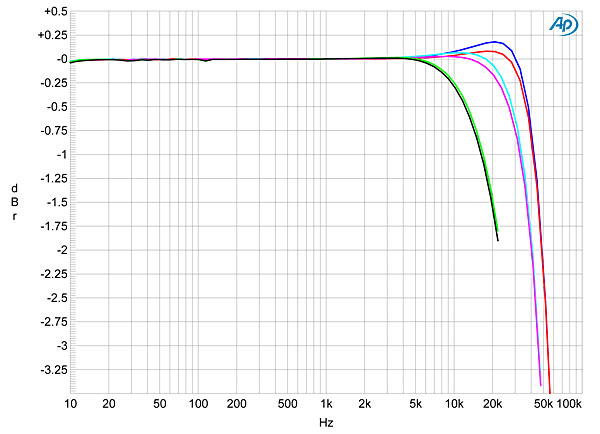
Fig.3 shows the digital input's frequency response with data sampled at 44.1, 96, and 192kHz. The early rolloff with 44.1kHz data (green and gray traces) can be seen, with the output down by 1.5dB at 20kHz. The low-pass rolloff is also earlier than usual at the higher sample rates, though with 192kHz data (blue, red), a slight peak is visible above the audioband; still, the ultrasonic response extends only slightly higher than it does with 96kHz data (cyan, magenta).
Fig.3 April Music Aura Note V2, TosLink input, frequency response at –12dBFS into 100k ohms with data sampled at: 44.1kHz (left channel gray, right green), 96kHz (left cyan, right magenta), 192kHz (left blue, right red) (0.25dB/vertical div.).
Fig.4 April Music Aura Note V2, USB input, 44.1kHz data, spectrum with noise and spuriae of dithered 1kHz tone at –90dBFS with: 16-bit data (left channel cyan, right magenta), 24-bit data (left blue, right red) (20dB/vertical div.).
Fig.5 April Music Aura Note V2, TosLink input, waveform of undithered 1kHz sinewave at –90.31dBFS, 16-bit data (left channel blue, right red).
Fig.6 April Music Aura Note V2, CD data, high-resolution jitter spectrum of analog output signal, 11.025kHz at –6dBFS, sampled at 44.1kHz with LSB toggled at 229Hz: 16-bit CD data (left channel blue, right red). Center frequency of trace, 11.025kHz; frequency range, ±3.5kHz.
Fig.7 April Music Aura Note V2, CD data, high-resolution jitter spectrum of analog output signal, 11.025kHz at –6dBFS, sampled at 44.1kHz with LSB toggled at 229Hz: 16-bit TosLink data (left channel blue, right red). Center frequency of trace, 11.025kHz; frequency range, ±3.5kHz.
Fig.8 April Music Aura Note V2, frequency response at 2.83V into: simulated loudspeaker load (gray), 8 ohms (left channel blue, right red), 4 ohms (left cyan, right magenta), 2 ohms (green) (0.5dB/vertical div.).
Fig.9 April Music Aura Note V2, small-signal, 10kHz squarewave into 8 ohms with Audio Precision LPF.
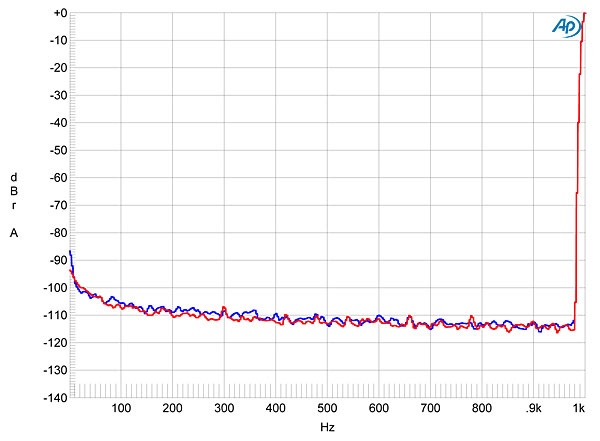
Channel separation at the speaker output was modest, at 60dB across the audioband. However, the amplifier's noise floor was free from AC-supply spuriae (fig.9), and while the unweighted, wideband signal/noise ratio (ref.2.83V into 8 ohms, taken with the inputs shorted to ground and the AP low-pass filter in circuit) was just 62.5dB, this improved to a respectable 80dB when the measurement bandwidth was restricted to the audioband, and to 84.3dB when A-weighted.
Fig.10 April Music Aura Note V2, spectrum of 1kHz sinewave, DC–1kHz, at 1W into 8 ohms with Audio Precision LPF (linear frequency scale).
Fig.11 April Music Aura Note V2, THD+N (%) vs 1kHz continuous output power into 8 ohms with Audio Precision LPF.
Fig.12 April Music Aura Note V2, THD+N (%) vs 1kHz continuous output power into 4 ohms with Audio Precision LPF.
Fig.13 April Music Aura Note V2, THD+N (%) vs frequency at 12.65V into: 8 ohms (left channel blue, right red), 4 ohms (left cyan, right magenta), 2 ohms (gray) with Audio Precision LPF.
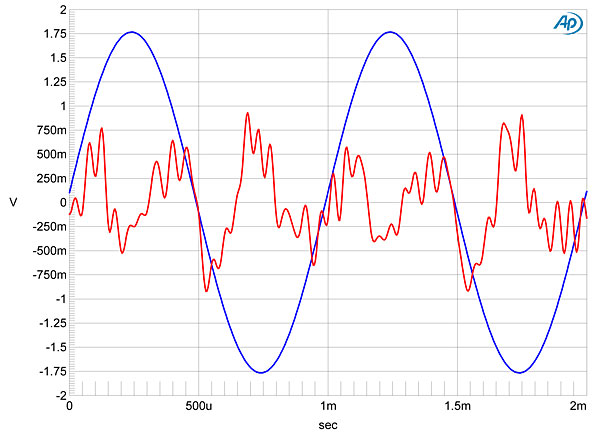
At moderate powers, the Aura Note's distortion is predominantly third-harmonic in nature (fig.14), though the two channels differ slightly in their harmonic makeups (fig.15). At low powers, any distortion components are buried beneath the noise floor (fig.16). Despite its decreasing linearity at high frequencies, the Aura Note V2 did well on the demanding high-power, high-frequency intermodulation test (fig.17). The difference component at 1kHz lay at –96dB (0.0015%), and the higher-order, higher-frequency components are all at or below –76dB (0.015%).
Fig.14 April Music Aura Note V2, 1kHz waveform at 20W into 8 ohms, 0.01% THD+N (blue); distortion and noise waveform with fundamental notched out (red, not to scale), with Audio Precision LPF.
Fig.15 April Music Aura Note V2, spectrum of 50Hz sinewave, DC–1kHz, at 40W into 4 ohms (linear frequency scale).
Fig.16 April Music Aura Note V2, spectrum of 50Hz sinewave, DC–1kHz, at 1W into 4 ohms (linear frequency scale).
Fig.17 April Music Aura Note V2, HF intermodulation spectrum, DC–24kHz, 19+20kHz at 40W peak into 4 ohms (linear frequency scale).















