

Using the front panel's source-selector switch, I toggled through the inputs until I came to PC. I went back to my iMac's Sound/Output window, and there it was: "Aura note V2." From that moment forward, all was well. The only curious thing about the V2's computer-audio performance was the fact that it did not display the sampling rates of the files I played.
Incidentally, setting up Bluetooth—which I actually attempted before computer-audio setup, also without benefit of instructions—was a breeze: In the Settings/Bluetooth window of my iPhone 6 Plus, the paired device came up as "Aura note V2(D1:56)," and did so in a matter of seconds: less a lingering handshake than a quick peck on the cheek, but it worked.
Supplied with the V2 is a relatively slim remote-control handset, notable only for its inclusion of controls not found on the front panel: buttons for setting time of day, creating up to 20 presets for the FM tuner, and selecting mono—though only for cleaning up FM stereo reception: there was otherwise no provision for mono playback, just as there was no balance control. Whoops.
Listening
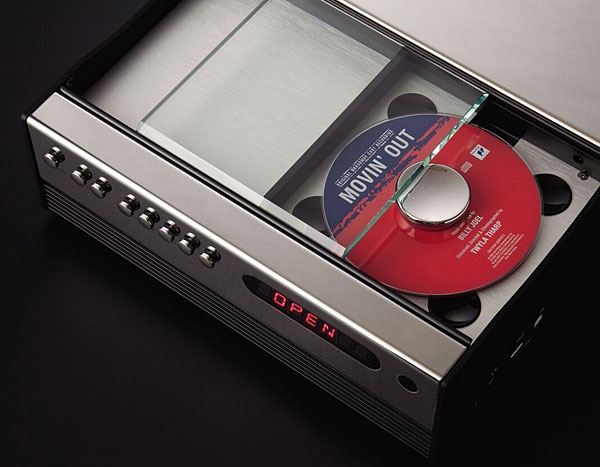
The first playback source I tried was the Aura Note V2's built-in CD player, and the first recording I tried was a reissue of violinist David Oistrakh and the London Symphony Orchestra, under the baton of Jascha Horenstein, performing Bruch's Scottish Fantasy (CD, Decca/Classic CSCD 6337)—an exceptionally good-sounding CD transfer of a remarkable analog recording from 1962. The Cliff Notes version of my response: Musically and sonically, the V2 played this disc in a manner so similar to my own gear—with color and clarity, spatial presence, and a good sense of momentum and flow—that I just fell into the performance and neglected to think. Of course, by the time Oistrakh entered, I realized that I wasn't hearing the same degrees of texture and realistic richness that I get from my more expensive Shindo Laboratory electronics: The Aura wasn't that good—but it was good enough to satisfy. I noted how big and resonant Kenny Burrell's guitar sounded in "A Sleepin' Bee," from his Soul Call (CD, Prestige/JVC JVCXR-0210-2), and how the V2's good momentum kept the unusually long solo intro from faltering, rhythmically. In "Pig in a Pen," from Ricky Skaggs's Ancient Tones (CD, Skaggs Family SKFR-CD 1001), Mark Fain's double bass sounded deep and powerful yet pacey and fast, and the vocals were vividly present in space.
But also with that last disc, when I pushed the volume too far, Stuart Duncan's fiddle intro to "Lonesome Night" sounded too aggressive. In fact, after a few weeks with the Aura Note V2, I came to realize that it had a loudness level beyond which it did not care to go; up to that point, it sounded better than its very reasonable price would suggest—but in very loud playback its top end coarsened a bit. The same effect set in when I asked the V2 to play early (read: terrible) CDs, such as Matthew Best and the Corydon Singers' recording of the Vaughan Williams Te Deum (Hyperion CDA66076), in which the choir's full-throttle entrance exhibited signs of audible strain. That coarseness was much less audible, and thus much less objectionable, through my DeVore Fidelity Orangutan O/96 speakers than through my Altec Valencias.
With the Aura Note's mode switch set to PC, I set about listening to a variety of files, noting as I did the V2's most consistent pluses: clarity, color, and, best of all, the same excellent sense of musical momentum and flow I heard while playing CDs. With "The Creation," from Franz Waxman's score for The Bride of Frankenstein, performed by Kenneth Alwyn and the Westminster Philharmonic Orchestra (AIFF from CD, Silva Screen FILMCD 135), the instruments were musically and spatially distinct from one another, and all were timbrally convincing. The insistent beating of the damped kettledrum had the right tension and touch, and the Aura Note effectively telegraphed the instrument's changes in intensity and, at the climax, in tempo. This recording uses a synthesizer in place of the called-for Ondes Martenot (essentially, a Theremin with more precise pitch control), and its sound rose and fell with fine color. And the big orchestral flourish that, in the film, coincides with Dr. Pretorius's (Ernest Thesiger) titular line was powerful and poised, though the orchestral bells were just a bit harsh in the loudest peaks.
 Listening to Opening, Metamorphosis One, and Truman Sleeps, from the collection Valentina Lisitsa Plays Philip Glass (Decca, 24/96 download), I was impressed with the V2's portrayal of the piano's tone, and of Lisitsa's variations in touch and flexible tempos (a little too flexible in some numbers, I think). Again, the sound seemed to coarsen somewhat on notes she played very loudly—an effect I avoided by keeping a judicious hand on the V2's volume buttons.
Anxious to try LPs through the ostensibly line-only Aura Note V2, I pressed into service Shindo's outboard phono preamp, the Aurieges Equalizer Amplifier, and directed its output to the V2's Line Input 1. I began playing Britten's Young Person's Guide to the Orchestra, with the composer conducting the London Symphony (LP, Decca SXL 6110), but was alarmed by a crackly distortion on the peaks of percussion instruments that sounded for all the world like coarse mistracking. WTF?
I disconnected the Aurieges phono preamp, plugged it into a line input of my regular Shindo electronics setup, and sat down to listen, worried that perhaps my EMT TSD 15 cartridge was ill. It wasn't—all was fine. Similarly, I retrieved from the other room my Croft Phono Integrated amplifier and used that to drive my speakers, with the Aurieges phono preamp feeding one of the Croft's line inputs. I heard no harshness.
I plugged the phono pre right back into the Aura Note, this time selecting Line Input 2, then reconnected the speakers to the V2's outputs and tried again. I heard the same harshness on the same peaks. Then, in one of those I know this won't work but I feel professionally obligated to try fits of activity, I tried running extra ground leads between various components, then tried changing my Shindo and Audio Note AN-Vx interconnects to other types. Nevertheless, through either of the Aura Note's line-level inputs, the Shindo Aurieges phono pre sounded unnaturally harsh, in a sense that suggested insufficient headroom in the V2.
Concerned—who wouldn't be?—I decided to try the V2's line inputs with another line-level source: my Sony SCD-777 SACD/CD player. I played the 2002 reissue of Glenn Gould's 1981 recording of J.S. Bach's Goldberg Variations (3 CDs, Sony Classical/Legacy S3K 87703, footnote 3). It sounded fine, and at least categorically similar to what I hear when I play that recording on the Sony through my Shindo electronics—a not-terribly-good recording of a decidedly peculiar-sounding concert grand—but absent the slightest suggestion of distortion on the peaks.
As Viv Stanshall says at the end of the Bonzo Dog Band's "Shirt," I think we're going to have to leave it there. In the event that the output of this $7900 phono preamplifier was too high for the input circuitry of this $2950 music center, the pairing is sufficiently unlikely as to leave me unconcerned—unless, of course, John Atkinson's measurements discover in the Aura Note some evidence of incompatibility with a larger selection of phono stages.
Over the Air Listening
Listening to Opening, Metamorphosis One, and Truman Sleeps, from the collection Valentina Lisitsa Plays Philip Glass (Decca, 24/96 download), I was impressed with the V2's portrayal of the piano's tone, and of Lisitsa's variations in touch and flexible tempos (a little too flexible in some numbers, I think). Again, the sound seemed to coarsen somewhat on notes she played very loudly—an effect I avoided by keeping a judicious hand on the V2's volume buttons.
Anxious to try LPs through the ostensibly line-only Aura Note V2, I pressed into service Shindo's outboard phono preamp, the Aurieges Equalizer Amplifier, and directed its output to the V2's Line Input 1. I began playing Britten's Young Person's Guide to the Orchestra, with the composer conducting the London Symphony (LP, Decca SXL 6110), but was alarmed by a crackly distortion on the peaks of percussion instruments that sounded for all the world like coarse mistracking. WTF?
I disconnected the Aurieges phono preamp, plugged it into a line input of my regular Shindo electronics setup, and sat down to listen, worried that perhaps my EMT TSD 15 cartridge was ill. It wasn't—all was fine. Similarly, I retrieved from the other room my Croft Phono Integrated amplifier and used that to drive my speakers, with the Aurieges phono preamp feeding one of the Croft's line inputs. I heard no harshness.
I plugged the phono pre right back into the Aura Note, this time selecting Line Input 2, then reconnected the speakers to the V2's outputs and tried again. I heard the same harshness on the same peaks. Then, in one of those I know this won't work but I feel professionally obligated to try fits of activity, I tried running extra ground leads between various components, then tried changing my Shindo and Audio Note AN-Vx interconnects to other types. Nevertheless, through either of the Aura Note's line-level inputs, the Shindo Aurieges phono pre sounded unnaturally harsh, in a sense that suggested insufficient headroom in the V2.
Concerned—who wouldn't be?—I decided to try the V2's line inputs with another line-level source: my Sony SCD-777 SACD/CD player. I played the 2002 reissue of Glenn Gould's 1981 recording of J.S. Bach's Goldberg Variations (3 CDs, Sony Classical/Legacy S3K 87703, footnote 3). It sounded fine, and at least categorically similar to what I hear when I play that recording on the Sony through my Shindo electronics—a not-terribly-good recording of a decidedly peculiar-sounding concert grand—but absent the slightest suggestion of distortion on the peaks.
As Viv Stanshall says at the end of the Bonzo Dog Band's "Shirt," I think we're going to have to leave it there. In the event that the output of this $7900 phono preamplifier was too high for the input circuitry of this $2950 music center, the pairing is sufficiently unlikely as to leave me unconcerned—unless, of course, John Atkinson's measurements discover in the Aura Note some evidence of incompatibility with a larger selection of phono stages.
Over the Air Listening
As I mentioned earlier, the V2's Bluetooth function worked—an outcome that, in the early days of that technology's adoption by the domestic-audio industry, was all one could ask. Today, Bluetooth is rosier—clearer, less murky, wider of bandwidth—and while the V2's wireless playback was sufficiently grainy not to be mistaken for high resolution, I found it surprisingly satisfying. And while "convenience" has never been my hi-fi watchword, I couldn't help being tickled by the ability to walk into the room and immediately play a song from my iPhone. (My 2010 Volkswagen Tiguan isn't sufficiently high-tech to allow such a thing—even when it's not on the lift at my local dealer's service department.)
From there, I made my way to the V2's FM tuner, which I tried with the included dipole antenna (the product formerly known as A Piece Of Wire), which plugs into a female F-connector on the V2's rear panel. Unfortunately, neither that nor my own el-cheapo indoor antenna were able to retrieve any signals that were both usable by the V2's tuner and representative of radio programming that I wished to hear.5
Headphone Listening
Finally, a word about using the Aura Note V2 with headphones—in this instance, a loaner pair of AudioQuest NightHawks, about which Herb Reichert wrote in the December 2015 edition of Gramophone Dreams. As Herb pointed out, it takes a while for a new pair of NightHawks to shake off their darkness; I have no idea how far along the tonal continuum this pair had progressed, but I do know that the NightHawks-V2 combination sounded grand. I heard no strain or grain of any sort—just a pleasantly richer-than-average listening experience. It never got better than with "Bunyan's Hymn (Monks Gate)," from John Renbourn's Traveller's Prayer (CD, Shanachie 78018): The fingerpicked steel-string guitar had beautiful tone, touch, and scale, and the colors and texture of the clarinets were richly gorgeous and convincing. Conclusion
For approximately two-thirds the price of an Aura Note Version 2, one can buy a Vorwerk Thermomix: a computerized kitchen appliance that chops, dices, kneads, blends, purées, shreds, steams, bakes, and sautés food. Since most households contain at least one person who has an interest in preparing food, the Thermomix would seem to have a sizable target audience, notwithstanding its considerable price; that said, there will remain segments of that market more attuned to traditional cooking—or to heating frozen entrées in the microwave, or to eating out.
Similarly, there's an audience for the Aura Note V2, some members of which may have even grander playback gear in a different room or domicile—while for others, an all-in-one, just-add-speakers music center is sufficient. For either such buyer, the V2 offers a generally very good musical and sonic experience, though I'd approach the mating of it with a phono preamp with caution if I approached it at all, and I advise similar care in speaker matching. Recommended, with caveats.
Footnote 2: This was mastered not from the 1981 digital recording—which, by 2002, Sony themselves and even a few members of the techie community were able to admit sounded awful—but from the analog safety recording made at the session, which it appears that no one, until then, had ever bothered listening to. Footnote 3: It seems that, in the months since I last wrote about the enjoyment of FM broadcasts, the Jesus stations in these radio-deprived outlands have upped their transmitting game. Literally the only intelligible broadcast I heard while scanning the airwaves with this tuner was this impassioned sentence fragment: ". . . INFLICTED BY AN ARROW FROM THE BOW OF GOD'S COVENANT!" I bailed.
The first playback source I tried was the Aura Note V2's built-in CD player, and the first recording I tried was a reissue of violinist David Oistrakh and the London Symphony Orchestra, under the baton of Jascha Horenstein, performing Bruch's Scottish Fantasy (CD, Decca/Classic CSCD 6337)—an exceptionally good-sounding CD transfer of a remarkable analog recording from 1962. The Cliff Notes version of my response: Musically and sonically, the V2 played this disc in a manner so similar to my own gear—with color and clarity, spatial presence, and a good sense of momentum and flow—that I just fell into the performance and neglected to think. Of course, by the time Oistrakh entered, I realized that I wasn't hearing the same degrees of texture and realistic richness that I get from my more expensive Shindo Laboratory electronics: The Aura wasn't that good—but it was good enough to satisfy. I noted how big and resonant Kenny Burrell's guitar sounded in "A Sleepin' Bee," from his Soul Call (CD, Prestige/JVC JVCXR-0210-2), and how the V2's good momentum kept the unusually long solo intro from faltering, rhythmically. In "Pig in a Pen," from Ricky Skaggs's Ancient Tones (CD, Skaggs Family SKFR-CD 1001), Mark Fain's double bass sounded deep and powerful yet pacey and fast, and the vocals were vividly present in space.
Listening to Opening, Metamorphosis One, and Truman Sleeps, from the collection Valentina Lisitsa Plays Philip Glass (Decca, 24/96 download), I was impressed with the V2's portrayal of the piano's tone, and of Lisitsa's variations in touch and flexible tempos (a little too flexible in some numbers, I think). Again, the sound seemed to coarsen somewhat on notes she played very loudly—an effect I avoided by keeping a judicious hand on the V2's volume buttons.
As I mentioned earlier, the V2's Bluetooth function worked—an outcome that, in the early days of that technology's adoption by the domestic-audio industry, was all one could ask. Today, Bluetooth is rosier—clearer, less murky, wider of bandwidth—and while the V2's wireless playback was sufficiently grainy not to be mistaken for high resolution, I found it surprisingly satisfying. And while "convenience" has never been my hi-fi watchword, I couldn't help being tickled by the ability to walk into the room and immediately play a song from my iPhone. (My 2010 Volkswagen Tiguan isn't sufficiently high-tech to allow such a thing—even when it's not on the lift at my local dealer's service department.)
Finally, a word about using the Aura Note V2 with headphones—in this instance, a loaner pair of AudioQuest NightHawks, about which Herb Reichert wrote in the December 2015 edition of Gramophone Dreams. As Herb pointed out, it takes a while for a new pair of NightHawks to shake off their darkness; I have no idea how far along the tonal continuum this pair had progressed, but I do know that the NightHawks-V2 combination sounded grand. I heard no strain or grain of any sort—just a pleasantly richer-than-average listening experience. It never got better than with "Bunyan's Hymn (Monks Gate)," from John Renbourn's Traveller's Prayer (CD, Shanachie 78018): The fingerpicked steel-string guitar had beautiful tone, touch, and scale, and the colors and texture of the clarinets were richly gorgeous and convincing. Conclusion
For approximately two-thirds the price of an Aura Note Version 2, one can buy a Vorwerk Thermomix: a computerized kitchen appliance that chops, dices, kneads, blends, purées, shreds, steams, bakes, and sautés food. Since most households contain at least one person who has an interest in preparing food, the Thermomix would seem to have a sizable target audience, notwithstanding its considerable price; that said, there will remain segments of that market more attuned to traditional cooking—or to heating frozen entrées in the microwave, or to eating out.
Footnote 2: This was mastered not from the 1981 digital recording—which, by 2002, Sony themselves and even a few members of the techie community were able to admit sounded awful—but from the analog safety recording made at the session, which it appears that no one, until then, had ever bothered listening to. Footnote 3: It seems that, in the months since I last wrote about the enjoyment of FM broadcasts, the Jesus stations in these radio-deprived outlands have upped their transmitting game. Literally the only intelligible broadcast I heard while scanning the airwaves with this tuner was this impassioned sentence fragment: ". . . INFLICTED BY AN ARROW FROM THE BOW OF GOD'S COVENANT!" I bailed.















