You can connect the Powernode to your network via Ethernet or WiFi. Since WiFi sound quality is dictated by a number of variables, including signal strength and network traffic, it's difficult to ensure perfect playback. At its worst, a poor WiFi connection will cause dropouts during play, which I find unacceptable. One way to help ensure WiFi quality is to get a dual-band WiFi router and dedicate one band to music.
Bluesound Node ($449)
The Bluesound Node is similar to the Powernode but even smaller (8" W by 5.7" H by 6.5" D). It comprises a network player and a 24/192-capable Cirrus Logic DAC, while offering a pair of RCA outputs and TosLink digital output. It has the same set of inputs as the Powernode, so you can run the Node wired or wireless. The Node also has a digital volume control that you can defeat in the Bluesound app, so you can connect it directly to a power amplifier. You can also couple the Node to your own DAC, so long as the DAC can accommodate TosLink. Bluesound Duo ($899)
The Duo, a straightforward satellite-subwoofer loudspeaker system designed by Paul Barton of PSB Speakers, is meant to be powered by the Powernode. Each satellite has a 4", metalized-polymer midrange driver with a rubber surround and a ferrofluid-cooled, 1" aluminum-dome tweeter. The subwoofer is powered by a 110W class-H discrete MOSFET amplifier driving a single bottom-ported 8" cone. The sub has an On/Off switch, volume control, variable crossover, phase switch, one pair of low-level RCA inputs, and pairs of speaker binding posts. The Bluesound app comes with a custom DSP setting for the Duo that improves the latter's in-room response, the company says. The system is rated by Bluesound at 36Hz–23kHz, ±3dB on axis at 0°.
Bluesound Pulse ($699)
The Bluesound app comes with a custom DSP setting for the Duo that improves the latter's in-room response, the company says. The system is rated by Bluesound at 36Hz–23kHz, ±3dB on axis at 0°.
Bluesound Pulse ($699)
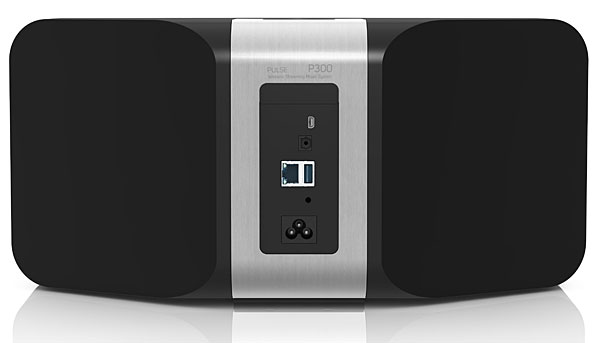
The Bluesound Pulse is a network-ready boom box measuring 16.4" W by 7.7" H by 7.4" D and weighing 13.4 lbs. It has an 80W (total power), biamplified Direct-Digital amplifier by NAD, two 2.75" drivers, and one 5.75" long-throw woofer, for a claimed frequency range of 45Hz–20kHz. The Pulse includes Ethernet and TosLink inputs, WiFi, and Bluetooth (via an optional dongle), and its basic playback controls, including volume, are mounted on its top. It requires AC wall power.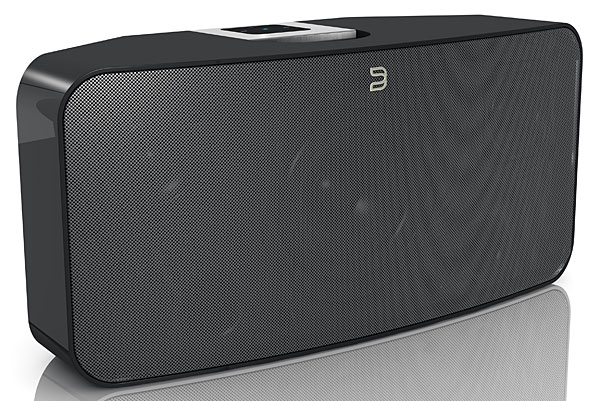
 Playing with Bluesound
The Vault and Node mainly resided on my Box Furniture Co. equipment rack in my main listening room; the other devices were scattered around our home. My main system includes the Pass Labs INT-30A integrated amplifier driving the DeVore Fidelity Gibbon Nine speakers. Cables and interconnects were from Kimber Kable, Auditorium 23, and AudioQuest. I had the Bluesound system access the AIFF library on my QNAP NAS, which houses approximately 11,000 files of CD and higher resolution, up to and including 24/192. I also loaded up the Vault with music using my iMac by dragging files from my NAS and dropping them into the Vault, which shows up as a network device in Apple's Finder. For streaming services, I mainly used Rdio and TuneIn Radio. The Bluesound app was a pleasure to use, and very responsive, with near zero lag time when I scrolled, browsed, or searched.
With the Vault connected to my Pass INT-30A, the sound was robust, full, and rich, if somewhat on the dark side. I've heard more-lit-up sound, more resolution, more microdetail—but comparing the Vault to other devices is difficult, as so few offer all of the same functionality. While you can certainly assemble the same set of features with separates, you'll also have to deal with a number of different boxes and apps. If the notion of a single interface for ripping, playing, and even buying music downloads appeals to you, the Vault delivers that.
Via TosLink, I coupled the Vault with the Auralic Vega, a DAC that both John Atkinson and I have reviewed favorably, and easily heard sonic improvements, including greater resolution, richer tone colors, and more of the lovely upper-end sparkle I've come to associate with the Vega.
The Node's analog output offered a sonic palette very similar to the Vault's: rich, full, and fun. While the Node didn't provide the last word in the resolution of low-level detail, I completely enjoyed listening to it as a network player and DAC, its sonic flavor reminding me of NAD's D 1050 DAC. I found I preferred using my Pass INT-30A's volume control to the Node's—the Pass seemed to provide a richer, fuller sound, even at low levels, while the Node's tended to wash things out. Using its TosLink output to the Auralic Vega offered the same sonic improvements as noted with the Vault. So if you have a TosLink-capable DAC that you enjoy, the Node offers a good solution for adding network-based music. The more expensive and DACless Moon MiND network player from Simaudio ($1300) restored the resolution I'd found missing with the Node, letting me hear further into the recording—especially when connected to the Vega via AES/EBU.
The Powernode-Duo combo carried on the Bluesound tradition of fit, full, and fun while also delivering big-ass, smile-inducing bass. Using the Bluesound app's optional custom DSP setting for the Duo helped snap the sound into clearer focus. Bass-heavy music like Congo Natty's excellent Jungle Revolution (16/44.1k, Big Dada) was pure chest-thumping pleasure; more delicate fare, such as pianist Angela Hewitt's take on keyboard works by J.S. Bach, from a ripped Hyperion CD, held together very well, offering the full weight and range of her piano. This combo had no problems filling a small room (16' by 14' by 9') with music. I compared the Powernode to Cambridge Audio's Minx Xi ($899.99), which offers similar features plus additional inputs and a headphone amp, both driving my DeVore Nines, and found the Bluesound offered a more engaging sound overall; the Minx was a bit thin in comparison.
Perhaps the most pleasant surprise came from the Pulse. The handful of portable Bluetooth speakers I've spent time with have sounded fairly anemic. The Bluesound Pulse, on the other hand, was relatively rich. In 24/88.2, Deep Rumba's beautifully recorded A Calm in the Fire of Dances (24/88.2k, American Clave) sounded very natural and sweet, with nice weight and color in the opening track, "Cubana," for solo saxophone.
I ran the Pulse strictly via WiFi and had no problems with dropouts, even with 24/192 files. Your mileage may vary. I also streamed some music to the Pulse and Node from my iPhone via Bluetooth, and while the sound was obviously not up to even CD quality, I see Bluetooth as a simple way of allowing other people to play their music through your hi-fi—in my book, a win-win.
I played all manner of music through the Bluesound devices—from streamed lossy files to CD quality to hi-rez downloads—and while I enjoyed them all, better-quality recordings simply sounded better, and higher-rez better-quality recordings sounded best. While I can enjoy listening to lossy streams to discover new music, I find I grow tired of their sound. It's like having an itch I can't scratch.
A Musical Ecosystem
I enjoyed my time with the Bluesound components. Their combination of rich, full, fun sound encouraged long-term listening. I also found them to be reasonably priced for their level of performance, and they let the buyer easily add music around the home by mixing various Bluesound components with an existing hi-fi, and/or running them solo while controlling everything from a single, easy-to-use app. While there are countless other ways to accomplish those ends while also improving on the Bluesound sound, they'll assuredly involve adding layers of complexity. Pick your poison.
The Bluesound Node is similar to the Powernode but even smaller (8" W by 5.7" H by 6.5" D). It comprises a network player and a 24/192-capable Cirrus Logic DAC, while offering a pair of RCA outputs and TosLink digital output. It has the same set of inputs as the Powernode, so you can run the Node wired or wireless. The Node also has a digital volume control that you can defeat in the Bluesound app, so you can connect it directly to a power amplifier. You can also couple the Node to your own DAC, so long as the DAC can accommodate TosLink.
Bluesound Duo ($899)The Duo, a straightforward satellite-subwoofer loudspeaker system designed by Paul Barton of PSB Speakers, is meant to be powered by the Powernode. Each satellite has a 4", metalized-polymer midrange driver with a rubber surround and a ferrofluid-cooled, 1" aluminum-dome tweeter. The subwoofer is powered by a 110W class-H discrete MOSFET amplifier driving a single bottom-ported 8" cone. The sub has an On/Off switch, volume control, variable crossover, phase switch, one pair of low-level RCA inputs, and pairs of speaker binding posts.
The Bluesound app comes with a custom DSP setting for the Duo that improves the latter's in-room response, the company says. The system is rated by Bluesound at 36Hz–23kHz, ±3dB on axis at 0°.
The Bluesound Pulse is a network-ready boom box measuring 16.4" W by 7.7" H by 7.4" D and weighing 13.4 lbs. It has an 80W (total power), biamplified Direct-Digital amplifier by NAD, two 2.75" drivers, and one 5.75" long-throw woofer, for a claimed frequency range of 45Hz–20kHz. The Pulse includes Ethernet and TosLink inputs, WiFi, and Bluetooth (via an optional dongle), and its basic playback controls, including volume, are mounted on its top. It requires AC wall power.
Playing with BluesoundThe Vault and Node mainly resided on my Box Furniture Co. equipment rack in my main listening room; the other devices were scattered around our home. My main system includes the Pass Labs INT-30A integrated amplifier driving the DeVore Fidelity Gibbon Nine speakers. Cables and interconnects were from Kimber Kable, Auditorium 23, and AudioQuest. I had the Bluesound system access the AIFF library on my QNAP NAS, which houses approximately 11,000 files of CD and higher resolution, up to and including 24/192. I also loaded up the Vault with music using my iMac by dragging files from my NAS and dropping them into the Vault, which shows up as a network device in Apple's Finder. For streaming services, I mainly used Rdio and TuneIn Radio. The Bluesound app was a pleasure to use, and very responsive, with near zero lag time when I scrolled, browsed, or searched.
I enjoyed my time with the Bluesound components. Their combination of rich, full, fun sound encouraged long-term listening. I also found them to be reasonably priced for their level of performance, and they let the buyer easily add music around the home by mixing various Bluesound components with an existing hi-fi, and/or running them solo while controlling everything from a single, easy-to-use app. While there are countless other ways to accomplish those ends while also improving on the Bluesound sound, they'll assuredly involve adding layers of complexity. Pick your poison.