Jon Iverson wrote about the JitterBug in January 2016 (Vol.39 No.10):
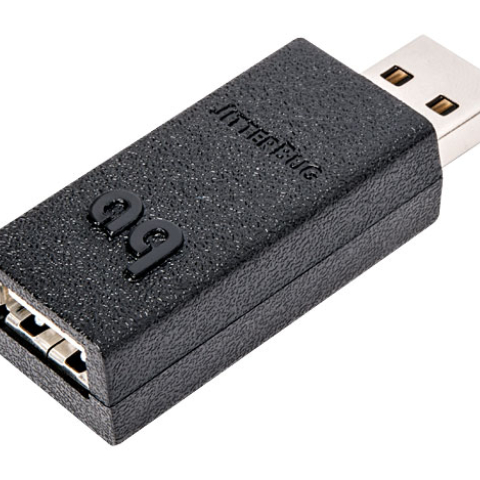
I've been a bit (or two) hard on the DragonFly compared to the Groove, but this JitterBug thing is something else entirely. It noticeably tightened up the details and the top end, and pushed the Apogee Groove into the Aurender Flow's orbit. A couple times at the beginning of Shawn Colvin's version of Gerry Rafferty's "Baker Street," from her new album, Uncovered (CD, Fantasy 7237415), the acoustic guitarist snaps the strings à la Michael Hedges; with the JitterBug, the effect was more focused, and jumped dynamically out from the soundstage. Then the vocals and the rest of the band come in, and the space feels bigger and more natural. Who'd have thought?—Jon Iverson
Kalman Rubinson also wrote about the JitterBug in January 2016 (Vol.39 No.10):
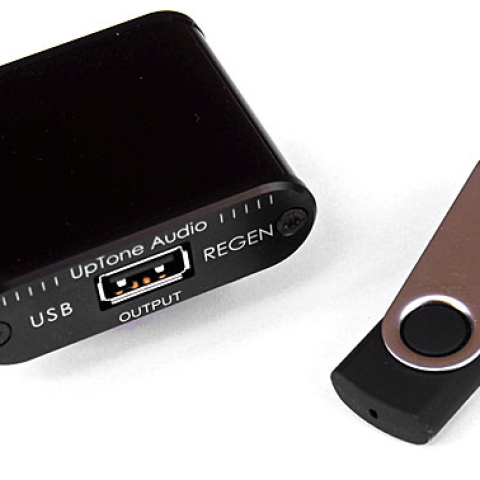
John Atkinson and the crew at AudioStream.com (footnote 1) have already scrutinized this little gadget ($49), and everyone seems to like it. How could I not give it a try? I was particularly interested in using it in my weekend system in Connecticut, in which resides my already overachieving miniDSP U-DAC8 multichannel USB DAC: Getting eight channels of USB D/A for $299 is amazing—and budget-priced products always seem ripe for tweaking. And, as I reported last time, UpTone's USB Regen—a USB signal regenerator intended to isolate audio peripherals from computer-system noise—had made a hugely satisfying improvement in that system's sound: Surely, the miniDSP would be a suitable mate for the bruited 'Bug.
When I asked AudioQuest for one, they sent two: AQ recommends using two—and no more—JitterBugs on each USB bus. I searched the JitterBug's box, and AQ's detailed instructions about how to use JitterBugs with various USB-connected devices, for any information about precisely what it does, and how. I found only two relevant statements:
"JitterBug is designed to remove unwanted noise currents and parasitic resonances from both the data (communication) and Vbus (power) lines of USB ports. . . .
"JitterBug's dual-circuitry measurably reduces unwanted noise currents and parasitic resonances. It also reduces jitter and packet errors (in some cases, packet errors are completely eliminated)."
Well, that's admirable—but how? JA was unable to find, in his measurements, any difference in DAC output resulting from the insertion of a JitterBug. Others have reported the same—but some have seen a change in the digital signal's "eye pattern," as observed on a digital oscilloscope. An eye pattern is a way of representing the precision of the digital pulses, which ideally should be square, thus indicating that the on-off transition is perfectly defined in time. Apparently, the JitterBug applies some kind of filter so that the squarewaves' risetime is slightly increased—the opposite of what we want if we want to reduce jitter. However, while we assume this is not good in the digital domain, it's unclear what effect such a filter might have on the DAC's analog output. Is it possible that the JitterBug is actually doing something else, and that the apparent digital compromise is merely a side effect? As long as it's reasonably square, is the eye pattern even relevant?
I don't know. But I, like others, can hear the JitterBug's positive effects on the analog output. I connected one 'Bug between the output of my server and the input of the miniDSP U-DAC8, and—with or without the UpTone USB Regen connected—the JitterBug did seem to sweeten the treble. And when I removed the JitterBug, I missed it. Though the JitterBug's effects were more noticeable without the USB Regen in the system, they were smaller than those of the UpTone accessory—which not only sweetened the treble but also, with multichannel recordings, tightened up the integration of elements within the soundstage.
I tried inserting a second JitterBug, as AQ recommends, in a different USB jack on the same server, but heard no difference. I also tried the JitterBug in my other system, in Manhattan, with the exaSound e28 DAC. The effect was similar: subtle but sweet.
The $49 AudioQuest JitterBug is the archetypal accessory whose audible benefits are unsupported by measurements—and, for that very reason, some consumers will reject it out of hand: two imponderables, both of which bother me. At the end of the day, I can only recommend you try it and decide for yourself.—Kalman Rubinson
Footnote 1: See the reviews by Michael Lavorgna and Steven Plaskin, respectively, here and here.
Footnote 1: See the reviews by Michael Lavorgna and Steven Plaskin, respectively, here and here.