

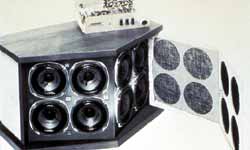
Now, let's consider for a moment some of the basic premises on which Dr. Bose based the design of the 901. The major departure from conventional design here is the system's unique directional characteristics, with most of the sound coming from eight rear-facing speakers and the rest from a single front-facing speaker. According to Dr. Bose's literature, this was done to simulate the conditions in a concert hall, where measurements have shown that only about 11% of the sound reaching a listener is direct sound, coming straight from the instruments, while the rest is reverberant energy, due to reflections from the boundaries of the hall (walls, ceiling, etc.). The implication here is that the 901 turns your listening room into a mini-auditorium, and that the spaciousness of the 901's sound is due to reverberations in the listening room. It is our feeling, though, that Dr. Bose is either oversimplifying his explanation of what the 901 does or has drawn some dubious conclusions from his basic premise, because as far as we can see, the "reverberant" aspect of the listening room is not really pertinent to the operation of the system at all. Reverberation is a slow decay of sound in a hall, due to reflections bouncing back and. forth between the hall boundaries (walls, ceiling, etc.) until they are absorbed. In a listening room of typical size, reverberation as such is too short in duration to contribute anything to the sound except some smearing of detail and the excitation of resonances within the audio range, so they are undesirable. And it is not reverberation that the 901 depends on anyway, it is reflection. And what the reflection does, we believe, is to produce the acoustical equivalent of an electrical comb filter (fig.1).
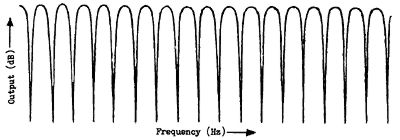 Fig.1 Frequency response (bandpass characteristic) of a comb filter. We think of the spatial aspect in sound as being a function of the directions from which sounds are reaching our ears. This is only half of the story, though. With one ear stopped up, the other is virtually oblivious to the directions of incoming sounds. In a concert hall, the unblocked ear can readily hear the hall reverberations arriving from all directions, but the spatial sense is entirely absent, just as it is from a monophonic recording. With both ears functioning, neither is any more aware of direction than it is working alone, but now the two ears are hearing differences between the impinging reverberations, and it is the comparisons between each ear's "input" which our brain interprets as spatial information. The sounds reaching us directly from the instruments are relatively simple in structure, consisting of a series of wavefronts like the walls of rapidly expanding balloons spreading out from each instrument. If we face an instrument head-on, its wavefronts pass each ear at the same instant and at the same angle—both ears hear exactly the same thing, and we localize the soundsource as dead ahead. Instruments located to one side reach the ears at slightly different moments, and the "shadow" of the head causes the more distant ear to hear a slight loss of volume and overtone content, and our brain tells us the sound is over there, to one side. The reflected sounds which we hear as reverberation, though, are exceedingly complex. Since they reach us from different directions, it is obvious that they will have travelled different distances (from the source) before they reach us. The infinite number of distances involved means that many soundwaves reaching us will be out of phase with one another at certain frequencies from certain directions and at other frequencies from other directions, and the patterns of cancellation will be different from one side of the hall than from the other (footnote 1).
The effect, as far each ear is concerned, is a series of sharp dips in the frequency response of the reverberant sound, with one ear hearing the dips at one set of frequencies and the other hearing them at another set of frequencies. And, of course, the location of each instrument on the stage will cause it to produce dips at different frequencies in its reverberant sound. The same principle has been used to produce pseudo-stereo recordings from monophonic ones, by means of a comb filter. This is a device which gives a frequency response that looks like a comb, and when two such devices are used, with the dips at different frequencies, the result is a pair of signals which simulate the spatial cues of reflective reverberation. Feed one to each speaker, and the mono sound will appear to spread across the space between them instead of appearing midway between them. (Other tricks are used in pseudo-stereo production to give the illusion of left-right positioning for certain instruments, but the main source of "spread" in these recordings comes from the comb filters.)
Fig.1 Frequency response (bandpass characteristic) of a comb filter. We think of the spatial aspect in sound as being a function of the directions from which sounds are reaching our ears. This is only half of the story, though. With one ear stopped up, the other is virtually oblivious to the directions of incoming sounds. In a concert hall, the unblocked ear can readily hear the hall reverberations arriving from all directions, but the spatial sense is entirely absent, just as it is from a monophonic recording. With both ears functioning, neither is any more aware of direction than it is working alone, but now the two ears are hearing differences between the impinging reverberations, and it is the comparisons between each ear's "input" which our brain interprets as spatial information. The sounds reaching us directly from the instruments are relatively simple in structure, consisting of a series of wavefronts like the walls of rapidly expanding balloons spreading out from each instrument. If we face an instrument head-on, its wavefronts pass each ear at the same instant and at the same angle—both ears hear exactly the same thing, and we localize the soundsource as dead ahead. Instruments located to one side reach the ears at slightly different moments, and the "shadow" of the head causes the more distant ear to hear a slight loss of volume and overtone content, and our brain tells us the sound is over there, to one side. The reflected sounds which we hear as reverberation, though, are exceedingly complex. Since they reach us from different directions, it is obvious that they will have travelled different distances (from the source) before they reach us. The infinite number of distances involved means that many soundwaves reaching us will be out of phase with one another at certain frequencies from certain directions and at other frequencies from other directions, and the patterns of cancellation will be different from one side of the hall than from the other (footnote 1).
The effect, as far each ear is concerned, is a series of sharp dips in the frequency response of the reverberant sound, with one ear hearing the dips at one set of frequencies and the other hearing them at another set of frequencies. And, of course, the location of each instrument on the stage will cause it to produce dips at different frequencies in its reverberant sound. The same principle has been used to produce pseudo-stereo recordings from monophonic ones, by means of a comb filter. This is a device which gives a frequency response that looks like a comb, and when two such devices are used, with the dips at different frequencies, the result is a pair of signals which simulate the spatial cues of reflective reverberation. Feed one to each speaker, and the mono sound will appear to spread across the space between them instead of appearing midway between them. (Other tricks are used in pseudo-stereo production to give the illusion of left-right positioning for certain instruments, but the main source of "spread" in these recordings comes from the comb filters.)
Footnote 1: You may argue that this would not be so if you sat exactly in the middle of the hall and listened to an instrument exactly on the middle of the stage, and we suppose it shouldn't, but it is anyway, which is probably one reason acoustical experts can't predict how a new hall is going to behave.—J. Gordon Holt
Fig.1 Frequency response (bandpass characteristic) of a comb filter. We think of the spatial aspect in sound as being a function of the directions from which sounds are reaching our ears. This is only half of the story, though. With one ear stopped up, the other is virtually oblivious to the directions of incoming sounds. In a concert hall, the unblocked ear can readily hear the hall reverberations arriving from all directions, but the spatial sense is entirely absent, just as it is from a monophonic recording. With both ears functioning, neither is any more aware of direction than it is working alone, but now the two ears are hearing differences between the impinging reverberations, and it is the comparisons between each ear's "input" which our brain interprets as spatial information. The sounds reaching us directly from the instruments are relatively simple in structure, consisting of a series of wavefronts like the walls of rapidly expanding balloons spreading out from each instrument. If we face an instrument head-on, its wavefronts pass each ear at the same instant and at the same angle—both ears hear exactly the same thing, and we localize the soundsource as dead ahead. Instruments located to one side reach the ears at slightly different moments, and the "shadow" of the head causes the more distant ear to hear a slight loss of volume and overtone content, and our brain tells us the sound is over there, to one side. The reflected sounds which we hear as reverberation, though, are exceedingly complex. Since they reach us from different directions, it is obvious that they will have travelled different distances (from the source) before they reach us. The infinite number of distances involved means that many soundwaves reaching us will be out of phase with one another at certain frequencies from certain directions and at other frequencies from other directions, and the patterns of cancellation will be different from one side of the hall than from the other (footnote 1). Footnote 1: You may argue that this would not be so if you sat exactly in the middle of the hall and listened to an instrument exactly on the middle of the stage, and we suppose it shouldn't, but it is anyway, which is probably one reason acoustical experts can't predict how a new hall is going to behave.—J. Gordon Holt















