

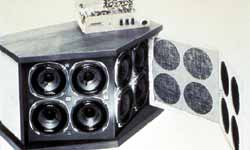
There are two other things about the design of the 901 that we question, too. One of these is the use of electrical equalization to compensate for deficiencies in the speakers at the high and low ends of the audio range. Equalization of this kind is fine, of course, if only a small amount is needed to add the last nth degree of perfection (?) to a system, and if the loudspeakers can take it without swapping extended range for increased distortion. What bothers us about the 901, though, is the amountof compensatory boost that has been used, rather than the fact that it is used at all. The equalizer that is part of the 901 system offers a selection of response curves via several front-panel switches (fig.3), but even in the operating mode that is identified as having the flattest response, the speakers themselves are being fed rather substantial amounts of bass and treble boost. And we are not convinced that this can yield as good performance as is obtainable from a system that needs little correctional boost or none at all.  Fig.3 Response curves (from one of Bose's blurbs for the 901) show the wide range of equalization contours available from the speaker's active equalizer.
Dr. Bose approached the problem of the inescapable bass resonance in speakers by moving this up in frequency (to around 200Hz) and applying equalization to offset the normal 6dB/octave rolloff below resonance. The result is unusually smooth response down through the range where all other speakers exhibit some sort of resonance, but the amount of bass boost necessary to carry the speakers below 40Hz is quite substantial, and puts rather extreme demands on the output capabilities of the amplifier, as well as on the capacities of the speakers. The speakers themselves produce audible distortion below 40Hz at what we would judge to be only moderate listening levels, yet on musical program material, the only subjective effect of this is to make deep lows sound a little less deep, and, in fact, the 901 is able to put out really respectable levels (even on bassy program material) without offensive distortion when driven by a modest 35Wpc with the equalizer unit set for bass cut (ie, with equalization ceasing at 40Hz), or with a brute-force power amplifier like the Crown DC-300, the 901 will deliver more than enough acceptably clean volume to satisfy anyone but a decibel fanatic. But what about that 200Hz resonance? Dr. Bose contends that, if you use for the nine speakers ones whose resonances all occur at slightly different frequencies, the resonance of any one becomes "inaudible." We are not convinced of this, for a resonance causes a transducer to continue vibrating for a time after the signal that started it going. has ceased, and adding more resonances can only cause the system to "hang over" at more different frequencies. Thus, we do not feel it was purely coincidental that the 901 we tested seemed to have a tend toward upper-bass heaviness in the four rooms we set it up in.
The effectiveness of highÄfrequency boost is open to some question, too. Theoretically, any device that has had its high end boosted, to yield the same treble response as an unequalized device, should have the same treble performance on musical signals, but we have not always found this to be the case. Equalization can cause a speaker cone to react more promptly to a transient signal, but it cannot reduce the inertia of the cone, and thus cannot increase the cone's ability to stop moving once the transient has passed. Instead, improving its start-up speed is more likely to make its stopping ability worse by causing it to overshoot the mark We could not determine just how much of the Bose 901's high-end performance was the result of this and how much was the result of smearing due to the prolonged room reflections, but the fact remains that all of our listening panelists gave the 901 rather poor marks for detail and definition. (Try this yourself: Play some sound-effects recordings of clinking or clanking metal, adjust any controls on hand for the most natural sound from these, and then see if you can stand listening to music with the same control settings.) Of course, the apparent high end from the 901 is profoundly affected by the surface texture of the walls behind and beside the speakers, for the more absorptive these are, the less treble will be reflected into the room. The worst possible condition is with draperies behind them (or an open entrance way), and the best is with glass.
The 901's veiling tendency will not appeal much to audio perfectionists with amplifiers that don't add hardness to the sound, and who can feed these clean, quiet program material. But it will be a definite boon to most hi-fi buffs, for it makes the speakers unusually tolerant of the hardness of typical solid-state electronica and the distortion from imperfectly tracked discs. And we mean no insult when we add that the 901 made our few treasured 78-rpm discs sound as listenable as we have ever heard them, and managed to do this without deadening their high end (as do all filters we've tried). We don't wish to give the impression, though, that the 901 is a dull-sounding system. You can, of course, make it sound that way via the treble-cut settings on the equalizer, or you can make it sound hard and zippy at the top, but with the equalizer set for flattest response (according to Bose's curves, and our ears), the 901 has much of the brilliance of a typical horn system, but without the "horny" midrange coloration. If we were to judge the 901 in terms of the best sound available, then, we would say that it produces a more realistic semblance of natural ambience than any other speaker system, but we would characterize it as unexceptional in all other respects. It is ideal for rock enthusiasts to whom sheer sonic impact is of paramount importance, and for classical listeners who want the next best thing to ambient stereo without the cost and the bother of rear-channel add-ons. However, we doubt that the 901 will appeal to perfectionists who have developed a taste for subtleties of detail and timbre.
Fig.3 Response curves (from one of Bose's blurbs for the 901) show the wide range of equalization contours available from the speaker's active equalizer.
Dr. Bose approached the problem of the inescapable bass resonance in speakers by moving this up in frequency (to around 200Hz) and applying equalization to offset the normal 6dB/octave rolloff below resonance. The result is unusually smooth response down through the range where all other speakers exhibit some sort of resonance, but the amount of bass boost necessary to carry the speakers below 40Hz is quite substantial, and puts rather extreme demands on the output capabilities of the amplifier, as well as on the capacities of the speakers. The speakers themselves produce audible distortion below 40Hz at what we would judge to be only moderate listening levels, yet on musical program material, the only subjective effect of this is to make deep lows sound a little less deep, and, in fact, the 901 is able to put out really respectable levels (even on bassy program material) without offensive distortion when driven by a modest 35Wpc with the equalizer unit set for bass cut (ie, with equalization ceasing at 40Hz), or with a brute-force power amplifier like the Crown DC-300, the 901 will deliver more than enough acceptably clean volume to satisfy anyone but a decibel fanatic. But what about that 200Hz resonance? Dr. Bose contends that, if you use for the nine speakers ones whose resonances all occur at slightly different frequencies, the resonance of any one becomes "inaudible." We are not convinced of this, for a resonance causes a transducer to continue vibrating for a time after the signal that started it going. has ceased, and adding more resonances can only cause the system to "hang over" at more different frequencies. Thus, we do not feel it was purely coincidental that the 901 we tested seemed to have a tend toward upper-bass heaviness in the four rooms we set it up in.
The effectiveness of highÄfrequency boost is open to some question, too. Theoretically, any device that has had its high end boosted, to yield the same treble response as an unequalized device, should have the same treble performance on musical signals, but we have not always found this to be the case. Equalization can cause a speaker cone to react more promptly to a transient signal, but it cannot reduce the inertia of the cone, and thus cannot increase the cone's ability to stop moving once the transient has passed. Instead, improving its start-up speed is more likely to make its stopping ability worse by causing it to overshoot the mark We could not determine just how much of the Bose 901's high-end performance was the result of this and how much was the result of smearing due to the prolonged room reflections, but the fact remains that all of our listening panelists gave the 901 rather poor marks for detail and definition. (Try this yourself: Play some sound-effects recordings of clinking or clanking metal, adjust any controls on hand for the most natural sound from these, and then see if you can stand listening to music with the same control settings.) Of course, the apparent high end from the 901 is profoundly affected by the surface texture of the walls behind and beside the speakers, for the more absorptive these are, the less treble will be reflected into the room. The worst possible condition is with draperies behind them (or an open entrance way), and the best is with glass.
The 901's veiling tendency will not appeal much to audio perfectionists with amplifiers that don't add hardness to the sound, and who can feed these clean, quiet program material. But it will be a definite boon to most hi-fi buffs, for it makes the speakers unusually tolerant of the hardness of typical solid-state electronica and the distortion from imperfectly tracked discs. And we mean no insult when we add that the 901 made our few treasured 78-rpm discs sound as listenable as we have ever heard them, and managed to do this without deadening their high end (as do all filters we've tried). We don't wish to give the impression, though, that the 901 is a dull-sounding system. You can, of course, make it sound that way via the treble-cut settings on the equalizer, or you can make it sound hard and zippy at the top, but with the equalizer set for flattest response (according to Bose's curves, and our ears), the 901 has much of the brilliance of a typical horn system, but without the "horny" midrange coloration. If we were to judge the 901 in terms of the best sound available, then, we would say that it produces a more realistic semblance of natural ambience than any other speaker system, but we would characterize it as unexceptional in all other respects. It is ideal for rock enthusiasts to whom sheer sonic impact is of paramount importance, and for classical listeners who want the next best thing to ambient stereo without the cost and the bother of rear-channel add-ons. However, we doubt that the 901 will appeal to perfectionists who have developed a taste for subtleties of detail and timbre.
Fig.3 Response curves (from one of Bose's blurbs for the 901) show the wide range of equalization contours available from the speaker's active equalizer. 














