

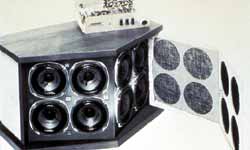
This is what the Bose 901 does, on a small scale. Fig.2 shows the paths of sound waves coming from a left-channel 901. A listener hears not only the front-facing speaker A, but also the right-rear reflection B and the left-rear reflection C which, bouncing from the side wall, effectively spreads the source of reflections beyond the limit of the rear wall and partway around the side wall. The reduced output from the front speaker (11% of the total) prevents it from dominating the entire sound "stage" and thus contracting the apparent radiating area to a small point. And since the distance between the front speaker and the listener is shorter than any other path, sounds from there reach him first, and his ear responds by localizing the unified wavefronts of direct sounds at about the center of the speaker. (This is known as the Precedence Effect.)  Fig.2 How reflections from the rear of a Bose 901 broaden the apparent source. As for the rear-radiated sounds, these behave as do the reflected ones in a concert hall. Their time of arrival at the listener varies according to the distance they travel, phase interference takes place, and the comb filter effect chops holes in the response of the reflected sounds. This broadens the apparent soundsource, and in that sense it does add spaciousness to the sound, but this alone can't account for the 901's remarkably spacious sound. What is needed to do this is the reverberant information from the second channel. It gets the same reflective treatment as that from the first channel, but now, along with the phase interference in each set of reflected signals, there is additional interference between them. Since this causes combing of similarities in the two reverberant fields more than it affects their differences, the effect is to increase the differences between the two reverberant signals, and our ears perceive the increased difference as enhanced spaciousness.
It is probably fair to say that the 901 actually exaggerates spaciousness from recordings, rather than reproducing it as it is contained in the recording. But since two-channel stereo reproduction is inherently deficient in spatial qualities anyway, it must also be said that the net result is an improvement in realism. The 901 does not synthesize the added spaciousness, though; it merely enhances what is already on the recording. Thus, a recording made outdoors will not be imbued with concert-hall spaciousness, but is instead made to sound even more convincingly outdoorsy. And a recording with no spatial information on it at all, like a mono one, will sound somewhat diffuse but will have virtually no more spaciousness than it would through any other speaker system. This tremendous gain in spatial effect is not, however, achieved without some sacrifices. Even though Precedence Effect helps to localize the discrete wavefronts from direct sounds in their proper places across the stereo stage, there is enough repetitive (cyclical) signal content in even the direct sounds for them to be subject to some combing as a result of the multiple reflections, and this causes some loss of imaging specificity. There is no increase in "wandering" tendency—indeed, the 901 yields as stable a stereo image as any speaker we have tested. But there is a perceptible widening of the apparent source of any given sound, making it possible (by spacing the speakers too far apart) to create such monstrosities as 2'-wide singers and 8' guitars. Even with optimal spacing, some purists will cavil at this loss of specificity, even though we point out that instrumental localization is not all that pinpointed under live listening conditions. On the other hand, at a live concert, our aural localization is abetted by visual localization, so there is something to be said for having more-specific aural localization when we must depend entirely on our ears, as when listening at home.
What is, we feel, a more serious shortcoming of the 901 principle is that it subjects the direct sounds in a recording to the same reflective process that enhances the recorded spatial material. The first of the rear-reflected waves reaches us a relatively long time after the front-radiated wave has passed, and while this is of no consequence as far as spatial information is concerned—and may actually enhance it—it cannot help but impair the detail of those signals which represent direct sound in the recording. Precedence effect can retain the localization of the direct sounds, but it cannot prevent the rear-reflected sounds from being audible a fraction of a second later. And since each rear-radiated wave reaches us from an infinite number of distances, it arrives not as a single delayed impulse, but as a smear. There is no perceptible echo—the delay is too short for the ear to perceive as a gap. Instead, there is what appears to be a marked softening of detail, as though every sound is being followed by a rapid decay rather than a sharp cessation of sound. It sounds, in fact, like short-lived hangover, which is just what it is. The only difference between this and the hangover we associate with resonating loudspeakers is that this involves a wider range of frequencies and is acoustically rather than mechanically induced.
Fig.2 How reflections from the rear of a Bose 901 broaden the apparent source. As for the rear-radiated sounds, these behave as do the reflected ones in a concert hall. Their time of arrival at the listener varies according to the distance they travel, phase interference takes place, and the comb filter effect chops holes in the response of the reflected sounds. This broadens the apparent soundsource, and in that sense it does add spaciousness to the sound, but this alone can't account for the 901's remarkably spacious sound. What is needed to do this is the reverberant information from the second channel. It gets the same reflective treatment as that from the first channel, but now, along with the phase interference in each set of reflected signals, there is additional interference between them. Since this causes combing of similarities in the two reverberant fields more than it affects their differences, the effect is to increase the differences between the two reverberant signals, and our ears perceive the increased difference as enhanced spaciousness.
It is probably fair to say that the 901 actually exaggerates spaciousness from recordings, rather than reproducing it as it is contained in the recording. But since two-channel stereo reproduction is inherently deficient in spatial qualities anyway, it must also be said that the net result is an improvement in realism. The 901 does not synthesize the added spaciousness, though; it merely enhances what is already on the recording. Thus, a recording made outdoors will not be imbued with concert-hall spaciousness, but is instead made to sound even more convincingly outdoorsy. And a recording with no spatial information on it at all, like a mono one, will sound somewhat diffuse but will have virtually no more spaciousness than it would through any other speaker system. This tremendous gain in spatial effect is not, however, achieved without some sacrifices. Even though Precedence Effect helps to localize the discrete wavefronts from direct sounds in their proper places across the stereo stage, there is enough repetitive (cyclical) signal content in even the direct sounds for them to be subject to some combing as a result of the multiple reflections, and this causes some loss of imaging specificity. There is no increase in "wandering" tendency—indeed, the 901 yields as stable a stereo image as any speaker we have tested. But there is a perceptible widening of the apparent source of any given sound, making it possible (by spacing the speakers too far apart) to create such monstrosities as 2'-wide singers and 8' guitars. Even with optimal spacing, some purists will cavil at this loss of specificity, even though we point out that instrumental localization is not all that pinpointed under live listening conditions. On the other hand, at a live concert, our aural localization is abetted by visual localization, so there is something to be said for having more-specific aural localization when we must depend entirely on our ears, as when listening at home.
What is, we feel, a more serious shortcoming of the 901 principle is that it subjects the direct sounds in a recording to the same reflective process that enhances the recorded spatial material. The first of the rear-reflected waves reaches us a relatively long time after the front-radiated wave has passed, and while this is of no consequence as far as spatial information is concerned—and may actually enhance it—it cannot help but impair the detail of those signals which represent direct sound in the recording. Precedence effect can retain the localization of the direct sounds, but it cannot prevent the rear-reflected sounds from being audible a fraction of a second later. And since each rear-radiated wave reaches us from an infinite number of distances, it arrives not as a single delayed impulse, but as a smear. There is no perceptible echo—the delay is too short for the ear to perceive as a gap. Instead, there is what appears to be a marked softening of detail, as though every sound is being followed by a rapid decay rather than a sharp cessation of sound. It sounds, in fact, like short-lived hangover, which is just what it is. The only difference between this and the hangover we associate with resonating loudspeakers is that this involves a wider range of frequencies and is acoustically rather than mechanically induced.
Fig.2 How reflections from the rear of a Bose 901 broaden the apparent source. As for the rear-radiated sounds, these behave as do the reflected ones in a concert hall. Their time of arrival at the listener varies according to the distance they travel, phase interference takes place, and the comb filter effect chops holes in the response of the reflected sounds. This broadens the apparent soundsource, and in that sense it does add spaciousness to the sound, but this alone can't account for the 901's remarkably spacious sound. What is needed to do this is the reverberant information from the second channel. It gets the same reflective treatment as that from the first channel, but now, along with the phase interference in each set of reflected signals, there is additional interference between them. Since this causes combing of similarities in the two reverberant fields more than it affects their differences, the effect is to increase the differences between the two reverberant signals, and our ears perceive the increased difference as enhanced spaciousness. 














