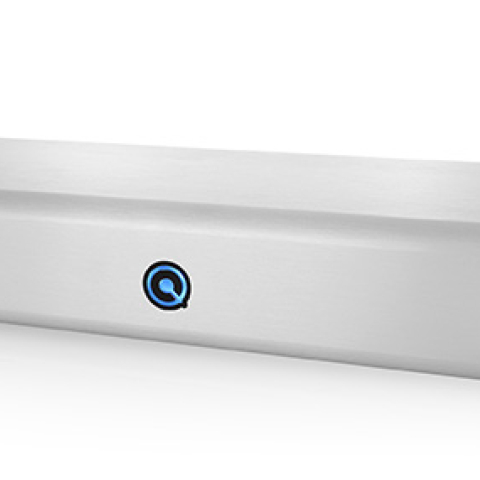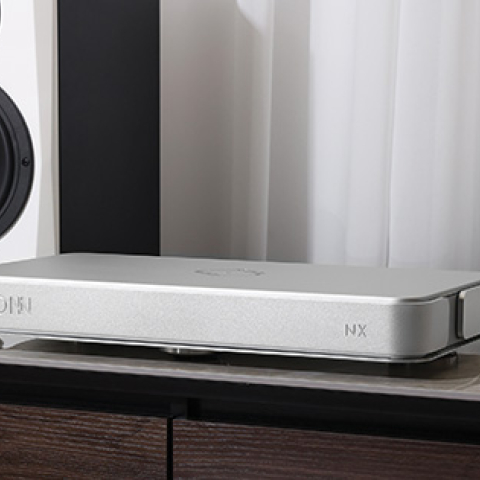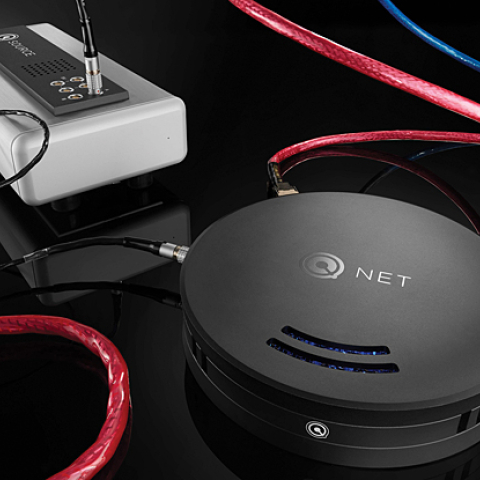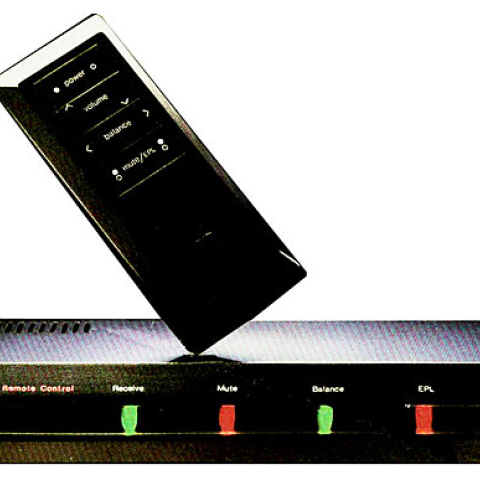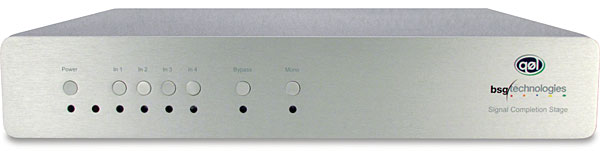
I walked into BSG's room at the Newport Beach Show in June 2012 unsure of what I was going to hear. I was well aware of this new company's qøl Signal Completion Stage ($3995), but didn't know if it was a genuine step forward in audio reproduction, or just another example of the hokum found on the fringes of our hobby. I took my listening seat, and BSG's CEO Larry Kay, cofounder and erstwhile publisher of Fi magazine, performed A/B comparisons with the qøl's processing in and out of circuit.
Fascinating.
As I wrote in my show report, the difference between bypass and process was enormous on both the Eagles' "Hotel California" and Leon Fleisher, George Szell, and the Cleveland Orchestra's recording of Brahms's Piano Concerto 2. Superficially, there seemed to be an increase in volume of 2–3dB; more significant was that individual objects in the soundstage—the solo voice in "Hotel California," the piano in the Brahms—didn't get louder. It was the surrounding space that gained in volume. With both pieces of music, the sound definitely improved with the Signal Completion Stage doing its stuff.
I asked for a review sample.
Signal Completion
The obvious question to be asked is "What does it do?" From BSG's website:
"BSG Technologies has developed a method of retrieving sonic information from audio signals that provides a realistic and complete rendering of the original acoustic event. . . . Instead of 'adding' a host of processing techniques intended to create 'effects,' we have simply found a way to extract information already present in recordings, but otherwise hidden in conventional reproduction. Our technology enables complete capture, transmission, and reproduction of such information, including elements that, until now, have remained hidden and buried in electronics, and unavailable to the listener. The result is an audio experience with fullness and richness beyond comparison and one which carries essentially all the dynamic, tonal, and spatial content of a real sonic event. . . . We call it 'qøl(tm).'"
The Signal Completion Stage uses technology developed by BSG's Barry Stephen Goldfarb, who has taught audio engineering and acoustics at the university level. BSG and Goldfarb applied for two patents on qøl, one of which, US Patent 8259960, was granted last fall. That patent refers to "phase layered" treble and bass signals as well as antiphase signals, but I found it difficult to see from the circuit diagrams included in the patent what was actually being done to the input signal. However, looking at the application for the other patent, US20110158413, I found the following two paragraphs:
"8: The objectives and advantage of the present invention may also be achieved through an audio signal reproduction method that involves, among other things, selecting a discrete signal source having left and right signal inputs, summing the left input signal and an inverted right input signal to produce a left–right difference signal, summing the right input signal and an inverted left input signal to produce a right–left difference signal, and summing the left and right input signals to produce a left+right summed signal. The method and circuit further involve adjusting the gain of the left+right summed signal, adjusting the gain of the left–right difference signal, and adjusting the gain of the right–left difference signal. Still further, the method and circuit involve summing the gain adjusted left+right summed signal and the gain adjusted left–right difference signal to produce a left audio output signal, where the ratio of the gains associated with the left+right summed signal and the left–right difference signal at least approximates the golden ratio [1 plus the square root of 5 divided by 2, or 1.618, equivalent to 4.18dB]. Similarly, the gain adjusted left+right summed signal and the gain adjusted right–left difference signal are summed to produce a right audio output signal, wherein the ratio of the gains associated with the left+right summed signal and the left–right difference signal at least approximates the golden ratio.
"9: The audio reproduction method of claim 8, wherein the gain of the left+right summed signal is asymmetrically adjusted relative to the gain of the left-right difference signal, such that the ratio of gains is within 10 percent of 1.618; and wherein the gain of the left+right summed signal is asymmetrically adjusted relative to the gain of the right-left difference signal, such that the ratio of gains is within 10 percent of 1.618."
Ah-ha! This looks like a variation on something with which I am familiar: the Blumlein Shuffler, which allows adjustment of a stereo soundstage's width and dates back to the 1930s. By converting a conventional stereo signal into Sum and Difference signals and amplifying or attenuating the Difference signal before rematrixing these signals to produce left and right outputs, the stage width can be reduced or expanded. And if you change the spectral balance of the Difference signal, you can selectively alter the stage width at some frequencies but not others.
I had experimented with shuffling when I produced one of the tutorial tracks on Stereophile's Test CD 3 (Stereophile STPH006-2). I took a choral stereo recording I had made with distant, almost-coincident cardioid microphones, converted it to Sum and Difference signals, then applied a low-frequency boost to the difference signal before reconverting the recording to left- and right-channel signals. My goal was to both compensate for the bass rolloff typical of distant cardioid mikes and widen the stage in the bass. The result was successful, though I found that getting the correct degree of equalization was difficult: too much, and the recording sounded phasey; too little, and the improvement in stage width was minimal.
The obvious question to be asked is "What does it do?" From BSG's website: