The BSG patents suggest that no equalization is used, but if qøl is a variant on the shuffler, multiplying the Difference signal by the Golden Ratio will widen the stage of the resultant stereo signal at all frequencies, as well as give a small increase in volume. And because the Difference signal carries information that is uncorrelated between the original channels, BSG's qøl process will increase the audibility of things like ambience and reverberation.
The Signal Completion Stage
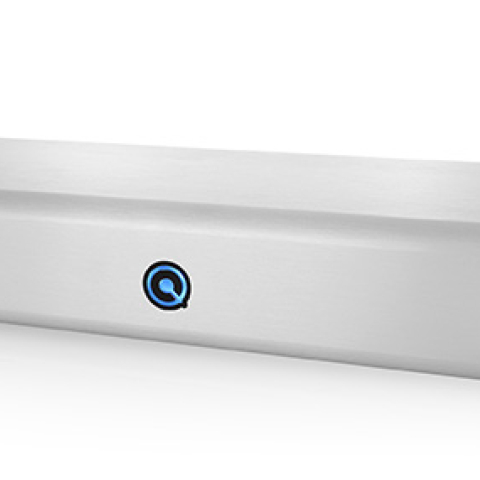
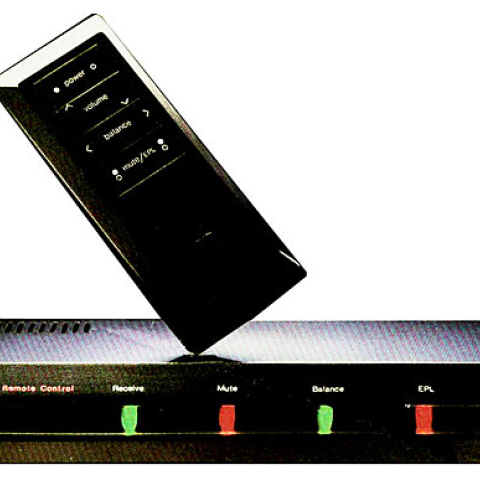
The Signal Completion Stage is impressively well made, considering it's the first product from a new company. It comprises a steel clamshell enclosure with an aluminum front panel. The rear panel carries arrays of XLR and high-quality RCA jacks; each of the four inputs is duplicated on both jacks, with the caveat that only one connector per input, balanced or single-ended, can be used at a time. There are two sets of stereo outputs, again on both XLR and RCA jacks. On the front panel are pushbuttons for On/Sleep, the four inputs, Bypass, and Mono, each accompanied by an LED that illuminates blue when active. A small, membrane-button remote control duplicates the front-panel buttons. Inside, other than the power supply and the front-panel buttons and LEDs, the Signal Completion Stage's circuitry is carried on a large, multilayer circuit board. An array of input-selection relays occupies the center of the board, separating the left- and right-channel signal paths. The unbalanced input jacks each feed a Burr-Brown OPA227 chip, this a low-noise, wide-bandwidth op-amp. Unusually for a domestic audio product, the balanced input jacks feed a high-quality line-receiver chip, a THAT 1206, more often found in pro-audio products. The qøl processing is performed by more OPA227 op-amps, which then feed a single-ended output stage based on an OPA227, or a balanced output stage based on the professional THAT 1646 line driver.
Sound Quality
Inside, other than the power supply and the front-panel buttons and LEDs, the Signal Completion Stage's circuitry is carried on a large, multilayer circuit board. An array of input-selection relays occupies the center of the board, separating the left- and right-channel signal paths. The unbalanced input jacks each feed a Burr-Brown OPA227 chip, this a low-noise, wide-bandwidth op-amp. Unusually for a domestic audio product, the balanced input jacks feed a high-quality line-receiver chip, a THAT 1206, more often found in pro-audio products. The qøl processing is performed by more OPA227 op-amps, which then feed a single-ended output stage based on an OPA227, or a balanced output stage based on the professional THAT 1646 line driver.
Sound Quality
BSG warns that the Signal Completion Stage requires a long break-in time, and that its sound quality will continue to improve through the first 150 hours of use. I ran it for a weekend nonstop in my test lab before inserting it between the balanced outputs of a Classé CP-800 D/A preamplifier and the balanced inputs of pairs of Classé CT-M600 or Lamm M1.2 Reference monoblock amplifiers. Even then, a slightly chromium-plated quality to the high frequencies was evident, though this slowly faded to neutrality as I continued playing music through the BSG. The first music I played was the hi-rez master files for While You Are Alive, my 2007 recording of Minnesotan male choir Cantus (Cantus CTS-1208). As I explained in my talks at the 2012 Rocky Mountain Audio Fest, I had created this recording by time-aligning and mixing the outputs of three pairs of microphones. My goal was to offer the fairly intimate sound, from about the third row of seats, of the singers arranged evenly from left to right and enveloped in the warm, supportive acoustic of Sauder Hall at Goshen College, in Indiana. With the Signal Completion Stage in Bypass, that is what I heard. Switching in qøl gave a slight increase in volume, but more important, while the images of the individual singers didn't change, the space surrounding those singers was larger. Using the CP-800's volume control to reduce the volume by 2.5dB when the Signal Completion Stage was active, so that my perception was not being swayed by the volume difference when I A/B'd the effects of qøl, didn't change my feeling that qøl embiggened the sound, giving a more realistic impression that the singers were performing in a real space. My use of a pair of spaced-omni mikes in the Cantus mix, as well as an ORTF cardioid pair, meant that the sizes of the singers' images increased slightly to the edges of the stage. If the qøl process involves shuffling, then I would have expected this distortion of image size to be exaggerated, the spaced-omni component being largely uncorrelated between the two channels. However, if it was, it didn't seem to be to any noticeable extent.
I repeated A/B comparisons with many kinds of music, without any different result. Whether the completely artificial techno-rock of Trentemøller's The Last Resort (CD, Pokerflat PFRCD18), the live rock of Lyle Lovett's Live in Texas (ALAC file ripped from CD, MCA), or a classic classical recording, such as Jacqueline du Pré's 1965 performance of the Elgar Cello Concerto with Barbirolli and the LSO (24-bit/96kHz FLAC files from HDtracks, EMI), which I list as one of my "Records 2 Die 4" elsewhere in this issue, the effect was the same: an enlargement of the soundstage; a greater impression of the ambience surrounding the performers; increased image depth and better layering within that depth; and a bigger sound, but without individual acoustic objects in the mix sounding louder. As much as the purist in me objected that this was an effect—a departure from the producer's original intentions, even if it added nothing that wasn't already present in the recording—I have to admit that I liked what the BSG Signal Completion Stage was doing.
The BSG has a Mono button for when it's handling dual-mono signals, for which it uses different circuitry. There was a 2.1dB increase in average level and an inversion of absolute polarity with the Mono function enabled and a mono recording, and looking at the Signal Completion Stage's output with a vectorscope revealed a very slight increase in stage width. Nevertheless, Miles Davis's 1949 recording of "Boplicity," from The Complete Birth of the Cool (CD, Capitol 94550), did sound fuller, less antique.
At the end of my formal auditioning, I created a Sum-Difference processor with the same Golden Ratio coefficient as the BSG qøl process, using the high-precision DSP engine in Metric Halo's MIO2882+2D FireWire audio interface, and sending the dithered 24-bit output via AES/EBU to the CP-800. Comparing the result of this processing to the Signal Completion Stage's, operating on decoded versions of the same files, was fascinating: My preference was for the BSG, even though the effect on the soundstage was virtually identical. There was just a little more ease to the sound. Was this due to the Signal Completion Stage doing more than I thought it was doing? Or was it just because performing the identical operation in the analog domain does less collateral damage to the music than with DSP? I don't know.
Summing Up
It's difficult to sum up my reaction to BSG's qøl Signal Completion Stage. On the one hand, I liked what it did to every recording I played through it. So much of the live event doesn't make it through to a two-channel recording, and the Signal Completion Stage usefully increased stereo's sense of envelopment. The answer to the fundamental question a reviewer must ask—"Does the product make the sound better?"—is an unequivocal "Yes." But it did appear from my measurements that the qøl process is primarily a variant of the well-known shuffling technique, and in that context, its $3995 price seems high. However, the Signal Completion Stage is a well-engineered product made to a high standard, and its four pairs of inputs offer a lot of flexibility. I wish only that it had a volume control so that, in addition to the qøl processing, it would become a full-function line preamplifier. Alternatively, a basic, single-input version could be less expensive. I know this sounds like a cop-out, but you must audition the effects of qøl for yourself—something made easier by BSG's 30-day, money-back guarantee for direct sales of the Signal Completion Stage. Whether the improvement in sound quality is worth the price asked will, even more than usual, be an individual decision.
The Signal Completion Stage is impressively well made, considering it's the first product from a new company. It comprises a steel clamshell enclosure with an aluminum front panel. The rear panel carries arrays of XLR and high-quality RCA jacks; each of the four inputs is duplicated on both jacks, with the caveat that only one connector per input, balanced or single-ended, can be used at a time. There are two sets of stereo outputs, again on both XLR and RCA jacks. On the front panel are pushbuttons for On/Sleep, the four inputs, Bypass, and Mono, each accompanied by an LED that illuminates blue when active. A small, membrane-button remote control duplicates the front-panel buttons.
Inside, other than the power supply and the front-panel buttons and LEDs, the Signal Completion Stage's circuitry is carried on a large, multilayer circuit board. An array of input-selection relays occupies the center of the board, separating the left- and right-channel signal paths. The unbalanced input jacks each feed a Burr-Brown OPA227 chip, this a low-noise, wide-bandwidth op-amp. Unusually for a domestic audio product, the balanced input jacks feed a high-quality line-receiver chip, a THAT 1206, more often found in pro-audio products. The qøl processing is performed by more OPA227 op-amps, which then feed a single-ended output stage based on an OPA227, or a balanced output stage based on the professional THAT 1646 line driver.
BSG warns that the Signal Completion Stage requires a long break-in time, and that its sound quality will continue to improve through the first 150 hours of use. I ran it for a weekend nonstop in my test lab before inserting it between the balanced outputs of a Classé CP-800 D/A preamplifier and the balanced inputs of pairs of Classé CT-M600 or Lamm M1.2 Reference monoblock amplifiers. Even then, a slightly chromium-plated quality to the high frequencies was evident, though this slowly faded to neutrality as I continued playing music through the BSG. The first music I played was the hi-rez master files for While You Are Alive, my 2007 recording of Minnesotan male choir Cantus (Cantus CTS-1208). As I explained in my talks at the 2012 Rocky Mountain Audio Fest, I had created this recording by time-aligning and mixing the outputs of three pairs of microphones. My goal was to offer the fairly intimate sound, from about the third row of seats, of the singers arranged evenly from left to right and enveloped in the warm, supportive acoustic of Sauder Hall at Goshen College, in Indiana. With the Signal Completion Stage in Bypass, that is what I heard. Switching in qøl gave a slight increase in volume, but more important, while the images of the individual singers didn't change, the space surrounding those singers was larger. Using the CP-800's volume control to reduce the volume by 2.5dB when the Signal Completion Stage was active, so that my perception was not being swayed by the volume difference when I A/B'd the effects of qøl, didn't change my feeling that qøl embiggened the sound, giving a more realistic impression that the singers were performing in a real space. My use of a pair of spaced-omni mikes in the Cantus mix, as well as an ORTF cardioid pair, meant that the sizes of the singers' images increased slightly to the edges of the stage. If the qøl process involves shuffling, then I would have expected this distortion of image size to be exaggerated, the spaced-omni component being largely uncorrelated between the two channels. However, if it was, it didn't seem to be to any noticeable extent.
It's difficult to sum up my reaction to BSG's qøl Signal Completion Stage. On the one hand, I liked what it did to every recording I played through it. So much of the live event doesn't make it through to a two-channel recording, and the Signal Completion Stage usefully increased stereo's sense of envelopment. The answer to the fundamental question a reviewer must ask—"Does the product make the sound better?"—is an unequivocal "Yes." But it did appear from my measurements that the qøl process is primarily a variant of the well-known shuffling technique, and in that context, its $3995 price seems high. However, the Signal Completion Stage is a well-engineered product made to a high standard, and its four pairs of inputs offer a lot of flexibility. I wish only that it had a volume control so that, in addition to the qøl processing, it would become a full-function line preamplifier. Alternatively, a basic, single-input version could be less expensive. I know this sounds like a cop-out, but you must audition the effects of qøl for yourself—something made easier by BSG's 30-day, money-back guarantee for direct sales of the Signal Completion Stage. Whether the improvement in sound quality is worth the price asked will, even more than usual, be an individual decision.