

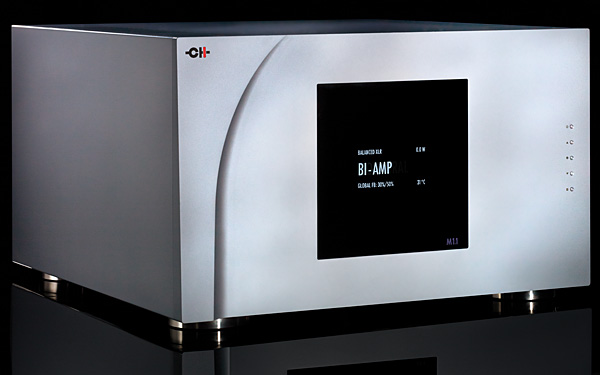
A series of small, vertically stacked pushbuttons adjacent to the generously sized color LED screen controls all functionality and adjustability. It's a complicated but logically arranged menu system, made easier to use if you're familiar with the similar ones used in the company's other products, including the CH Precision P1 phono preamp, which I own. In most cases, setup will no doubt be performed by the dealer, though it's still a good idea to understand and learn the menu system. A virtual meter monitors power output.
The M1.1's maximum gain can be adjusted in 0.5dB steps over a 24dB range, to better match loudspeaker sensitivity and room size. And, as noted above, when the amp is used in bi-amping mode, gain for each driver segment can be independently adjusted. The amp's output stage can be adjusted in 10% steps to change the percentage of global vs local feedback, from 0% local-only feedback to 100% global-only feedback; this allows users to control the amplifier's damping factor to precisely fine-tune bass performance and can be done on the fly, either from the front panel or, once the amp is network-connected, via CH's Android-based app.
Of course, the amount of feedback dialed in by the user also affects total harmonic distortion, which can go from less than 0.1% (with 0% global feedback) to less than 0.01% (with 100% global feedback). Signal/noise ratio is claimed to be an excellent 115dB.
The instruction manual for this engineering tour-de-force includes pages of eye-glazing menu trees. Fortunately, most end users will never have to hack their way through those forests. I consulted with CH's American representative Ralph Sorrentino, and we chose monaural configuration, which the instructions say is "optimal for low impedance speakers requiring large amounts of current"—which well describes the Wilson Audio Specialties Alexx, loudspeakers—and we began with 20% global feedback. I found that more than 20% global feedback made the bass sound overly tight and constricted somewhat the musical flow of my system; less than 20% feedback pushed the sound beyond liquid, into a place that bordered on being soggy: Sorrentino's suggested 20% proved ideal. I ran the M1.1's using their balanced inputs.
I've grown accustomed to your pace
For review purposes, the best way to approach a comparison between a brand-new, highly refined, high-priced, high-performance amp and one with similar qualities that also happens to be your reference of many years—in my case, the darTZeel NHB-458—is to imagine you're never going back to the latter: Pretend you're hooking up with someone new after the break-up of a long-term relationship. Immediate, direct comparisons are self-defeating. Again, as with significant others, it's best to just go with the new experience and enjoy (or not) your new partner on their own terms.
 Though the M1.1s weren't brand-new, I let them break in for 24 hours using the Swim mode (continuous, random music selection) of my Sooloos server. Due to review-scheduling issues, I had the amps here for an unusually long time: By the time I started writing, I knew their character well, and I'd become accustomed to interacting with them, comfortably so—as in any successful long-term relationship.
At this price point, there ought to be much to like—and nothing to dislike—about a product, and that was the case with the suave, muscular-sounding M1.1s. After some experimentation, it also turned out that the CH amps sounded better plugged directly into the wall socket and not (surprisingly) into AudioQuest's Niagara 7000 AC power conditioner— and I preferred AudioQuest's Dragon silver-conductor speaker cables to TARA Labs' Omega SP: points I return to below.
On the spectrum of bright/fast/lean/analytical vs warm/slow/rich/forgiving, the M1.1s were slightly on the latter side, just as the darTZeels are slightly on the former—but neither one veers far from the middle. (Oops: I promised not to compare my new date to my "ex"—but you probably know how that goes!)
The M1.1s' powerful bass grip and remarkable slam were immediately noticeable on guitarist Anthony Wilson's easy-to-recommend self-released Songs and Photographs (Goat Hill GHR-005). As co-producer Joe Harley quipped when I first told him how much I enjoyed the record's bottom end, "Jay [Bellerose] really likes to hit that kick drum hard!"
And boy, does he ever, especially on tracks like "Song From a Dream." Yet through the M1.1s, the impressive weight was accompanied by precise attack, generous but well-controlled sustain, and rapid decay, so the well-textured drum sound surprised me as it should have—like a depth charge—without sounding overripe, losing its grip, or hanging around too long. Each kick drum hit moved notable amounts of air—more than I remember hearing or feeling with my former partner.
That album was among the first I played after installing the CH Precision amps. The overall presentation—strong bottom yet well-articulated transients on Wilson's guitar—had me pulling out other records with noticeably powerful bass, like Ella Fitzgerald Sings the Rodgers and Hart Song Book (ORG/Verve MG VS-64022), recorded in stereo in 1956. There's a powerful and surprising kick drum on the playful "You Took Advantage of Me," and through the M1.1s, it didn't disappoint.
Ella's vocals, probably recorded using a "tippy"-sounding ribbon microphone, took on a smoother, creamier tonality than I expected, combined with an enjoyably solid, three-dimensional vocal image. The slightly edgy string sound—surely a product of those same mikes—had a sweeter, more sonorous luster than I'd expected: That, too, was a pleasant surprise.
From there it was on to the superb Electric Recording Company reissue of Elgar's Cello Concerto with soloist Jacqueline Du Pré and Sir John Barbirolli conducting the LSO (EMI/ERC ASD 655/ERC 044). Here's where the M1.1s demonstrated the sort of rich, generous midrange I associate more with tube amps than with solid-state ones. Yet that richness didn't obscure the clarity of the bow strikes, or the juxtaposition of the cello's solid, three-dimensional image in front of the equally well-presented orchestra. And when the brass entered on the orchestra's dramatic first statement of the heart-tugging theme, they had sufficient metal bite to sound convincing.
Some solid-state amps known for sweetness and an overall warm presentation can sound muffled and overly smooth in passages where the recording or instrumentation calls for bite and edge. In my system, the M1.1s produced a generally warm picture (compared to my ex), but they never sounded muffled, nor did I ever long for tone-control correction to shine light on familiar reference recordings. Instead, I fully enjoyed a subtle shift in tonal perspective in which acoustic guitars had more body and less string-transient sound, and handclaps had more flesh and less slap—just two examples.
More to the point, some amplifiers that veer toward the warm and smooth side of the sonic continuum can produce boredom by softening transients, and sometimes by obscuring inner detail in a pleasant fog. The M1.1s never went there. You'd be sure of that if you'd been with me to hear them play Binaural Baroque, a direct-to-disc binaural recording by the Locrian Ensemble of London (Chasing the Dragon VALDC005). While binaural is best enjoyed via headphones, the presentation through my Wilson Audio Specialties Alexx loudspeakers, driven by the M1.1s, was vividly three-dimensional, especially the Vivaldi Guitar Concerto, which placed guitarist Morgan Szymanski solidly and convincingly in front of the ensemble.
Did the presentation on that Elgar recording, and on other exceptional-sounding, minimally miked recordings, lose a bit of hall reverberation and air, compared to what I was used to? Yes, slightly so—but other attractive sonic qualities were gained in the trade-off.
And there it is: trade-off—a theme to which my mind repeatedly returned throughout the review period, as I played familiar records and digital files. Something was lost, something else was gained. And you can be sure that theme re-emerged when I returned my reference amps to the system and again played some of these same recordings.
The M1.1s excelled at making extra rhythmic sense of even very familiar recordings, perhaps in part because they seemed, in a very positive way, to slow down the presentation's pace, which tended to reveal more musical intent (don't try to measure that!), without creating a sense of sluggishness. Musical events and notes seemed to linger longer, without overstaying their welcome, and when the music called for extra force and weight, the M1.1s delivered.
Why do some amps sound fast and others slow? I don't know, but the ones that are too fast tend to slide across the action, missing the musical crevices, while the ones that are too slow get stuck and fall into them. For its part, the M1.1s dug deeply into the musical action, well-paced and with confident but not excessive grip, and they moved with sufficient speed to deliver rhythm'n'pacing excitement on recordings in all musical genres.
I think you get the rhythmic picture—and the tonal picture: the M1.1s took bright-sounding recordings to a better tonal space, while escorting well-balanced ones to a richer, often more satisfying place.
On the other hand, inevitably, somewhat warm and soft recordings tended to get hopelessly lost in a warm ooze—which is why I preferred these amps when plugged directly into the wall, instead of the AudioQuest Niagara AC conditioner, and when connected to the Wilson Alexxes with AudioQuest Dragons instead of the TARA Labs Omega SP speaker cables. The Niagara 7000 pairs well with the darTZeel amps, as do the transparent but slightly warm TARA Labs cables. But for whatever reason or reasons, plugging the M1.1s into the Niagara took the warm, rich overall presentation to a darker and softer place, as did the TARA Omega SPs. It was a place where the system didn't need to go. (People who claim that cables and AC conditioning don't make a difference are foisting upon the gullible their own brand of snake oil: Regardless of how much or how little you spend, system satisfaction depends on correct cable and conditioner choices!)
I've heard and reviewed such cooler sounding (and costly) powerhouse amplifiers as the big Moon by Simaudio 888 monoblocks—amps that deliver greater spatial resolution, and put more speed and sparkle in the air, but that deliver those plusses at the expense of image solidity, textural generosity, and a fully expressed harmonic palette. As with the cable and power conditioner choices described here, those qualities can be addressed with associated component choices—but it's best to choose a component that, straight out of the box, comes close to your sonic ideal. As the M1.1s did for me.
Conclusion
Though the M1.1s weren't brand-new, I let them break in for 24 hours using the Swim mode (continuous, random music selection) of my Sooloos server. Due to review-scheduling issues, I had the amps here for an unusually long time: By the time I started writing, I knew their character well, and I'd become accustomed to interacting with them, comfortably so—as in any successful long-term relationship.
At this price point, there ought to be much to like—and nothing to dislike—about a product, and that was the case with the suave, muscular-sounding M1.1s. After some experimentation, it also turned out that the CH amps sounded better plugged directly into the wall socket and not (surprisingly) into AudioQuest's Niagara 7000 AC power conditioner— and I preferred AudioQuest's Dragon silver-conductor speaker cables to TARA Labs' Omega SP: points I return to below.
On the spectrum of bright/fast/lean/analytical vs warm/slow/rich/forgiving, the M1.1s were slightly on the latter side, just as the darTZeels are slightly on the former—but neither one veers far from the middle. (Oops: I promised not to compare my new date to my "ex"—but you probably know how that goes!)
The M1.1s' powerful bass grip and remarkable slam were immediately noticeable on guitarist Anthony Wilson's easy-to-recommend self-released Songs and Photographs (Goat Hill GHR-005). As co-producer Joe Harley quipped when I first told him how much I enjoyed the record's bottom end, "Jay [Bellerose] really likes to hit that kick drum hard!"
And boy, does he ever, especially on tracks like "Song From a Dream." Yet through the M1.1s, the impressive weight was accompanied by precise attack, generous but well-controlled sustain, and rapid decay, so the well-textured drum sound surprised me as it should have—like a depth charge—without sounding overripe, losing its grip, or hanging around too long. Each kick drum hit moved notable amounts of air—more than I remember hearing or feeling with my former partner.
That album was among the first I played after installing the CH Precision amps. The overall presentation—strong bottom yet well-articulated transients on Wilson's guitar—had me pulling out other records with noticeably powerful bass, like Ella Fitzgerald Sings the Rodgers and Hart Song Book (ORG/Verve MG VS-64022), recorded in stereo in 1956. There's a powerful and surprising kick drum on the playful "You Took Advantage of Me," and through the M1.1s, it didn't disappoint.
Ella's vocals, probably recorded using a "tippy"-sounding ribbon microphone, took on a smoother, creamier tonality than I expected, combined with an enjoyably solid, three-dimensional vocal image. The slightly edgy string sound—surely a product of those same mikes—had a sweeter, more sonorous luster than I'd expected: That, too, was a pleasant surprise.
From there it was on to the superb Electric Recording Company reissue of Elgar's Cello Concerto with soloist Jacqueline Du Pré and Sir John Barbirolli conducting the LSO (EMI/ERC ASD 655/ERC 044). Here's where the M1.1s demonstrated the sort of rich, generous midrange I associate more with tube amps than with solid-state ones. Yet that richness didn't obscure the clarity of the bow strikes, or the juxtaposition of the cello's solid, three-dimensional image in front of the equally well-presented orchestra. And when the brass entered on the orchestra's dramatic first statement of the heart-tugging theme, they had sufficient metal bite to sound convincing.
Some solid-state amps known for sweetness and an overall warm presentation can sound muffled and overly smooth in passages where the recording or instrumentation calls for bite and edge. In my system, the M1.1s produced a generally warm picture (compared to my ex), but they never sounded muffled, nor did I ever long for tone-control correction to shine light on familiar reference recordings. Instead, I fully enjoyed a subtle shift in tonal perspective in which acoustic guitars had more body and less string-transient sound, and handclaps had more flesh and less slap—just two examples.
More to the point, some amplifiers that veer toward the warm and smooth side of the sonic continuum can produce boredom by softening transients, and sometimes by obscuring inner detail in a pleasant fog. The M1.1s never went there. You'd be sure of that if you'd been with me to hear them play Binaural Baroque, a direct-to-disc binaural recording by the Locrian Ensemble of London (Chasing the Dragon VALDC005). While binaural is best enjoyed via headphones, the presentation through my Wilson Audio Specialties Alexx loudspeakers, driven by the M1.1s, was vividly three-dimensional, especially the Vivaldi Guitar Concerto, which placed guitarist Morgan Szymanski solidly and convincingly in front of the ensemble.
Did the presentation on that Elgar recording, and on other exceptional-sounding, minimally miked recordings, lose a bit of hall reverberation and air, compared to what I was used to? Yes, slightly so—but other attractive sonic qualities were gained in the trade-off.
And there it is: trade-off—a theme to which my mind repeatedly returned throughout the review period, as I played familiar records and digital files. Something was lost, something else was gained. And you can be sure that theme re-emerged when I returned my reference amps to the system and again played some of these same recordings.
The M1.1s excelled at making extra rhythmic sense of even very familiar recordings, perhaps in part because they seemed, in a very positive way, to slow down the presentation's pace, which tended to reveal more musical intent (don't try to measure that!), without creating a sense of sluggishness. Musical events and notes seemed to linger longer, without overstaying their welcome, and when the music called for extra force and weight, the M1.1s delivered.
Why do some amps sound fast and others slow? I don't know, but the ones that are too fast tend to slide across the action, missing the musical crevices, while the ones that are too slow get stuck and fall into them. For its part, the M1.1s dug deeply into the musical action, well-paced and with confident but not excessive grip, and they moved with sufficient speed to deliver rhythm'n'pacing excitement on recordings in all musical genres.
I think you get the rhythmic picture—and the tonal picture: the M1.1s took bright-sounding recordings to a better tonal space, while escorting well-balanced ones to a richer, often more satisfying place.
On the other hand, inevitably, somewhat warm and soft recordings tended to get hopelessly lost in a warm ooze—which is why I preferred these amps when plugged directly into the wall, instead of the AudioQuest Niagara AC conditioner, and when connected to the Wilson Alexxes with AudioQuest Dragons instead of the TARA Labs Omega SP speaker cables. The Niagara 7000 pairs well with the darTZeel amps, as do the transparent but slightly warm TARA Labs cables. But for whatever reason or reasons, plugging the M1.1s into the Niagara took the warm, rich overall presentation to a darker and softer place, as did the TARA Omega SPs. It was a place where the system didn't need to go. (People who claim that cables and AC conditioning don't make a difference are foisting upon the gullible their own brand of snake oil: Regardless of how much or how little you spend, system satisfaction depends on correct cable and conditioner choices!)
I've heard and reviewed such cooler sounding (and costly) powerhouse amplifiers as the big Moon by Simaudio 888 monoblocks—amps that deliver greater spatial resolution, and put more speed and sparkle in the air, but that deliver those plusses at the expense of image solidity, textural generosity, and a fully expressed harmonic palette. As with the cable and power conditioner choices described here, those qualities can be addressed with associated component choices—but it's best to choose a component that, straight out of the box, comes close to your sonic ideal. As the M1.1s did for me.
Conclusion
CH Precision's powerful M1.1 is a superbly engineered and built amplifier that can be configured for use in a variety of ways, and in a variety of systems. As I noted above, the review pair remained in mine for a longer than usual time: Once I'd acclimated to their sonic characteristics and, in particular, come to enjoy how they express musical emotion and convey musical meaning, I was content to let them play for as long as possible.
Yes, a $104,000 pair of monoblocks exists on a rarified plane, but for those who can afford it, and who are looking to move up or even sideways, the M1.1 is well worth considering: It can carry a tune and dance without stepping on its own toes—just take care, during the install, that it doesn't crush yours!
For review purposes, the best way to approach a comparison between a brand-new, highly refined, high-priced, high-performance amp and one with similar qualities that also happens to be your reference of many years—in my case, the darTZeel NHB-458—is to imagine you're never going back to the latter: Pretend you're hooking up with someone new after the break-up of a long-term relationship. Immediate, direct comparisons are self-defeating. Again, as with significant others, it's best to just go with the new experience and enjoy (or not) your new partner on their own terms.
Though the M1.1s weren't brand-new, I let them break in for 24 hours using the Swim mode (continuous, random music selection) of my Sooloos server. Due to review-scheduling issues, I had the amps here for an unusually long time: By the time I started writing, I knew their character well, and I'd become accustomed to interacting with them, comfortably so—as in any successful long-term relationship.
At this price point, there ought to be much to like—and nothing to dislike—about a product, and that was the case with the suave, muscular-sounding M1.1s. After some experimentation, it also turned out that the CH amps sounded better plugged directly into the wall socket and not (surprisingly) into AudioQuest's Niagara 7000 AC power conditioner— and I preferred AudioQuest's Dragon silver-conductor speaker cables to TARA Labs' Omega SP: points I return to below.
On the spectrum of bright/fast/lean/analytical vs warm/slow/rich/forgiving, the M1.1s were slightly on the latter side, just as the darTZeels are slightly on the former—but neither one veers far from the middle. (Oops: I promised not to compare my new date to my "ex"—but you probably know how that goes!)
CH Precision's powerful M1.1 is a superbly engineered and built amplifier that can be configured for use in a variety of ways, and in a variety of systems. As I noted above, the review pair remained in mine for a longer than usual time: Once I'd acclimated to their sonic characteristics and, in particular, come to enjoy how they express musical emotion and convey musical meaning, I was content to let them play for as long as possible.















