The only quick comparison we could perform involved the amp stands. With Lloyd's help, I moved the 125lb D'Agostino Progression monoblocks from their Monaco amp stands to their Monza equivalents. Cables were hardly bent in the process, and the Progressions didn't even have time to cool before being reconnected. Only one hitch: Given the Monza's shorter shelf length—optional longer shelves were not yet available—only half of each of the Progressions' feet rested on the shelf. After we listened, to avoid potential damage over the long term, we placed three Apex footers under each amp.
After switching the monos from Monaco to Monza amp stands, timbres remained basically unchanged on "Good Morning, School Girl" from Muddy Waters' 1964 album Folk Singer (16/44.1 FLAC, Chess/Tidal), but air increased around instruments, low notes were better defined, and soundstaging improved dramatically. When we'd listened to "Good Morning, School Girl" with the all-Monaco setup, percussion seemed stuck in the left speaker and steel guitar in the right. Between the two floated a fragmented divide eventually inhabited by Muddy Waters' voice and fuzzy, deep bass accompaniment.
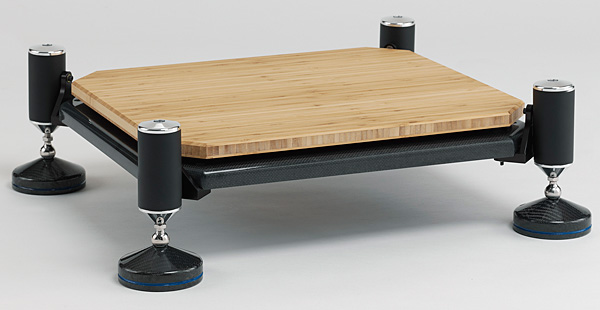 After the move to the Monzas, the left/right divide vanished. Percussion and guitar sang far more realistically from two ends of a seamless, unified soundstage that was set noticeably farther back. What had seemed like a poorly engineered recording now shone as an impressive sonic achievement.
Michael Tilson Thomas and the San Francisco Symphony's digital-only recording of Berg's Three Pieces for Orchestra (24/192 WAV, SFS Media SF0070) confirmed that the soundstage had moved farther back. Depth increased, as did the sense of air surrounding the performers; the sound of the orchestra now suggested acoustic instruments resonating naturally in space. As on mezzo-soprano Marianne Crebassa and pianist Fazil Say's recording of Debussy's Trois Chansons de Bilitis, from their album Secrets (24/96 WAV/Erato 564483), the Monza amp stands helped better convey venue dimensions. Equally notable was an increase in body; images seemed a bit weightier and more substantial, and undertones fuller and more realistic. My heart and soul were drawn deeper into the music.
After the move to the Monzas, the left/right divide vanished. Percussion and guitar sang far more realistically from two ends of a seamless, unified soundstage that was set noticeably farther back. What had seemed like a poorly engineered recording now shone as an impressive sonic achievement.
Michael Tilson Thomas and the San Francisco Symphony's digital-only recording of Berg's Three Pieces for Orchestra (24/192 WAV, SFS Media SF0070) confirmed that the soundstage had moved farther back. Depth increased, as did the sense of air surrounding the performers; the sound of the orchestra now suggested acoustic instruments resonating naturally in space. As on mezzo-soprano Marianne Crebassa and pianist Fazil Say's recording of Debussy's Trois Chansons de Bilitis, from their album Secrets (24/96 WAV/Erato 564483), the Monza amp stands helped better convey venue dimensions. Equally notable was an increase in body; images seemed a bit weightier and more substantial, and undertones fuller and more realistic. My heart and soul were drawn deeper into the music.
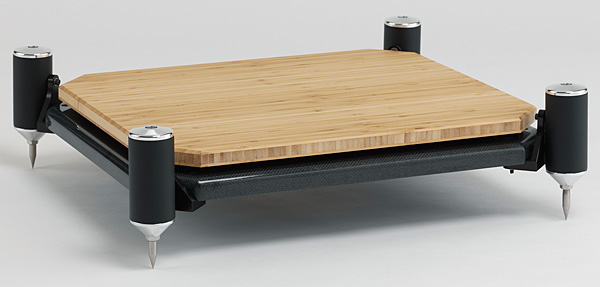 After switching amp stands and re-auditioning the tracks, we tackled the big rack. I enlisted a bunch of spare power cords and outlets to keep my sensitive digital equipment warm while we dismantled the Monaco. After measuring how much space was needed for each component, we assembled the Monza rack from scratch. (Actually, Lloyd assembled the double-width Monza on his own, in an hour, claiming that since the Monza comes with clear instructions and all necessary brackets and tools—there's also a manual online—mere mortals can probably assemble a large double rack in 1.5 hours or construct a single four-shelf Monza in an hour.)
Because Stereophile reviewers do not share their assessments with companies and distributors until reviews have been prepared for publication, I kept my mouth shut as I noted what the switch to Monza amp stands had wrought. But after Lloyd's departure, and after everything had settled in and I returned for a first listen to the complete Monza system, I discovered that the sound had turned far too monochromatically dark. Though the plusses remained—soundstage set farther back, increased air/depth/body, and bass more controlled—the darker (dare I say duller?) presentation lacked the life I crave.
Aware of the radically different colorations created by the Apex footers' chrome and silicon nitride balls, I wrote Lloyd to ask which he had used when he set up the six-column main rack in my absence. I was hardly surprised when I learned that he had chosen gray silicon nitride balls for its six extra-large Apex footers. This, I deduced, was the cause of the dark coloration: When we inserted Apex feet between the Progression amps and the Monza's bamboo shelving, we initially used the gray silicon nitride ball interface. To my ears, those balls darkened/toned down the sound and reduced brilliance: For he who prefers lively, wet halls to drier acoustics, the sound was too dark.
After switching amp stands and re-auditioning the tracks, we tackled the big rack. I enlisted a bunch of spare power cords and outlets to keep my sensitive digital equipment warm while we dismantled the Monaco. After measuring how much space was needed for each component, we assembled the Monza rack from scratch. (Actually, Lloyd assembled the double-width Monza on his own, in an hour, claiming that since the Monza comes with clear instructions and all necessary brackets and tools—there's also a manual online—mere mortals can probably assemble a large double rack in 1.5 hours or construct a single four-shelf Monza in an hour.)
Because Stereophile reviewers do not share their assessments with companies and distributors until reviews have been prepared for publication, I kept my mouth shut as I noted what the switch to Monza amp stands had wrought. But after Lloyd's departure, and after everything had settled in and I returned for a first listen to the complete Monza system, I discovered that the sound had turned far too monochromatically dark. Though the plusses remained—soundstage set farther back, increased air/depth/body, and bass more controlled—the darker (dare I say duller?) presentation lacked the life I crave.
Aware of the radically different colorations created by the Apex footers' chrome and silicon nitride balls, I wrote Lloyd to ask which he had used when he set up the six-column main rack in my absence. I was hardly surprised when I learned that he had chosen gray silicon nitride balls for its six extra-large Apex footers. This, I deduced, was the cause of the dark coloration: When we inserted Apex feet between the Progression amps and the Monza's bamboo shelving, we initially used the gray silicon nitride ball interface. To my ears, those balls darkened/toned down the sound and reduced brilliance: For he who prefers lively, wet halls to drier acoustics, the sound was too dark.
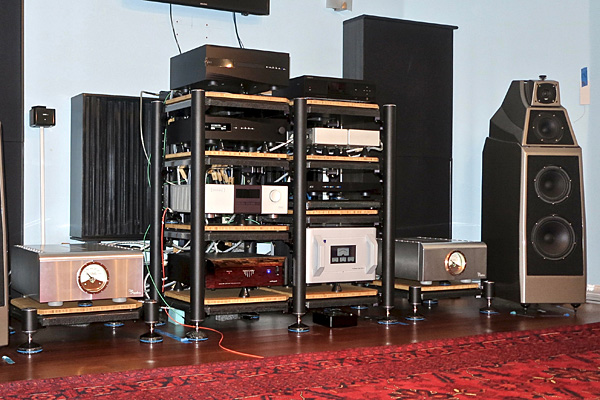 Changing balls by lifting a 120lb double rack that held 275lb of equipment was something that a neighbor and I together could not do. After consulting Lloyd, my friend Tim and I attempted to insert a car jack under the strong yet relatively narrow aluminum supports that anchored the more fragile carbon frames to the Monza's front/center pole. Alas, no jack we could find could squeeze in at the correct angle. Only after I had removed five heavy pieces of equipment was Tim able to tilt the rack up just enough to enable me to rapidly replace four of the Apex's six gray balls with chrome.
After that, the sound was glorious. Playing the Seattle Symphony's recently reviewed recording of Strauss's Alpine Symphony (24/96 WAV, SSM1023) confirmed that its airy soundstage remained farther back than before, with more depth to the sound. This extended work, which straddles a fine line between the grandly effusive and grossly kitsch, contains passages in which every symphonic instrument that you could possibly haul up the Alps, plus a massive organ, lets loose. It's music that, with volume up high, could reduce many a mass-market speaker to a crackling mess. With the Monza racks, every complex instrumental line emerged with consummate clarity.
Formula platform, Bamboo couplers, and Apex footers
Changing balls by lifting a 120lb double rack that held 275lb of equipment was something that a neighbor and I together could not do. After consulting Lloyd, my friend Tim and I attempted to insert a car jack under the strong yet relatively narrow aluminum supports that anchored the more fragile carbon frames to the Monza's front/center pole. Alas, no jack we could find could squeeze in at the correct angle. Only after I had removed five heavy pieces of equipment was Tim able to tilt the rack up just enough to enable me to rapidly replace four of the Apex's six gray balls with chrome.
After that, the sound was glorious. Playing the Seattle Symphony's recently reviewed recording of Strauss's Alpine Symphony (24/96 WAV, SSM1023) confirmed that its airy soundstage remained farther back than before, with more depth to the sound. This extended work, which straddles a fine line between the grandly effusive and grossly kitsch, contains passages in which every symphonic instrument that you could possibly haul up the Alps, plus a massive organ, lets loose. It's music that, with volume up high, could reduce many a mass-market speaker to a crackling mess. With the Monza racks, every complex instrumental line emerged with consummate clarity.
Formula platform, Bamboo couplers, and Apex footers
When we set up the big double Monza, we placed my original Grand Prix Formula platform between the Rossini Clock and the rack's bamboo shelf and put Apex footers between platform and clock. To help evaluate their efficacy, audiophile neighbor Peter ter Horst paid a visit. Multiple times, we removed and replaced the Formula platform only, noting our A/B/A/B/A impressions. Then, with platform in place, we did the A/B/A/B/A dance with Apex feet. For music, I returned to Muddy Waters' "Good Morning, School Girl," this time in MQA 24/192—Pete loves the sound of MQA, which he streams from Tidal at home. I also chose part of the second movement (titled "The Ninth of January") from Shostakovich's Symphony No.11, "The Year 1905," performed by Andris Nelsons and the Boston Symphony Orchestra on an excellently engineered recording (24/96 WAV, Deutsche Grammophon 002859502). This knockout track, which depicts the Russian Czar's Bloody Sunday massacre of unarmed protesters, rapidly builds from eerie near-silence to a full-frontal assault of heavy-metal proportions. Try playing it on your own system at symphonic levels (if your room and neighbors can handle it) and see if it can hold everything together without distorting. Without Formula platform and Apex footers, bass was a bit muddled. Restoring both affected bass, which became notably clearer on the Muddy Waters song. Focus and depth also improved throughout the range, and front-to-back positioning was clarified. I could hear deeper into the soundstage and discern air around snare drums on the Shostakovich even when the entire orchestra began blasting and pounding. The music also felt even more ominous and terrifying.
Pete said of the Muddy Waters track, "It's as if I was watching the performance in person and noting how the percussionist was striking his drum a bit differently each time. I couldn't hear that without the platform. I also heard more natural sparkle and ambience in the steel guitar's upper strings." You can only hear those things when the noise floor is sufficiently low to allow subtleties to emerge.
The effect of the bamboo couplers was minimal. Without the Apex feet, I thought the sound was flatter. Bass lost some definition, Waters' voice was less involving, and color contrasts diminished. Peter said, "With the feet, I get a slightly better sense of soundstage coherence and hear more continuity in the center." Undoubtedly, some of that effect was produced by the chrome ball interface atop the footers.
Summing up
Enhancing system performance with racks, platforms, equipment supports, and room treatment has its parallels in the tuning of a concert hall: Acousticians pay careful attention to every single element they can address. Ask the folks at Carnegie Hall, who after their big renovation discovered that they had negatively impacted its fabled sonics by altering the composition of and space beneath the floor. (They fixed it.) Or check out the glorious acoustic of Philharmonie de Paris, whose irregularly shaped curved walls are covered with diffusers, and whose ceiling hosts acoustic panels, suspended in an irregular array. Excellent components and recordings, like excellent instruments and artists, deserve no less attention.
Do all the elements of a carefully engineered component rack make a difference? Bien sûr. Does Grand Prix Audio's Monza isolation system deliver greater benefits than its 20-year-old Monaco design? Absolutely. Does Monza also offer far more easily adjustable spacing and a smaller footprint? Ditto. Is its appearance handsome? I sure think so. Do two optional Grand Prix support devices, Apex footers and Formula platforms offer additional sonic benefits? Yes.
What degree of improvement will the Grand Prix Monza isolation system bring to your system? That I cannot answer. While every bit of vibration control makes a difference, audibility is proportional to equipment quality. As one who does not subscribe to the "law" of diminishing returns—there are no diminishing returns when expectations are high, sensitivity is great, and pockets are deep—what I can say with certainty is that in my hardly inexpensive reference system, Monza's benefits are profound. I would never want to go back.
After the move to the Monzas, the left/right divide vanished. Percussion and guitar sang far more realistically from two ends of a seamless, unified soundstage that was set noticeably farther back. What had seemed like a poorly engineered recording now shone as an impressive sonic achievement.
After switching amp stands and re-auditioning the tracks, we tackled the big rack. I enlisted a bunch of spare power cords and outlets to keep my sensitive digital equipment warm while we dismantled the Monaco. After measuring how much space was needed for each component, we assembled the Monza rack from scratch. (Actually, Lloyd assembled the double-width Monza on his own, in an hour, claiming that since the Monza comes with clear instructions and all necessary brackets and tools—there's also a manual online—mere mortals can probably assemble a large double rack in 1.5 hours or construct a single four-shelf Monza in an hour.)
Because Stereophile reviewers do not share their assessments with companies and distributors until reviews have been prepared for publication, I kept my mouth shut as I noted what the switch to Monza amp stands had wrought. But after Lloyd's departure, and after everything had settled in and I returned for a first listen to the complete Monza system, I discovered that the sound had turned far too monochromatically dark. Though the plusses remained—soundstage set farther back, increased air/depth/body, and bass more controlled—the darker (dare I say duller?) presentation lacked the life I crave.
Changing balls by lifting a 120lb double rack that held 275lb of equipment was something that a neighbor and I together could not do. After consulting Lloyd, my friend Tim and I attempted to insert a car jack under the strong yet relatively narrow aluminum supports that anchored the more fragile carbon frames to the Monza's front/center pole. Alas, no jack we could find could squeeze in at the correct angle. Only after I had removed five heavy pieces of equipment was Tim able to tilt the rack up just enough to enable me to rapidly replace four of the Apex's six gray balls with chrome.
After that, the sound was glorious. Playing the Seattle Symphony's recently reviewed recording of Strauss's Alpine Symphony (24/96 WAV, SSM1023) confirmed that its airy soundstage remained farther back than before, with more depth to the sound. This extended work, which straddles a fine line between the grandly effusive and grossly kitsch, contains passages in which every symphonic instrument that you could possibly haul up the Alps, plus a massive organ, lets loose. It's music that, with volume up high, could reduce many a mass-market speaker to a crackling mess. With the Monza racks, every complex instrumental line emerged with consummate clarity.
When we set up the big double Monza, we placed my original Grand Prix Formula platform between the Rossini Clock and the rack's bamboo shelf and put Apex footers between platform and clock. To help evaluate their efficacy, audiophile neighbor Peter ter Horst paid a visit. Multiple times, we removed and replaced the Formula platform only, noting our A/B/A/B/A impressions. Then, with platform in place, we did the A/B/A/B/A dance with Apex feet. For music, I returned to Muddy Waters' "Good Morning, School Girl," this time in MQA 24/192—Pete loves the sound of MQA, which he streams from Tidal at home. I also chose part of the second movement (titled "The Ninth of January") from Shostakovich's Symphony No.11, "The Year 1905," performed by Andris Nelsons and the Boston Symphony Orchestra on an excellently engineered recording (24/96 WAV, Deutsche Grammophon 002859502). This knockout track, which depicts the Russian Czar's Bloody Sunday massacre of unarmed protesters, rapidly builds from eerie near-silence to a full-frontal assault of heavy-metal proportions. Try playing it on your own system at symphonic levels (if your room and neighbors can handle it) and see if it can hold everything together without distorting. Without Formula platform and Apex footers, bass was a bit muddled. Restoring both affected bass, which became notably clearer on the Muddy Waters song. Focus and depth also improved throughout the range, and front-to-back positioning was clarified. I could hear deeper into the soundstage and discern air around snare drums on the Shostakovich even when the entire orchestra began blasting and pounding. The music also felt even more ominous and terrifying.
Enhancing system performance with racks, platforms, equipment supports, and room treatment has its parallels in the tuning of a concert hall: Acousticians pay careful attention to every single element they can address. Ask the folks at Carnegie Hall, who after their big renovation discovered that they had negatively impacted its fabled sonics by altering the composition of and space beneath the floor. (They fixed it.) Or check out the glorious acoustic of Philharmonie de Paris, whose irregularly shaped curved walls are covered with diffusers, and whose ceiling hosts acoustic panels, suspended in an irregular array. Excellent components and recordings, like excellent instruments and artists, deserve no less attention.