In poker, "tells" are subtle physical or verbal actions that give away the strength of players' hands.
I am not a poker player, but I am an audiophile, and I use a variety of "tells" as my prime tools in critical listening. You know my worn-out line: "You can't hear what you're not listening for."
I use tells extensively during speaker placement. I use them most extensively, though, when installing and aligning phono cartridges. In that process, tells are a necessity because achieving the best possible sound depends on knowing when I have achieved the best possible sound.
For decades, I've known and worked with people who install expensive audio gear for a living. I've been one of those people myself. Today, I am fortunate to know a small cadre of highly skilled listeners who work professionally as turntable setter-uppers. Some of them design and manufacture tonearms, turntables, or cartridges. I've made it my job to wrangle setup tells out of these high-grade–cartridge whisperers.
More than steady hands, installing and aligning phono cartridges requires a few installation tools, some of which I'll mention below. The tools need not be expensive. You can set up a cartridge just fine with just a stylus pressure gauge and the free alignment protractor that came with your tonearm.
Long ago, my turntable setter-upper friend Michael Trei taught me to start every installation process with a visual inspection of the cantilever's relationship to the cartridge body. If the cantilever is not perfectly parallel to the cartridge body's sides, zenith must be set using only the cantilever (not the body) as a visual guide.
Some cartridge installers go one step further with their cantilever examination: They start their install using a microscope to verify that the contact patches on the diamond are positioned at an exact right angle to the cantilever's centerline (footnote 1). If they spot a deviation, they compensate for it during zenith adjustments by counter-rotating the cartridge by the same amount. This zenith-fixing solution is by necessity approximate, like every other cartridge alignment strategy—except setting VTF, which is precise.
VTF
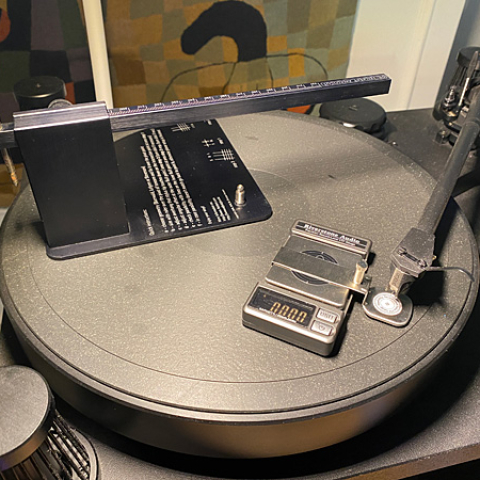
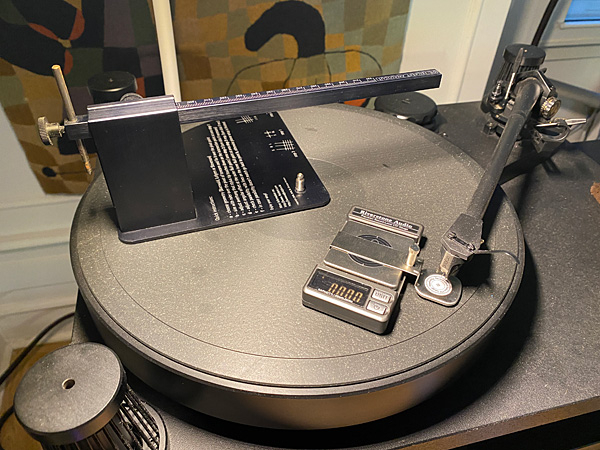
Setting VTF is always critical, so the first thing I do after tightening the cartridge screws—snug but not tight—is set the tracking force to the exact center of its recommended range. I use a Riverstone Audio Precision Record-Level VTF gauge because it accurately measures tracking force at LP surface level. Measuring at the record surface is important because with some types of tonearms—and with ferromagnetic turntable platters like the one on the original Thorens TD-124—the force can vary dramatically with height. Alignment
To set overhang, azimuth, zenith, and VTA (approximately, by eye), I use one or more LED flashlights, the magnifier on my iPhone, and either the sturdy, lasts-forever aluminum protractor supplied with the Dr. Feickert Analogue Blackbird turntable or the Acoustical Systems SMARTractor cartridge-alignment tool. The SMARTractor's bright, reflective surfaces and high-quality magnifier aid my eyes and show me more of what I need to see, improving my confidence that the alignments I make are true.
After setting overhang to within a quarter of a millimeter, I set null points using Löfgren "A," which is identical to Baerwald, with nulls at 66.0mm and 120.9mm. Then, with the headshell level and the cartridge and cantilever looking plumb and square with the right marks on the alignment jig, I snug-tighten the mounting screws and readjust VTF.
Antiskate
A few years ago, one of my German brothers, a tonearm designer, admonished me to use less antiskating force, saying that too much antiskate damages the stylus and the record grooves. I should get away from automatically adjusting side bias for modulation levels one rarely encounters in actual play, he explained. Instead, I should use a "softer" setting, one that results in even pressure on both groove walls during average modulation levels. To achieve that soft setting, he taught me to use a blank, groove-free record, adjusting the force until the tonearm moves slowly toward the record label. No tells needed here. Azimuth
After setting the cartridge plumb on the alignment jig, I use tracks 2 & 3 of Analogue Productions' The Ultimate Analogue Test LP to fine-tune azimuth with a Musical Surroundings Fozgometer. The Fozgometer measures channel crosstalk, allowing users to accurately achieve electrical symmetry, which means the setup is also geometrically correct, assuming the cartridge is built accurately. If, however, the diamond's orientation is set out of square with the coil assembly, as sometimes happens, an additional tiny nudge adjustment will be necessary.
Footnote 1: See this month's Analog Corner.
Setting VTF is always critical, so the first thing I do after tightening the cartridge screws—snug but not tight—is set the tracking force to the exact center of its recommended range. I use a Riverstone Audio Precision Record-Level VTF gauge because it accurately measures tracking force at LP surface level. Measuring at the record surface is important because with some types of tonearms—and with ferromagnetic turntable platters like the one on the original Thorens TD-124—the force can vary dramatically with height. Alignment
To set overhang, azimuth, zenith, and VTA (approximately, by eye), I use one or more LED flashlights, the magnifier on my iPhone, and either the sturdy, lasts-forever aluminum protractor supplied with the Dr. Feickert Analogue Blackbird turntable or the Acoustical Systems SMARTractor cartridge-alignment tool. The SMARTractor's bright, reflective surfaces and high-quality magnifier aid my eyes and show me more of what I need to see, improving my confidence that the alignments I make are true.
A few years ago, one of my German brothers, a tonearm designer, admonished me to use less antiskating force, saying that too much antiskate damages the stylus and the record grooves. I should get away from automatically adjusting side bias for modulation levels one rarely encounters in actual play, he explained. Instead, I should use a "softer" setting, one that results in even pressure on both groove walls during average modulation levels. To achieve that soft setting, he taught me to use a blank, groove-free record, adjusting the force until the tonearm moves slowly toward the record label. No tells needed here. Azimuth
After setting the cartridge plumb on the alignment jig, I use tracks 2 & 3 of Analogue Productions' The Ultimate Analogue Test LP to fine-tune azimuth with a Musical Surroundings Fozgometer. The Fozgometer measures channel crosstalk, allowing users to accurately achieve electrical symmetry, which means the setup is also geometrically correct, assuming the cartridge is built accurately. If, however, the diamond's orientation is set out of square with the coil assembly, as sometimes happens, an additional tiny nudge adjustment will be necessary.
Footnote 1: See this month's Analog Corner.