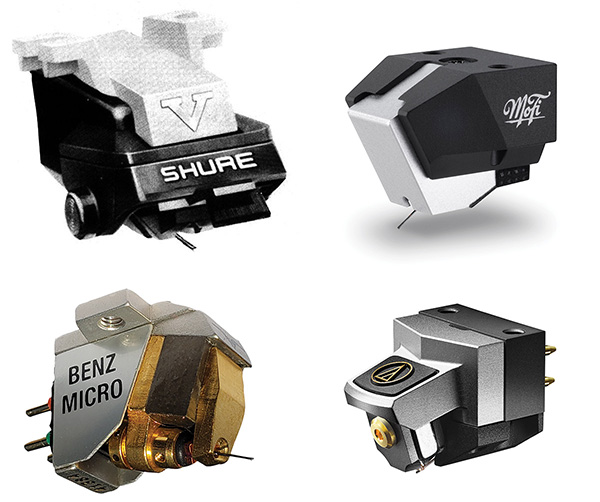
In the context of a modern hi-fi system, phono cartridges are most akin to loudspeakers in that both are electromechanical transducers. Cartridges convert the mechanical movements of a stylus tracing a record groove to an electrical current. Loudspeakers convert an electrical current to vibrations that cause the air to move out into the room as soundwaves that our ears and brain sense as music. [Stereophile's reviews of phono cartridges can be found here.—Ed.].
Between the record grooves and the sound coming out of the speakers, everything is electrical, but music always ends—and usually starts—in the mechanical realm (footnote 1).
At base, all phono cartridges (or all but one if that laser turntable still exists) contain a stylus that makes physical contact with record grooves. There's then some mechanical-electrical means of converting the undulations of the grooves into electrical current, which then passes through a system and comes out as sound waves. There are several ways to do the electromechanical transducing, but the two most common are moving magnet and moving coil. Grado, Goldring, and perhaps others make variable-reluctance—also called moving iron—cartridges, and Nagaoka's MP line is a variation on the moving iron principle called moving permalloy. There are a few more exotic technologies (footnote 2).
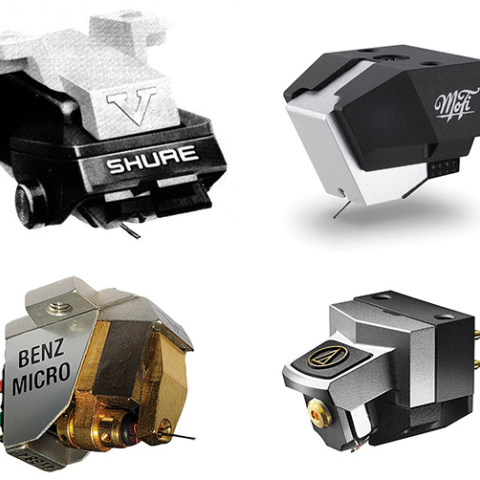
Moving magnet (MM) cartridges work as their name suggests: Tiny magnets are mounted at the end of a cantilever connected to the stylus, and they move within an array of fixed-position coils. The changes in magnetic field around the coils induce an electrical current that flows out the four connectors at the back of the cartridge. In general, MM cartridges are able to produce a high-voltage output, meaning they require less electrical gain in the phono preamplifier.
Moving coil (MC) cartridges also work as their name suggests: Tiny coils, often a few windings of wire thinner than a human hair, are mounted somewhere on the cantilever. (Typically, they are mounted at the rear near the pivot point, although in the Audio-Technica AT-ART1000 MC cartridge, for example, the coils are mounted above the stylus.) Near the coils is a fixed magnet; its exact position varies from cartridge to cartridge. The coils' movement within the magnetic field induces a varying electrical current in the coils. The coils' tiny wires terminate at the cartridge's four terminals at the rear.
The stated advantage of MC cartridges is the low mass of the coils, which theoretically allows the stylus to more precisely trace the groove. (Moving iron cartridges may have even less mass on the cantilever.) Those MC cartridges with vanishingly tiny coils produce a very small output voltage, so more gain is required from the preamp. Alternatively, a step-up transformer can be placed between the cartridge and the preamp that transforms current into extra voltage. A relatively recent innovation—a "current-mode" phono preamp—operates on the principle of current (not voltage) amplification.
Some manufacturers make high-output MC cartridges—for instance the Denon DL-110 or Hana SL MK II—which use bigger coils to generate higher output voltages. This also means that they have a higher-mass groove-tracing assembly than that of their low-output stablemates (footnote 3).
Both MM and MC cartridges contain styli, cantilever assemblies (cantilever, connecting pipe, pivot point, and stationary parts behind the pivot point), coils, and magnets. They also include some sort of damper, which both controls stylus movement and smooths out resonances and other frequency-response anomalies. The goal of a cartridge is to output a frequency response that corresponds precisely to the amplitude of the grooves the stylus is tracing. My testing, and reams of testing done by others and published in decades of audio magazines and online, indicates that some cartridges fall far short of the goal—in some cases no doubt as a result of intentional voicing—while some are admirably close to that ideal. This frequency response—and the overall output level—needs to be the same in both the left and right channels. Flat frequency response and equal L–R output is a hard mark to hit.
The design of the cartridge body is also important because it minimizes unwanted resonances, shields the coils from stray electromagnetic fields, and contributes to the desired total mass of the cartridge-tonearm system. Cartridge mass, as well as how little or how much physical resistance the stylus's damping system produces while tracking a groove (known as compliance), combine with tonearm mass, tonearm design (straight, S-shaped, linear-tracking, etc.), stylus shape, and how well a cartridge is set up to determine how accurately records will be tracked.
Summarizing, a phono cartridge is a complex small machine, each part requiring manufacturing expertise and the assembly requiring exquisite precision and attention to detail.
I spent a couple of months studying present-day cartridge manufacturing. I spoke to representatives from the Big Two—Audio-Technica and Ortofon—as well as Excel Sound, Lyra, Nagaoka, and DS Audio. I also spoke with the corporate archivist at Shure, who provided details about that company's long-running but now-defunct cartridge-making business. I learned about the supply chains, what expertise is outsourced and what is done in-house. Some of this information is in plain sight online, in company literature, and in the journals of audio professionals. Some of it is hidden, and some details required guesswork.
The cartridge business has benefited from the vinyl revival, which began around 2007, yet the industry is still much smaller than it was in the 1970s vinyl heyday. In those days, millions of cartridges were made and sold each year. According to RIAA figures, the peak year for US vinyl sales in units was 1977: 534 million albums and singles were sold. Last year's number was 44.2 million, impressive for a dated technology but hardly in the same league.
Let's start at the record groove, with the stylus. Nowadays, no cartridge manufacturer makes diamond styli. It's possible that some companies made both diamond styli and cartridges in the past, but many if not most cartridge makers always bought styli from specialty industrial diamond companies. Modern-day styli are primarily sourced from Orbray (formerly Namiki) and Ogura—both based in Japan—and Fritz Gyger in Switzerland. These companies make integrated nude diamond-cantilever assemblies. Orbray is the only maker of Shibata-shaped styli, perhaps because of a licensing agreement with the patent holder. Orbray also makes the single-diamond laser-cut stylus/cantilever used on topline cartridges by Audio-Technica, DS Audio, and Kuzma (footnote 4). Gyger, Orbray, and Ogura all claim to have unique diamond shapes that fall roughly into the hyperelliptical or microline/ MicroRidge categories. Orbray also makes conical and elliptical styli, both nude and bonded (small diamond tips glued to a metal shank that attaches to the cantilever) in both standard 0.7mil radii for LP grooves and 3.0mil radii for wide-groove records (footnote 5).
Some cartridge manufacturers make their own bonded stylus assemblies. They buy diamond tips from the three primary stylus suppliers, and perhaps other companies, and either make or buy metal cantilevers. They then glue the diamond to the shank and attach the shank to the cantilever in-house. Nagaoka and probably others sell bonded stylus assemblies to other cartridge manufacturers. Examples of cartridges using bonded stylus assemblies made in-house are the Ortofon 2M Red, the Audio-Technica AT-VM95E, and the Nagaoka MP-110. Jico, Nagaoka, and others also make replacement stylus assemblies for a variety of vintage and current-production MM cartridges using both nude and bonded diamond stylus/cantilever assemblies.
Current-production cartridges contain cantilevers made of aluminum, sapphire, ruby, or boron—and then there are those single-diamond stylus/cantilevers. I could find no examples of current-production beryllium cantilevers such as were used in the Shure V15 Type V. Orbray appears to be the only maker of ruby and sapphire cantilevers.
An interesting detail about boron cantilevers, shared with me by Lyra's Jonathan Carr: Boron-fiber manufacturing in Japan ceased many years ago. When the material that was stockpiled for cantilever making ran out, a global search for a new supplier turned up a defense contractor in Massachusetts. Thus, boron cantilever manufacturing continues apace (footnote 6).
Rubber dampers are sometimes made in-house and sometimes purchased from outside suppliers. Ortofon claims expertise in rubber making and uses its own proprietary rubber compounds in its dampers, all made in-house. Audio-Technica makes some dampers in-house and outsources others.
All the major cartridge manufacturers wind coils in-house for both MMs and MCs. The delicate job of making MC coils is quite a craft, and each company has a few specialists who do this job (footnote 7). The type of wire used varies by model and make. For instance, Ortofon uses silver-coated copper wire in some MM and MC coils and pure silver in some MCs. Several other manufacturers use pure silver coils in MC cartridges, an example being the Goldring Ethos SE. The type of wire and the number of windings affect internal impedance and output voltage. Cartridge makers and audiophiles also have strong opinions about how different materials and coil designs sound with music playback.
The tiny magnets used in MM cartridges, and the larger magnets in MCs, are outsourced from companies expert in making industrial magnets. Many cartridges use alnico magnets—composed primarily of aluminum (Al), nickel (Ni), and cobalt (Co)—as has been the case for decades. A few use modern neodymium magnets (made from an alloy of neodymium, iron, and boron).
Cartridge bodies can be made of metal, plastic, combinations of both, or more exotic materials like carbon fiber, ceramic, stone, or wood. One example of recent advances in cartridge-body manufacturing is Ortofon's use of selective laser melting, which removes precise bits of a machined metal cartridge body to form a less-resonant shape (footnote 8).
Grado and some smaller-scale Japanese manufacturers use wood for some cartridge bodies. The Koetsu Onyx Platinum uses onyx stone for the cartridge body and a platinum-cobalt alloy magnet.
There is no reliable information about market share. All the major cartridge manufacturers are privately held, although Denon, which is a small player nowadays, is part of Sound United, which was recently acquired by Harman International, a division of publicly traded Samsung. Based on discussions with executives from several companies including cartridge retailers, I'll speculate that in terms of units, Audio-Technica is the top player. Aside from the cartridges that company sells directly through retail, it is also an OEM supplier of cartridges based on the VM95 and its lowest-end AT3600 templates. A-T's OEM cartridges are made in Hangzhou, China. Its retail MM cartridges and all but the top-end MCs are made in Naruse, Machida, Japan, which is in the Tokyo metro area. The top-line MCs are made in a small artisan-style shop near the company's headquarters, also in Machida.
Running a close second in my estimation—it is possible that they are first in terms of volume and/or total sales—Ortofon, which is based in Nakskov, Denmark, makes all its cartridges in that country, including those supplied OEM to turntable manufacturers. (The Technics SL-1500, for instance, is packaged with an Ortofon 2M Red.)
Nagaoka and Excel Sound, both based in Japan, are also major OEM suppliers. Excel owns the Hana brand and makes The Vessel line for Nevada-based LP Gear. Both companies appear to be midsized.
Grado, which is based in Brooklyn, New York, is another medium-sized manufacturer; it's hard to tell whether it sells as many cartridges as, eg, Nagaoka.
Dozens of small-scale cartridge manufacturers exist, as small as one person in a home workshop. Such bespoke products tend to be in the higher range of cartridge pricing.
Speaking of pricing: The branded version of Audio-Technica's AT3600, an MM cartridge with a bonded conical stylus, retails for $30 (footnote 9). DS Audio's top-line cartridge (with a one-piece diamond stylus/cantilever), in a package with its matching Grand Master Phono Stage/Equalizer, retails for $60,000. Kuzma's new CAR-60 MC cartridge, which uses the same type of diamond stylus/cantilever, retails for $18,200. Lyra's top-line Atlas λ Lambda retails for $14,295.
The mainstream price range for nude diamond MM cartridges is from about $130 (Audio-Technica AT-VM95EN, nude elliptical stylus on aluminum cantilever) to more than $1000 (for, for instance, the Ortofon 2M Black LVB 250 with nude Shibata stylus on boron cantilever). Starter moving iron variants with nude diamond styli include the Nagaoka MP-150 ($349). The recently announced Nagaoka MP-700 with a MicroRidge stylus on a boron cantilever retails for $1399 (footnote 10). MC cartridge prices start at a few hundred dollars and go up into the tens of thousands.
Footnote 1: Plenty of present-day music is created in computers and realized electrically until it is played back through speakers or headphones. Some music is created using mechanical devices that generate an electrical signal that is recorded immediately—for example, a plucked bass guitar string recorded through a direct-injection box. Footnote 2: Michael Trei explored the history of "alternative" phono-cartridge technologies in Spin Doctor #11. You can find a tutorial from Goldring on how moving iron cartridges work at tinyurl.com/2bp6xypt. My late colleague Art Dudley wrote a succinct description of Grado's patented "Flux-Bridger" system; you can find it here. Nagaoka's MP series is a variation on moving iron that the company calls moving permalloy. Julie Mullins at AnalogPlanet explains how it works here. Another transduction method used in current phono cartridges is DS Audio's optical method, which uses an LED light source, mirrors mounted to the stylus, and light-sensing current-generation devices to produce the electrical signal. See Michael Trei's detailed review of the system here. Yet another current-production method is Soundsmith's strain gauge: tinyurl.com/5ahy5pvz.
Footnote 3: In these two videos, master craftsman A. J. van den Hul makes an MC cartridge by hand: youtu.be/TbTSor-4J-c and youtu.be/Km4sUJmG83E.
Footnote 4: Kuzma states on its website that its cartridges "are made to our specifications by a Japanese company with over 50 years' experience in this field" using bodies made by Kuzma and shipped to Japan. Owner Franc Kuzma said, "I am not allowed to tell which company" makes Kuzma cartridge motors.
Footnote 5: 78rpm records released before 1948—and most thereafter—are wide-groove. Commercial wide-groove records were also issued at 33 1/3 rpm. Wide-groove transcription records, used extensively for delayed broadcast of radio programs, were often recorded at 33 1/3. While a 3mil stylus is a safe starting point to play a wide-groove record, professional archivists and transfer engineers often have an arsenal of stylus sizes and shapes on hand, with a goal of finding the position in the groove that yields the lowest distortion and the highest signal/noise ratio. Although it may not be available for long—the business is for sale—esotericsound.com offers the Rek-O-Kut Archival Disc Play Kit, a set of six styli with widths from 1.5–4mil, packaged with a Nagaoka MP-110 cartridge for $895.
Footnote 6: Jonathan Carr of Lyra tells the boron supply-chain story here: youtube.com/watch?v=fQeut0__a_4&t=1925s. The whole video is worthwhile viewing. The current supplier of boron is Specialty Materials in Lowell, Massachusetts. The company Carr refers to as Namiki is now called Orbray; that company's interesting history can be found at orbray.com/special/en/.
Footnote 7: This lovely video by Jana Dagdagan, Stereophile's former videographer, shows how a Denon DL-103 MC cartridge is made: youtu.be/dKDtNrN2jy8.
Footnote 8: Ortofon's Leif Johannsen explains selective laser melting in this video: youtu.be/F6xlbjaE87w. All the videos in Ortofon's series "What Makes a Cartridge Good?" are educational and rich in information.
Footnote 9: See lpgear.com/product/ATC17.html. You can buy nonbranded variants of the AT3600 from Chinese OEM suppliers for $20 or less. Upgrade styli made by A-T and others can cost 10× the price of the cartridge motor with a base bonded conical stylus.
Footnote 10: See this report on our sister website, AnalogPlanet.
Footnote 1: Plenty of present-day music is created in computers and realized electrically until it is played back through speakers or headphones. Some music is created using mechanical devices that generate an electrical signal that is recorded immediately—for example, a plucked bass guitar string recorded through a direct-injection box. Footnote 2: Michael Trei explored the history of "alternative" phono-cartridge technologies in Spin Doctor #11. You can find a tutorial from Goldring on how moving iron cartridges work at tinyurl.com/2bp6xypt. My late colleague Art Dudley wrote a succinct description of Grado's patented "Flux-Bridger" system; you can find it here. Nagaoka's MP series is a variation on moving iron that the company calls moving permalloy. Julie Mullins at AnalogPlanet explains how it works here. Another transduction method used in current phono cartridges is DS Audio's optical method, which uses an LED light source, mirrors mounted to the stylus, and light-sensing current-generation devices to produce the electrical signal. See Michael Trei's detailed review of the system here. Yet another current-production method is Soundsmith's strain gauge: tinyurl.com/5ahy5pvz.